2026 FIBA Women’s World Cup Semifinals: France vs Germany, USA vs Spain
The 2026 FIBA Women’s World Cup has boiled down to four heavyweights and one high‑stakes Saturday in Berlin. The United States, France, Spain, and Germany all marched through their quarterfinals with authority. Now the margins shrink, the noise rises, and every possession starts to feel like a verdict.
Two games. Two very different paths to the final. No soft landing for anyone.
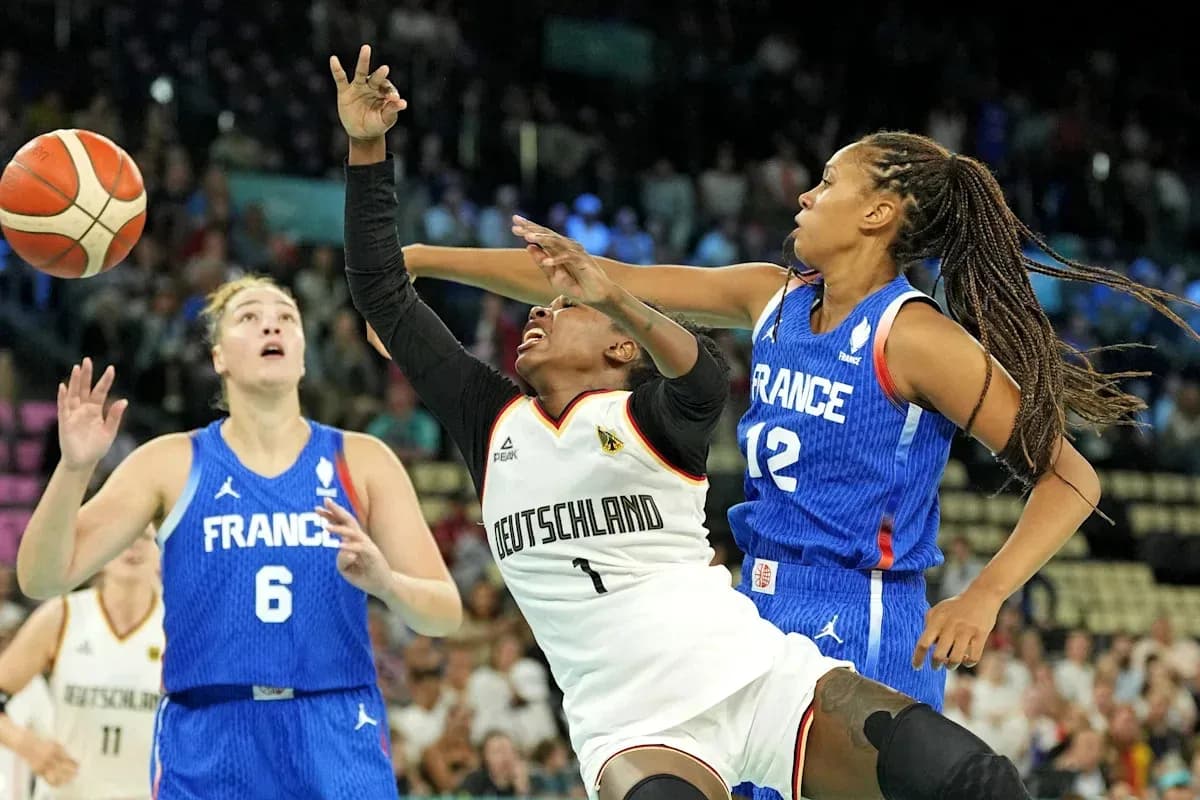
France vs Germany: Firepower Meets Home Floor
France have not just been winning. They’ve been steamrolling. They’ve broken the single‑game three‑point record, buried opponents under scoring runs, and played like a group intent on erasing the sting of the 2024 Paris Olympics loss to the USA.
They look like the team to beat.
Their biggest weapon isn’t just one star. It’s the depth that keeps coming in waves. Off the bench, Marine Johannès has turned the tournament into her personal shooting exhibition. She sits eighth in scoring at 16.5 points per game and leads all players with 16 made threes so far. She’s not even starting. She’s changing games from the second unit.
When Johannès checks in, the tempo spikes. Defenses stretch. Passing lanes open. It’s the kind of luxury very few teams in this field can match.
Up front, Gabby Williams has been playing some of the best basketball of her World Cup career. She’s driven France’s edge on both ends, and when she’s in rhythm, the French attack looks almost inevitable. If she sustains this level, France’s route to the final stays clear.
Germany, though, have something no other semifinalist owns: Berlin.
A home World Cup, a home semifinal, a crowd ready to drag every defensive stand over the line. Led by Marie Gülich, Germany have ridden that energy all the way into the last four. Gülich’s 11.8 points per game don’t just show up on the box score; they’ve come at moments when Germany needed a jolt, a basket to steady nerves or ignite a run.
The supporting cast has grown with the stakes. Leonie Fiebich and Nyara Sabally have both lifted their games as the tournament has gone on. Against Belgium in the quarterfinal, Fiebich delivered a team‑high 17 points and 10 rebounds, a statement double‑double on a big stage. Sabally matched that tone with 16 points and 12 boards of her own.
That’s the formula Germany need: their frontcourt winning battles, their stars playing above their averages, the crowd roaring them into second and third efforts.
But here’s the problem they can’t ignore: depth. Germany’s bench has given them valuable minutes, yet it doesn’t run as deep or as dangerous as France’s rotation. Over 40 minutes, that gap can become a crack, then a chasm.
They’ve seen this movie before. At the 2024 Olympics, France beat Germany 84–71 in the quarterfinals. If Germany don’t tighten the screws defensively, they risk watching a similar story unfold. They can’t trade baskets with this French team. They have to drag them into a grind, contest the arc, and turn the game into a test of toughness, not just shot‑making.
Prediction: France Wins.
France look like a group on a mission, still fueled by that painful Olympic exit. They have kept the pressure high all tournament and never taken their foot off the pedal. Germany will need their most disciplined defensive performance of the World Cup and a raucous Berlin crowd to tilt the floor. If they can disrupt France’s three‑point rhythm, the upset door opens a crack.
But right now, France hold the handle.
Spain vs United States: Style Clash on the High Wire
Spain arrive in the semifinals with momentum and balance. They topped Group A, earned a bye, and then dismantled Australia 89–66 to book their place in Berlin’s final four. This is not a surprise run. It’s a measured climb.
Against Australia, Megan DiLeo (née Gustafson) set the tone with 16 points on 7‑for‑11 shooting. Confident from her season with the Portland Fire in the WNBA, she’s carried that form straight into this World Cup. Her game has sharpened, and so has her impact.
Spain’s other major spark has been Iyana Martín. She’s averaging 16.5 points per game, seventh in the entire tournament, and her scoring has given Spain a reliable perimeter engine. When Martín finds her spots, Spain’s offense hums.
They score. A lot. Spain are averaging 81.0 points per game, moving the ball, spacing the floor, and punishing mistakes. On most nights, that’s enough to overwhelm opponents.
The problem? The team standing across from them scores even more.
The United States are averaging 90.5 points per game and have found another gear since a nervy group stage scare against Italy. That wobble seems distant now. In the quarterfinals, they obliterated Hungary 108–56, a demolition that underlined both their firepower and their depth.
Napheesa Collier led that charge with 19 points, continuing a tournament of consistent, high‑level play. The former WNBA Defensive Player of the Year has anchored both ends of the floor, the kind of presence that settles a team when the stakes rise.
Rhyne Howard added 15 points and knocked down 3 of her 5 attempts from deep, another reminder that the USA can hurt opponents from every angle. Take away the paint and they shoot over you. Press the perimeter and they bully you inside.
Then there’s the bench, an embarrassment of riches. Former WNBA MVP candidates Caitlin Clark, Paige Bueckers, and Angel Reese come in as “reserves,” yet all three have delivered when called upon. Few teams in international basketball can respond to foul trouble or a cold stretch by turning to that level of talent.
Defensively, the numbers are just as imposing. The United States have held their four opponents to an average of 58.3 points per game. They dominate the glass as well, pulling down 31.5 defensive rebounds per game compared to Spain’s 26.3. That gap matters. It means fewer second chances for Spain, fewer broken‑play threes, fewer momentum‑swinging put‑backs.
For Spain, the equation is brutally clear. They must defend at a level they haven’t yet needed in this tournament. Their offense can keep them in it, but only if they can slow the American rhythm, cut off transition, and scrap for every rebound. If they let the USA control the boards, the game tilts quickly.
Prediction: USA Wins.
Spain’s run has been impressive, built on cohesion and belief. But the United States bring something else: a deep history of thriving in these pressure moments, and a roster that covers every base—scoring, rebounding, defense, and depth.
On this stage, with this talent, they should have too much.
The only question now is which of these giants will carry that momentum from Berlin into the final—and who will be left wondering how close they came to rewriting the story of this World Cup.