Portugal vs Denmark: Tactical Insights from UEFA Nations League Clash
Under the lights of Estádio Municipal de Braga, this was meant to be a coronation night for Portugal at the top of League A – Group D. Instead, it became a brutal reminder that in the UEFA Nations League, margins are thin and Denmark are far more than supporting actors. The 4-1 away win did not just tilt the scoreline; it reshaped the tactical narrative between two sides who have shadowed each other in the group, Portugal finishing on 12 points with a goal difference of 2, Denmark on 9 with a goal difference of 3.
I. The Big Picture – Structure and Seasonal DNA
Both managers mirrored each other on the board: 4-2-3-1 against 4-2-3-1, two nations trusting similar structures but very different interpretations of risk and control.
Portugal’s Nations League campaign has been defined by front-foot dominance. Heading into this game they had played 5 matches in total, winning 4 and losing 1, scoring 10 and conceding 8 overall. At home they had been slightly more fragile: 3 matches played, 2 wins, 1 defeat, with 4 goals scored and 5 conceded. The numbers sketch a side that loves to dictate but leaves the back door ajar. Their overall attacking average of 2.0 goals per game, combined with 1.6 goals conceded per game, underlines a high-event, high-variance identity.
Denmark arrived as the group’s counter-punchers. Across 5 matches in total they had 3 wins and 2 defeats, scoring 11 and conceding 8 overall. On their travels they had played 3 times, winning 2 and losing 1, with 7 goals scored and 4 conceded. An away attacking average of 2.3 goals per game and 1.3 conceded suggests a team comfortable absorbing pressure, then striking with precision. Their overall goal difference of 3, compared to Portugal’s 2, already hinted at a side more balanced across the pitch.
The final scoreline in Braga – Portugal 1, Denmark 4 – felt like the logical extreme of those underlying trends: Portugal’s expansive ambition colliding with Denmark’s ruthless clarity.
II. Tactical Voids and Discipline – Edges and Exposures
There were no listed absentees, so both coaches went into the night with full decks. That put the spotlight firmly on selection choices and in-game management rather than enforced compromises.
Jorge Jesus doubled down on technical control and central creativity. Diogo Costa started in goal behind a back four of Diogo Dalot, Rúben Dias, Renato Veiga and Alberto Baio. In front of them, Rúben Neves and Vitinha formed the double pivot, with a high-skill trio of Pedro Neto, João Félix and Bruno Fernandes supporting Gonçalo Ramos as the lone striker. It was a line-up built to own the ball and compress the game into Denmark’s half.
The risk, though, was always in transition. Portugal’s season card profile hints at emotional volatility late in games: 61.54% of their yellow cards have arrived between 76 and 90 minutes, and their only red card in the competition has also come in that late window. It paints a picture of a side that, when chasing or protecting a result, can lose composure.
Denmark’s disciplinary curve is more evenly spread. Their yellow cards cluster around 31-45 minutes and 91-105 minutes, each accounting for 33.33%, with smaller spikes later in normal time. There have been no red cards in this Nations League run. In a high-stakes away fixture, that calmer edge under pressure was always likely to matter.
III. Key Matchups – Hunter vs Shield, Engine Room Battles
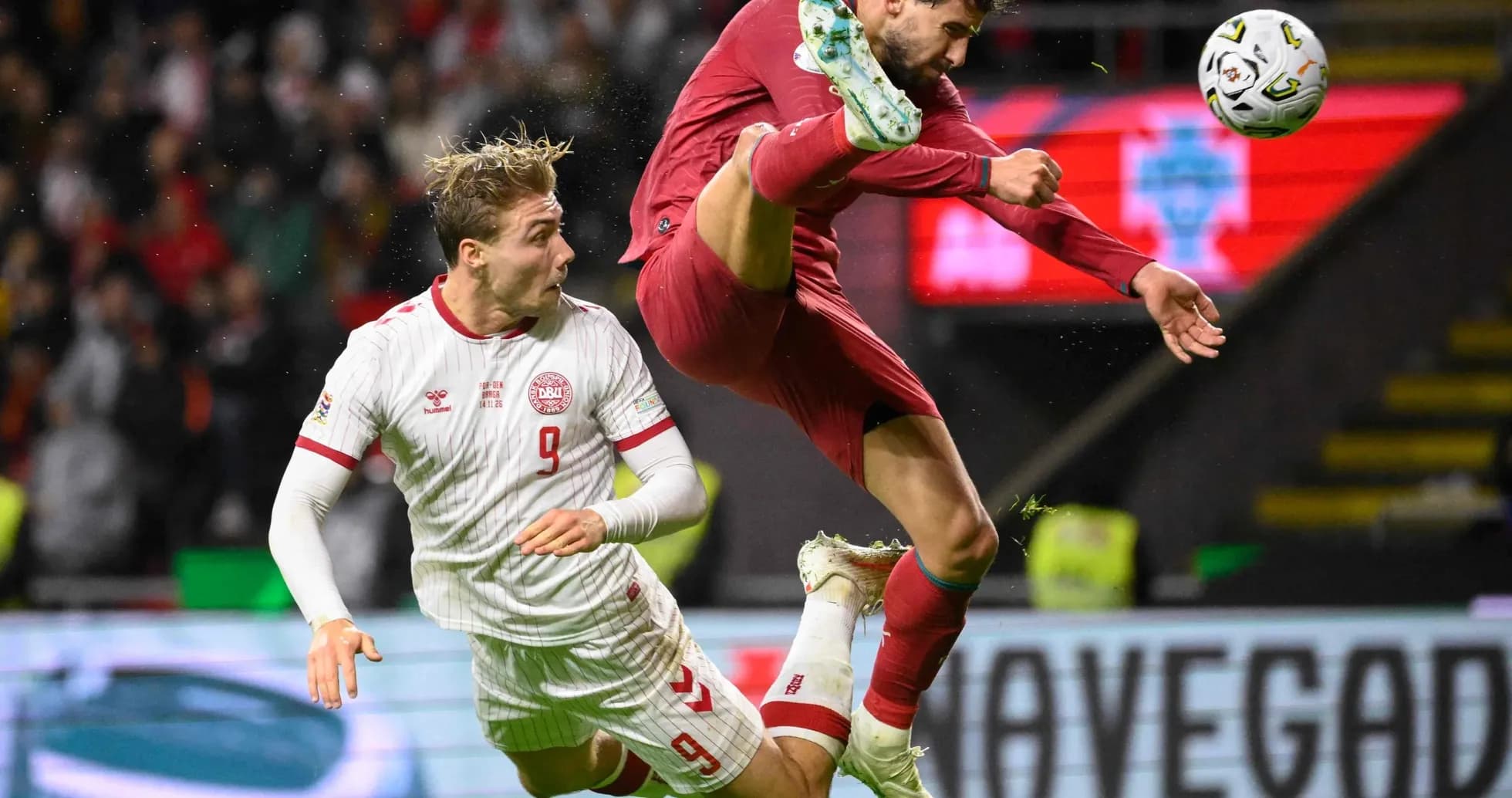
The marquee duel was always going to be Rasmus Højlund against Rúben Dias. Højlund has been one of the competition’s standout forwards: 5 goals in 5 appearances, with 11 shots in total and 8 on target, and a strong rating of 7.46. He is not just a finisher; 35 duels contested and 20 won, plus 11 fouls drawn, show a striker who thrives in physical battles and uses his body intelligently.
Dias, by contrast, has been the defensive metronome for Portugal. Five full matches, 450 minutes, 295 completed passes at 91% accuracy, 5 blocked shots and 3 interceptions speak of a centre-back who reads the game and steps into danger zones. Yet his 2 yellow cards and 6 fouls committed underscore that he sometimes has to defend on the edge, particularly when exposed.
In Braga, the pattern of the campaign played out again: Denmark’s front line, led by Højlund and supported by the fluid movement of Mikkel Damsgaard and Mohamed Daramy, repeatedly pulled Dias and Veiga into uncomfortable spaces. Damsgaard, one of the competition’s most complete creators with 2 goals, 2 assists, 202 passes at 86% accuracy and 10 dribble attempts with 9 successes, operated in the half-spaces behind Højlund, dragging Portugal’s double pivot away from their comfort zones.
On the other side, Portugal’s “10 zone” was entrusted to João Félix and Bruno Fernandes. Félix has been their sharpest attacking needle: 3 goals, 1 assist, 5 shots with 4 on target, and 7 key passes. His ability to drift between the lines and link with Ramos should have been the key to unlocking Denmark’s back four. Yet the Danish double pivot of Pierre-Emile Højbjerg and Morten Hjulmand, both starting, gave the visitors a robust spine. Højbjerg’s positional discipline allowed Jannik Vestergaard’s replacement in this context, J. Andersen, and O. Provstgaard to hold a relatively high line without being dragged into wild chases.
The engine room duel between Rúben Neves and Vitinha against Højbjerg and Hjulmand was decisive. Portugal’s pair sought to dictate tempo, but Denmark’s midfielders were content to let them have sterile possession before springing into aggressive presses once the ball entered the attacking third. That dynamic repeatedly forced Portugal into risky passes in central zones – exactly where Denmark’s transitional threat is most lethal.
IV. Statistical Prognosis and Tactical Verdict
From a season-long statistical lens, this result sits squarely within the trajectories of both sides. Portugal’s overall attacking average of 2.0 goals per game, combined with conceding 1.6, always carried the risk that, on a night when finishing dipped, their defensive openness would be punished. Denmark, with 2.2 goals scored and 1.6 conceded overall, and a particularly sharp away attack at 2.3 goals per match, were primed to exploit any looseness.
Even without explicit xG values, the profiles are clear. Portugal create enough volume to outscore most opponents but are structurally vulnerable, particularly when their full-backs – Dalot and Baio in this case – both push high simultaneously. Denmark, meanwhile, have built a Nations League identity on efficiency: a compact 4-2-3-1, a ruthless central striker in Højlund, and a high-usage creator in Damsgaard who can turn limited phases of possession into premium chances.
Following this result, the tactical lesson for Portugal is stark. Against elite, vertically minded opponents, their current balance between creativity and control is tilted too far towards risk. The presence of enforcers like João Palhinha on the bench underlines that Jorge Jesus had more conservative options available but chose audacity instead.
For Denmark, the night in Braga confirms that their blueprint scales against top-tier opposition. A disciplined back four, a hard-running double pivot, and a front four that can interchange and press in waves make them perfectly suited to knockout-style football. Their perfect penalty record in the competition – 2 taken, 2 scored – further reinforces an image of a side that embraces decisive moments.
In narrative terms, this was not just a 4-1 away win; it was a statement that in the coming Nations League quarter-finals, Denmark are not simply a dangerous outsider. They are a fully formed, tactically coherent threat, while Portugal, for all their talent, still feel like a side searching for the right equilibrium between spectacle and control.