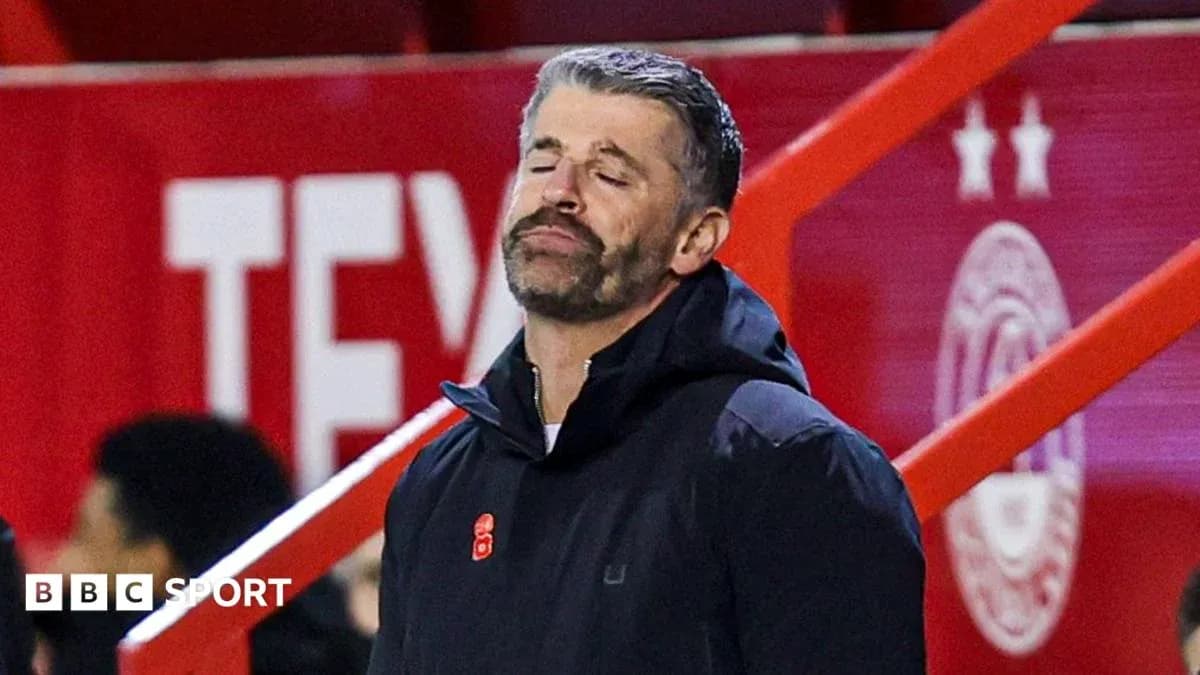
Aberdeen Sacks Stephen Robinson After Disappointing Start
Stephen Robinson’s Aberdeen tenure is over before it ever truly began.
After just eight months in the Pittodrie dugout, the 51-year-old has been sacked, paying the price for a grim start to the Premiership season that has left the club staring down the table rather than up it. Three wins from 12 league matches, four straight defeats in all competitions, and a 4-0 home humiliation by Hibernian on Saturday finally snapped the board’s patience.
Aberdeen sit second bottom. The mood feels even lower.
Brian Kerr and Stephen Craigan have gone with him, leaving Stuart Duff to pick up the pieces as interim head coach. It is a sizeable mess to inherit: a squad stripped of belief, a team with the joint worst attacking record in the division, and a fanbase that has moved from concern to open revolt.
A rebuild that never settled
Robinson arrived in March with a solid CV and a reputation for overachieving on tight budgets. Oldham Athletic, Motherwell, Morecambe, St Mirren – he had always found a way to make his teams competitive. At St Mirren he delivered three consecutive top-six finishes and a League Cup win, then swapped Paisley for Pittodrie on a long-term deal running to 2029.
He came into Aberdeen at a chaotic moment, with relegation a real threat. To his credit, he steadied the ship last season with the players he inherited. Survival secured, the club backed him heavily in the summer. Fifteen players out, fifteen in. A full-scale overhaul.
It never knitted together.
The tactical shape changed constantly, Robinson veering between a back four and a back five in search of solidity. The return was meagre: just two clean sheets in the league. At the other end, the goals dried up. Aberdeen became one of the Premiership’s bluntest attacks, often sterile in possession and fragile without it.
Of the new arrivals, only goalkeeper Marius Muller and full-back Nesta Guinness-Walker have started every league game. Top scorer Kevin Nisbet – also ever-present – has carried the attacking burden almost alone, and even he felt the sharp edge of supporter frustration. When the captain was substituted during the Hibs defeat, sections of the home crowd cheered his withdrawal. That noise said as much about the wider mood as it did about the player.
Club legend Willie Miller did not hold back. He called the 4-0 loss “utterly embarrassing” and said Robinson looked “a man lost”. His verdict on the squad was brutal.
“The players aren't up to scratch, not up to playing at this level and dealing with high-ish expectations,” he said, drawing a line not at trophies, but at simply competing in the top six. “They're nowhere near that.”
Board backing, thin returns
This is the sixth permanent manager to depart since Dave Cormack took control at Pittodrie in November 2019. The churn has become a storyline in itself. One Scottish Cup win aside, Aberdeen have been on a downward curve, stuck in a cycle of hiring, firing and starting again.
The phrase “rinse and repeat” fits uncomfortably well.
Cormack’s commitment and investment are not in question. The managerial hit rate is. Under his watch, each new appointment has been sold as a reset, a fresh start, a new era. Each time, the promise has faded into familiar disappointment.
Former defender and ex-manager Alex McLeish chose not to turn his fire on the board, but he did shine a light on recruitment.
“The board have really worked hard over the years to try and get Aberdeen back to a kind of level, won a cup a couple of years ago. I don't blame the board for anything at all,” he said. “Recruitment is absolutely key and if you've bought a bunch of players and then they're not performing then that is a real worry.”
There are, he pointed out, a few players already at a good level. The question is whether the rest can rise to meet it.
A manager swimming against the tide
Robinson’s appointment followed a long and at times bewildering search to replace Jimmy Thelin, who had initially been identified as the preferred candidate. By the time the Northern Irishman arrived, a portion of the Aberdeen support already felt underwhelmed, seeing the move as one born of anxiety rather than strategy.
He never quite escaped that perception.
Results did not help. Performances often felt disjointed, the team caught between identities. The manager’s body language on the touchline told its own story as the weeks wore on. Post-match interviews in recent games had the air of a man running out of answers.
For many fans, the tipping point had been passed some time ago. Saturday’s collapse against Hibs only confirmed what felt inevitable.
Across 28 matches in all competitions, Robinson leaves with 11 wins, five draws and 12 defeats. On paper, that record is not catastrophic. In context – a heavily backed rebuild, a long contract, and the club’s stated ambitions – it falls a long way short.
What comes next
The search begins again.
Recently appointed chief executive Adrian Bevington now steps into the spotlight, alongside sporting director Lutz Pfannenstiel. The pair arrived with reputations built on deep networks and smart decision-making. Those contacts and that judgement will be tested immediately.
This next call is not just about style or long-term philosophy. It is about survival.
After the international break, Aberdeen head to Kilmarnock on 21 November, then travel to Ibrox to face Rangers three days later. Dundee visit Pittodrie on 28 November. Three games that could either steady the club or drag it deeper into trouble.
The new manager will inherit a squad low on confidence, struggling for goals, and still trying to work out what it is meant to be. Stability has been the missing ingredient at Pittodrie for years.
The question now is simple and stark: can Aberdeen finally break the cycle, or is this just the next chapter in a story the fans are tired of reading?