AJ Dybantsa and Zion Williamson: The New NBA's Volatile Middle Class
The top 100 always reveals something about where the league is headed. Spots 78 through 51 this year don’t just list names; they sketch out the NBA’s uneasy middle class — stars on the rise, stars in limbo and stars fighting the clock.
Here’s how it looks, from a 19-year-old No. 1 pick in Washington to a former phenom in New Orleans trying to redefine what his prime actually is.
A new wave at the edges: rookies, risers and reclamations
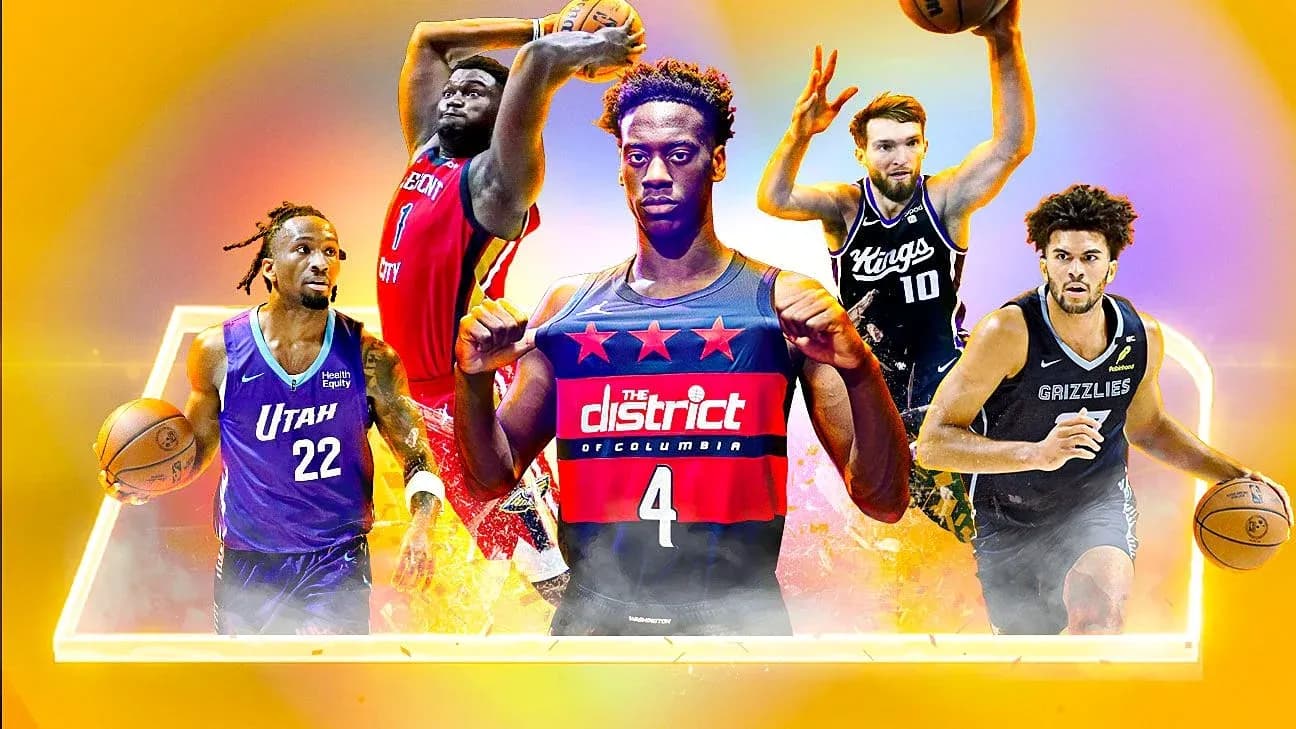
AJ Dybantsa, at 19, walks into Washington with the weight of a name the franchise hasn’t heard in this context since John Wall. The Wizards’ first No. 1 pick in 15 years arrives as the nation’s leading scorer, fresh off 25.5 points per game at BYU and with a game built around contact, pressure and constant attacking. He’s also stepping into a locker room that already features Anthony Davis and Trae Young. Where he slots in that pecking order will decide whether he’s a Rookie of the Year frontrunner or just another talented scorer trying to find air in a crowded room.
In Philadelphia, VJ Edgecombe already answered that question. The No. 3 pick didn’t just start from Day 1 for a second-round playoff team; he logged more minutes than any rookie since Ben Simmons and Donovan Mitchell in 2017-18. Sixteen points, 5.6 rebounds, 4.2 assists and 35% from deep is not empty volume. It’s a foundation piece.
Utah has one of the most intriguing rebuilds in the league, and Keyonte George is at the center of it. He missed out on Most Improved chatter because of the 65-game rule, but the numbers tell the story: one of only 11 players to average at least 23 points and six assists last season, and the second Jazz player ever with 3,000 points and 1,000 assists in his first three years, joining Deron Williams. Now he gets Jaren Jackson Jr. and No. 2 pick Darryn Peterson as reinforcements. If Utah jumps back into the postseason, George’s leap from unranked to 68 will look conservative.
Atlanta’s Nickeil Alexander-Walker is what happens when opportunity meets readiness. In his first season with the Hawks, he exploded to 20.8 points per game, the largest scoring jump in the league, and took home Most Improved honors. He can shoot, create and defend, and he did it as the starting 2-guard for one of the hottest teams in the league down the stretch. This is no longer a “nice story” role-player arc. This is All-Star upside.
Detroit’s Ausar Thompson brings a different kind of star potential. His jumper remains a question, but his defense is already an answer. He led the league in steals per game and finished second in total deflections, then turned the playoffs into a showcase of disruption, nearly averaging four combined steals and blocks. The Pistons locked him up on a deal that could age extremely well. If not for Victor Wembanyama, he’d be sitting on the short list of future Defensive Player of the Year candidates.
In Minnesota, Jaden McDaniels is quietly becoming the kind of two-way wing every contender chases. Long known for his defense, he climbed 19 spots in these rankings because of what he did on the other end: career highs in points (14.8), assists (2.7) and 3-point percentage (41%), capped by a 32-point Game 6 to knock out Denver in the first round. He also defended 2026 All-Stars for 1,163 matchups, fourth most in the league. With Julius Randle and Naz Reid gone and Donte DiVincenzo out long-term, McDaniels’ offensive usage is only going up.
Guards on the move, guards under pressure
Ja Morant’s name at 77 feels jarring until you remember the last three seasons: only 79 games played. Now he lands in Portland, where the backcourt is overflowing. Damian Lillard is back, Jrue Holiday is there, Scoot Henderson is developing, Shaedon Sharpe will eventually return from a torn meniscus. Morant’s production in Memphis — one of just nine players since 2019-20 to average at least 20 points and seven assists — is still the bar. The question is whether he can stay on the floor long enough, and with enough ball in his hands, to reach it again.
Lillard himself sits just eight spots higher at 69, a reminder of how fragile star status can be when injuries hit. He missed all of last season with an Achilles injury. The last time he played, he was still a 25-point scorer and a 38% shooter from 3. Now he returns to Portland, the franchise he defined, with the record books already stamped: most career points and second-most assists in Trail Blazers history. Sentiment will be thick. The expectations will be, too.
Tyler Herro’s summer was chaotic even by NBA standards. First, the trade from Miami to Milwaukee. Then, the highly publicized altercation with former teammate Bam Adebayo in Las Vegas. Strip away the noise and you still have a 2025 All-Star who evolved from sixth man to lead initiator in Miami and now walks into his hometown as the primary engine on a rebuilding Bucks team. With Giannis Antetokounmpo gone, Herro will have a green light and the ball. Last season, he ranked second in points per direct isolation among high-volume players, trailing only Shai Gilgeous-Alexander. Milwaukee will live with the misses to get that kind of shot creation.
Boston’s Payton Pritchard finally got the runway he’d been waiting for. Elevated to a consistent starting role before moving back to the bench in February, he posted career highs across the board: 17.0 points, 3.9 rebounds, 5.2 assists. His touches jumped from 51.8 to 68.9 per game, the second-largest increase among high-usage players who topped 4,000 touches in each of the past two seasons. He started 50 games after just 17 starts in his first five years. For a Celtics team now reshaping its identity, his role is no longer marginal.
Desmond Bane gave Orlando something it simply didn’t have: reliable perimeter shooting. He played all 82 games — one of only four players to do so — and continued his streak of seasons averaging more than 20 points and at least two made 3s on strong percentages. On a Magic team battered by injuries in the starting lineup, his availability and efficiency weren’t luxuries. They were lifelines.
Darius Garland’s slide from 38 to 62 reflects both health and upheaval. He played only 45 games last season before being shipped from Cleveland to the Clippers. Yet the early returns in Los Angeles were promising: the team went 13-6 in the 19 games he played. As one of 71 active players with at least 1,000 made 3s, he’ll be central to Ty Lue’s spacing and matchup-driven offense. He also ranked 10th in points per direct pick among high-volume on-ball screen operators. The tools haven’t gone anywhere.
Nickeil Alexander-Walker, Herro, Bane, Garland, Morant, Lillard — the league’s guard tier between superstardom and role player has never been more crowded, or more volatile.
Big men with big questions
Oklahoma City has quietly built one of the nastiest frontcourts in the league. Isaiah Hartenstein, when healthy, has been the rugged interior piece they needed. He’s only played 94 games over the past two seasons, but when he’s on the floor, he averages a double-double and ranks among the league’s best in defensive impact, finishing fifth in total defensive net points. His size and relentlessness pair with Chet Holmgren’s length and skill to form a two-big combination that can bully the glass and still move in space.
Cason Wallace, Hartenstein’s teammate, cracks the top 100 for the first time largely on the strength of his defense. He led the NBA in total steals and deflections, made All-Defense, and held opponents to 41.6% shooting as the closest defender, fifth-best in the league. In the playoffs, he hounded Austin Reaves, Devin Booker, Stephon Castle and Jalen Green into a combined 25% from 3. Durability is part of his value too: at least 68 games in each of his first three seasons, including a full 82 as a rookie.
Walker Kessler’s leap is based almost entirely on projection — and the faith of the Los Angeles Lakers. They traded unprotected first-round picks in 2031 and 2033 plus swaps in 2028 and 2030 to pry him from Utah, then handed him four years and $130 million. This for a 7-foot-2 center coming off labrum surgery who played just five games last season. But his profile is irresistible: 2.4 blocks per game for his career, second only to Victor Wembanyama since he entered the league, and a perfect lob partner for Luka Doncic while anchoring the defense.
Indiana’s Ivica Zubac, once a quietly dominant rebounder in Los Angeles, now anchors the Pacers’ interior. He finished fourth in the league in boards (12.6 per game) the year before last and made second-team All-Defense. Injuries derailed a second straight double-double campaign and led to his midseason trade, but his impact at the rim remains elite: opponents shot just 49% at the basket against him, fourth-best among high-volume rim protectors.
In Cleveland, Jarrett Allen is about to get a full season of James Harden pick-and-rolls. The early sample was devastating. From Feb. 7 to the end of the regular season, Allen set 13.7 on-ball screens per game for Harden, top five among duos to run at least 100 pick actions together. His scoring jumped to 18.4 points on 70.5% shooting in those 13 games. Already one of the league’s most efficient finishers — 64% from the field, fifth among qualifiers — Allen now has a partner who can unlock even more.
Sacramento’s Domantas Sabonis sits in a different kind of limbo. His 2025-26 season was a nightmare: only 19 games played after season-ending knee surgery, ending a three-year run as the league’s rebounding king. Yet the offensive profile hasn’t changed. He remains one of the NBA’s premier double-double machines and an offensive hub who can pass, screen and punish smaller defenders. The issues are familiar too: no 3-point range and shaky rim protection, making it difficult to build a consistently elite defense around him.
Zion Williamson’s situation in New Orleans is even more complicated. The good news: 62 games, the second-highest total of his career. The bad news: his usage rate and scoring dipped to career lows, settling at 21.0 points per game. He still led the league in paint scoring at 15.4 points per game among players who appeared in at least 40 contests, but the overwhelming, unstoppable version of Zion has given way to something more ordinary. With no All-Star appearances since 2023 and persistent defensive and spacing concerns, he now faces a stark reality: the league has moved, and he has to evolve to keep up.
Wings who decide playoff series
Dillon Brooks has gone from meme to movement. Once “Dillon the Villain,” he’s now the guy teams call when they want to change their culture. Houston jumped from 22 to 41 wins in his first season there. Phoenix, where he averaged a career-best 20.2 points last year, improved by nine wins and rewarded him with a three-year extension. He also ranked top 10 in made 2-point jumpers, according to GeniusIQ. His edges remain sharp, but the production and impact on winning are undeniable.
Trey Murphy III is the prototype everyone wants: a true 3-and-D wing with hints of more. He shot 38% from 3 for his career and finished sixth in 3s made per game last season, while quietly increasing his assist numbers every year. He also joined Lauri Markkanen as just the second player in league history to record at least 200 made 3s and 100 dunks in a season. That blend of vertical and horizontal spacing makes him one of the most coveted potential trade targets in the league.
Mikal Bridges is the NBA’s iron man, and he’s not just logging minutes — he’s leveraging them. His streak of 638 consecutive games is already eighth all time and the second-longest to start a career, behind Johnny Kerr. He could pass Harry Gallatin, Bill Laimbeer and Dolph Schayes this season. After a regular season where his scoring dipped, he caught fire in the playoffs, shooting 56% and hitting big shots throughout the Knicks’ run. If that version of Bridges carries over, New York’s ceiling shifts again.
Michael Porter Jr. needed a reset, and Brooklyn gave him one. Freed from Denver, he delivered a career-high 24.2 points per game and extended his streak of seasons shooting better than 36% from 3, landing at 36.3%. He logged 14 games with at least 30 points, more than double any other season in his career. A late-season hamstring strain raised familiar durability questions, but with an expiring $40.8 million deal and eligibility for a four-year, $234 million extension, this season will define his market.
Julius Randle also lands in Brooklyn, his stock dented by another postseason stumble. He dropped 12 spots in the rankings despite averaging over 20 points for the fifth time in six years, largely because his playoff efficiency cratered: five fewer points per game, 39% from the field, 24.4% from 3. Yet he remains one of only four players last season to post at least 1,500 points, 500 rebounds and 300 assists. In Minnesota’s point-guard-less lineups, he averaged 5.0 assists, hinting at how he might grease the wheels for a Nets offense that finished dead last.
Brandon Ingram, now on his third team in three seasons, is the pure scorer whose impact never quite matches the box score. He’s lived in the 20–25 point range every year since winning Most Improved in 2019-20, with high usage and league-average efficiency. Last season he finished third in made midrange shots, trailing only DeMar DeRozan and Kevin Durant. The Clippers know exactly what they’re getting: buckets. What they don’t yet know is how much else he’ll bring.
Paul George arrives in Boston as the headliner in the stunning Jaylen Brown trade, his fourth stop in a 17-year career. He just finished a strong first-round series for Philadelphia against these same Celtics — 17.4 points, 55% from 3, plus 4.0 rebounds, 3.0 assists and 1.4 steals — before Boston decided they’d rather have him than Brown. George is two made 3s from passing Kyle Korver for eighth all time, and once again he joins a team with real postseason expectations. A third trip to the conference finals is on the table.
Aaron Gordon, in Denver, remains the connective tissue for a contender. The numbers are stark: the Nuggets played at a 62-win pace with him and a 48-win pace without him last season. Then they crumbled in the first round while he battled a calf issue. His rankings drop reflects the concern — just 53 games per year on average since the 2023 title run — but the fit with Nikola Jokic and Jamal Murray is still close to perfect. He’s even rebuilt his jumper, shooting 41% from 3 over the past two seasons after a decade at 32%.
From rookies like Dybantsa and Edgecombe to veterans like George, Lillard and Williamson, this slice of the top 100 captures a league in transition. The stars are aging. The young guards are coming. The wings and bigs who can defend, space and stay healthy will decide who actually matters in May.
Who climbs out of this crowded middle next season — and who sinks — might say more about the NBA’s future than any name in the top 10.