Alan Knight: Portsmouth Legend Passes Away at 65
Alan Knight, Portsmouth’s one-club colossus and the man supporters simply called “The Legend”, has died aged 65 after being diagnosed with prostate cancer earlier this year.
For more than two decades, Fratton Park was his stage. Knight pulled on the Portsmouth shirt 801 times between 1978 and 2000, a staggering total that stands as the record number of appearances by a goalkeeper for a single English club. In an era when loyalty in football has become a romantic notion, he lived it.
He was only 16 when he walked out for his debut, a teenager thrown into the rough and tumble of the old Division Three against Rotherham in 1978. He kept a clean sheet. From that moment, the club had its goalkeeper, and a bond was formed that would stretch across four divisions and four decades.
Knight saw almost everything in a Portsmouth shirt. Relegation battles, promotion surges, financial strain, wild celebrations. He helped deliver three promotion-winning campaigns, including a Division Three title and, most memorably, Pompey’s long-awaited return to the top flight in 1986-87 after a 28-year absence. For a generation of supporters, his broad frame and blue shirt are stitched into every memory of that rise.
He did not drift away quietly either. Knight’s final appearance came on 3 January 2000, a 2-1 Division One defeat at Norwich. He was 38, still guarding the net, still representing the same club he had joined as a boy. That outing made him the only Portsmouth player to have played in four different decades, a statistic that underlines just how deeply he was woven into the club’s fabric.
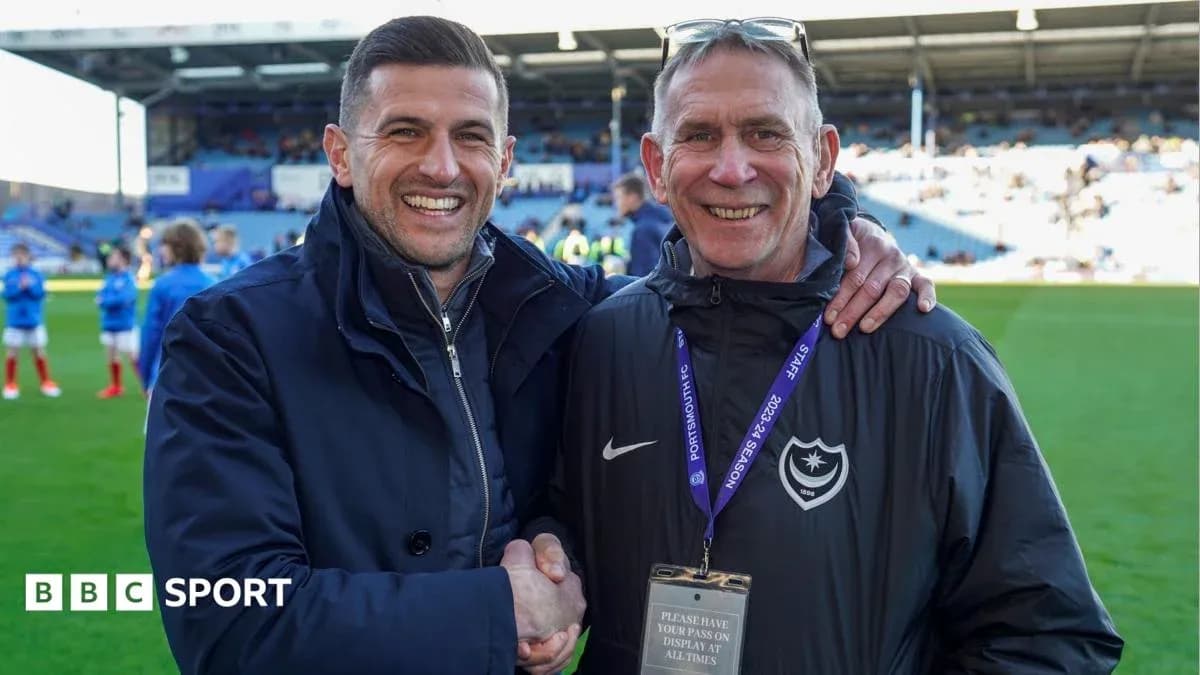
Retirement did not loosen that grip. Knight moved into coaching and served as an ambassador for Portsmouth, a visible, reassuring link between the club’s past and its future. Around Fratton Park he wasn’t just a former player; he was part of the place.
His service did not go unnoticed beyond the terraces. Knight was awarded an MBE after hanging up his gloves and later received the Freedom of the City of Portsmouth, honours that reflected both his footballing contribution and his standing in the wider community.
When prostate cancer entered his life in 2024, Knight chose not to retreat into silence. Speaking to the BBC after his diagnosis, he described it as having “came as a massive shock” but decided to talk openly, hoping his experience would push others to seek help if they noticed symptoms. It was typical of the way he had lived his career: front on, no hiding.
He joined a group of men playing walking football in Portsmouth, a simple game with a serious purpose. The sessions became a support circle, a place where those living with cancer could share the weight. Knight explained how the diagnosis “just changes everything” once the word is used, and how vital it was to lean on the people around him.
“The support network, having your mates around you - family first and foremost - but then to have your mates and your team-mates around you is huge,” he said. “It gives you that lift when you can be slipping into that bit of depression.”
For Portsmouth fans, the image of Alan Knight will always be framed by goalposts and floodlights, a defiant figure in blue standing tall as Fratton Park roared. Now the stands will fall silent for him, but the story of “The Legend” – the boy who became a club, a city and a symbol – will endure every time another young goalkeeper dreams of making just one appearance where he made 801.