Ballon d'Or 2026: Coaches Compete for Glory
The Ballon d'Or gala is built for star forwards, golden boots, and viral goal compilations. Yet in London, two months from now, a different kind of spotlight will cut through the noise. Ten coaches, five from the men’s game and five from the women’s, will walk into the room knowing one thing: whoever leaves with this trophy will be branded the best coach of 2026.
No hiding behind systems. No deflection to the players. This one lands squarely on the dugout.
A Men’s Shortlist Written in Spanish… With One Bold Exception
Look at the men’s nominees and one theme hits you in the face: Spain.
- Mikel Arteta (Arsenal)
- Luis de la Fuente (Spanish national team)
- Unai Emery (Aston Villa)
- Vincent Kompany (Bayern Munich)
- Luis Enrique (Paris Saint-Germain)
Four out of five. Different personalities, different temperaments, but one shared footballing culture. This is not a quirk of the voting system. It’s a statement about where the game’s tactical pulse currently beats strongest.
Arteta arrives with the kind of résumé that used to belong only to old continental giants. A Premier League title wrestled back to north London and a Champions League final run to go with it. Arsenal have not just won; they have imposed themselves, week after week, in a league that punishes hesitation.
Luis Enrique has gone one better in Europe. Again. Back-to-back Champions League titles with Paris Saint-Germain, a club that spent a decade trying to buy its way to this exact moment. He has taken a dressing room of stars and turned it into a functioning, relentless unit. That alone places him in the thick of this race.
Then there is Unai Emery, forever the tournament specialist, now with another European trophy to prove it. The UEFA Europa League belongs to his legend, and this time he has done it with Aston Villa, a club that only recently re-established itself among England’s elite. Emery hasn’t just rebuilt Villa; he has weaponised them.
And yet, all of them may be looking up at one man.
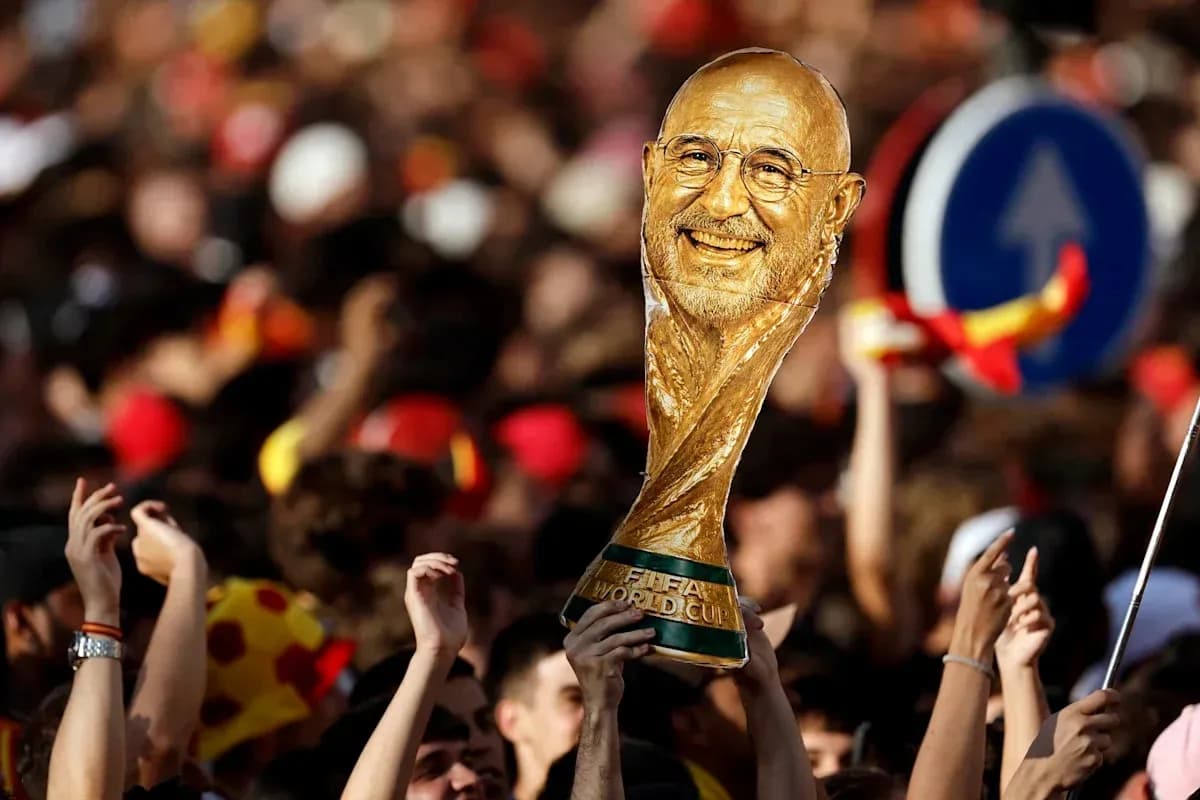
Luis de la Fuente holds the trump card: he won the biggest prize of all with the Spanish national team. International football does not offer the luxury of time or transfer windows. You meet, you mould, you win — or you go home. De la Fuente did the first two so well that the third felt inevitable. That tends to sway ballots.
Only one name breaks the Iberian pattern.
Vincent Kompany stands as the lone Belgian on the list, but there is nothing solitary about the way his Bayern Munich side played this year. Bundesliga title? Secured. DFB Pokal? Added. Performances? At times, breathtaking. Bayern did not just dominate; they entertained, with the kind of positional play that betrays the fingerprints of Pep Guardiola on Kompany’s footballing education.
Even here, the Spanish influence lingers. The ideas that shaped Guardiola in Barcelona now echo through Munich, via a former captain who has turned theory into a ferocious, winning machine.
So the question lingers over the rest of the world: how did Spain pull this off? Four coaches at the top of the men’s game, all in the same year. Coincidence feels like the weakest explanation.
A New Name Guaranteed in the Women’s Game
On the women’s side, the script is different but no less compelling. Every nominee is chasing a first Ballon d'Or coaching crown. Whoever wins will carve a fresh name into the trophy.
- Jonatan Giráldez Costas (OL Lyonnes)
- Andrée Jeglertz (Manchester City)
- Nils Nielsen (Japanese national team)
- Pere Romeu (FC Barcelona)
- Elena Sadiku (BK Häcken)
If silverware is the currency, this is a room full of heavy spenders.
Jonatan Giráldez has turned OL Lyonnes into a domestic wrecking ball. French Championship, French Cup, French League Cup — a clean sweep at home. Lyon have long been a superpower in the women’s game, but maintaining that standard is a job that crushes the unprepared. Giráldez has done more than maintain it. He has reinforced it.
Andrée Jeglertz answers from England with a double of his own. WSL title in the bag, FA Cup to match, Manchester City standing tall in the most competitive women’s league on the planet. City’s rise has been steady; this season, it became emphatic.
Nils Nielsen brings a different profile. No club, no weekly grind, but a continental crown with Japan: the Asian Cup. Tournament football is merciless. You solve problems in days, not months. Nielsen did exactly that, guiding a national team through the kind of high-pressure environment where one bad half can undo years of work.
Elena Sadiku has written her own story with BK Häcken, lifting the Europa Cup and putting the Swedish club firmly in the European conversation. For a coach outside the traditional mega-clubs to break into this shortlist, you need more than a good run. You need a defining triumph. The Europa Cup gave her that.
Then there is Pere Romeu, standing at the controls of a juggernaut.
FC Barcelona’s women’s side have become the standard-setters of the modern era, and Romeu’s season reads like a trophy catalogue: UEFA Women’s Champions League, Spanish Cup, La Liga, Spanish Super Cup. Four major trophies, one campaign, and a style of football that rarely takes a backward step. It is the kind of haul that usually tilts awards in one direction.
The stage is set. Ten coaches, ten different routes to greatness, one prize that will sit on a shelf and quietly say: this was the best of 2026.
The players will always own the headlines. But in London, for one night, the spotlight will belong to the minds on the touchline — and the rest of the world will be left wondering whose ideas define the era from here.