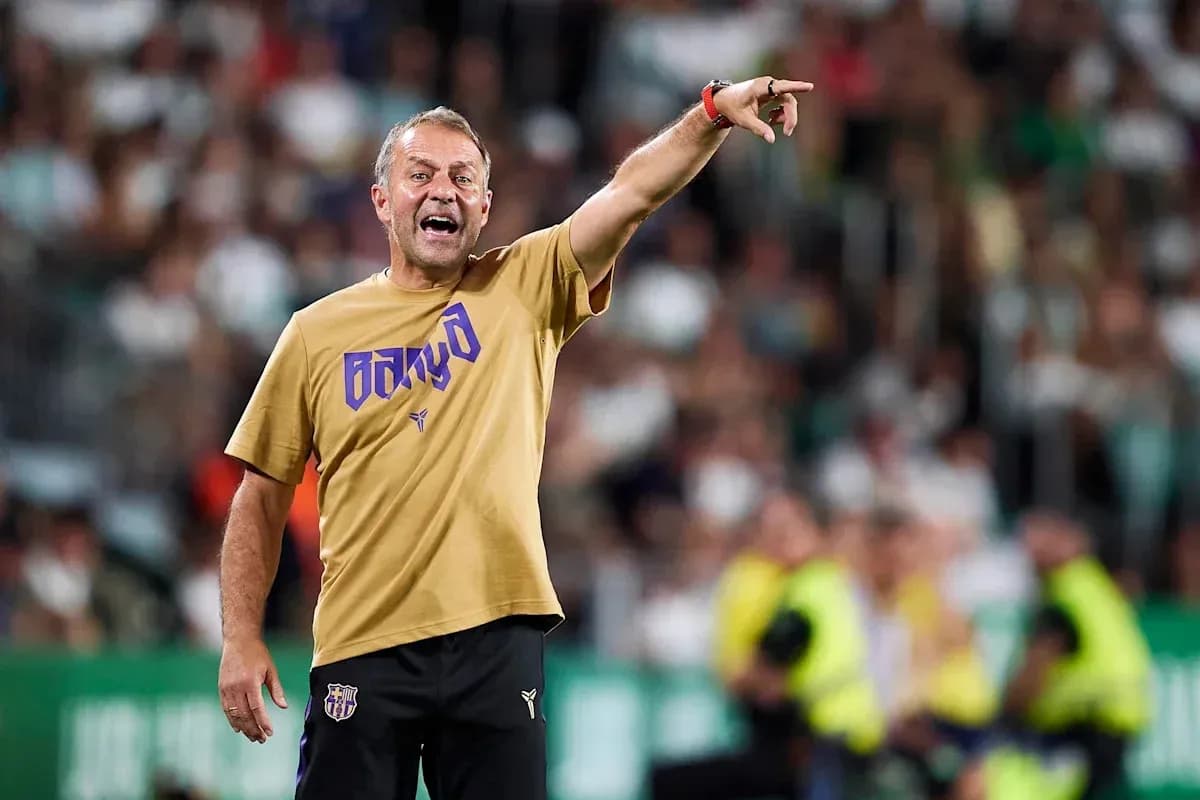
Barcelona's Centre-Back Dilemma: Finding a Solution
The clock is ticking in Barcelona, and for all the noise of this transfer window, one problem still glares back from the squad list: centre-back.
Hansi Flick has seen his new-look Barça hit five past Rayo Vallecano, a 5-2 win that showed the attacking ceiling of this team. It also exposed the familiar cracks. Rayo found spaces, ran into channels, and reminded everyone that this Barça can thrill going forward yet still be picked apart at the back.
With the club fighting on several fronts, that is a dangerous balance to carry into the season’s heart.
A thin core at the back
Álvaro Cortés’ departure has stripped the position down to the bare bones. On paper, there are three senior centre-backs: Pau Cubarsí, Gerard Martín, and Andreas Christensen. On the pitch, that number feels even smaller.
Eric García and Jules Koundé can both play centrally, but Flick has pushed them to right-back. In tactical terms, they live there now. Counting them as genuine central options would be bending reality.
Cubarsí and Martín have become the trusted pairing for the big nights. Young, composed, and brave on the ball, they have grown into Flick’s first-choice duo. Their performance against Athletic Club underlined it: calm under pressure, assured in possession, unflustered by the occasion.
Christensen sits just behind them in the hierarchy. Reliable when fit, intelligent in his positioning, and experienced at the top level. The problem is obvious: his body does not always keep pace with the schedule. Any spell on the sidelines for him, or worse, an injury to Cubarsí or Martín, would leave Barcelona one knock away from a full-blown crisis.
That is not squad depth. That is wishful thinking.
What Barça really need
The requirement here is not romantic. Barcelona do not need a marquee name, a new defensive leader, or a player who demands to start every major game.
They need a grown-up solution.
One more centre-back who can slot in without fuss, take minutes in the league against lesser opposition, cover for injuries, and allow Flick to rest his young pillars when the fixtures pile up. Someone comfortable with the ball, disciplined without it, and affordable in a summer where every euro has been stretched.
A low-cost signing. A smart loan. A defender who understands his role and embraces it. That is the profile Deco has to find in the final hours.
Ruud Nijstad: the long shot with long legs
Into that gap steps a name that has caught Barça’s attention: Ruud Nijstad.
The 18-year-old Dutchman, a left-footed centre-back at FC Twente, brings the kind of physical profile Barcelona rarely produce from La Masia. At 195 cm (6'5"), he dominates in the air and imposes himself physically, yet has also impressed observers with his defensive reading and his ability to carry the ball out from the back.
On paper, he ticks a lot of boxes. Young, tall, comfortable in possession, left-footed, and already speaking openly of his admiration for Barça. He has even admitted he would love to play alongside Cubarsí at the club. For a team that wants to build a long-term defensive core, the idea of pairing two teenagers with that kind of potential is enticing.
Reality, though, is far less generous.
Nijstad has only just signed a contract with FC Twente that runs until 2029. Twente see him as a prized asset, a defender to build around, not one to cash in on at the first call from abroad. With hours left in the window, prising him away would be complicated and likely expensive, exactly the sort of deal Barcelona have been trying to avoid this summer.
The fit is appealing. The deal is anything but simple.
Deadline day dilemma
So the question hanging over Barcelona is brutally clear: can they afford to walk away from this window without another centre-back?
Trusting Cubarsí and Martín is logical. Building a structure that collapses the moment one of them pulls up with a muscle problem is not. Flick needs options. He needs rotation. He needs the ability to manage risk, not just react to it.
Nijstad might be the ideal long-term project, the kind of defender who could anchor the back line for a decade. Yet the urgency of the situation points to something more pragmatic: a short-term fix, a loan, a low-cost veteran, a defender who doesn’t stunt the growth of Cubarsí and Martín but shields them from burnout.
Barcelona have spent the summer patching holes, adding quality, and reshaping a squad that has to compete now while still planning for tomorrow. The back line, though, still feels one injury away from being exposed.
The window is closing. Deco knows the stakes. The choice is stark: gamble on the fitness and form of three centre-backs across a long, punishing season—or find one more body to hold the line when it matters most.