Barcelona Dominates Feyenoord in Champions League Opener
Rain lashed down, but Barcelona played as if under clear blue skies. Feyenoord never stood a chance.
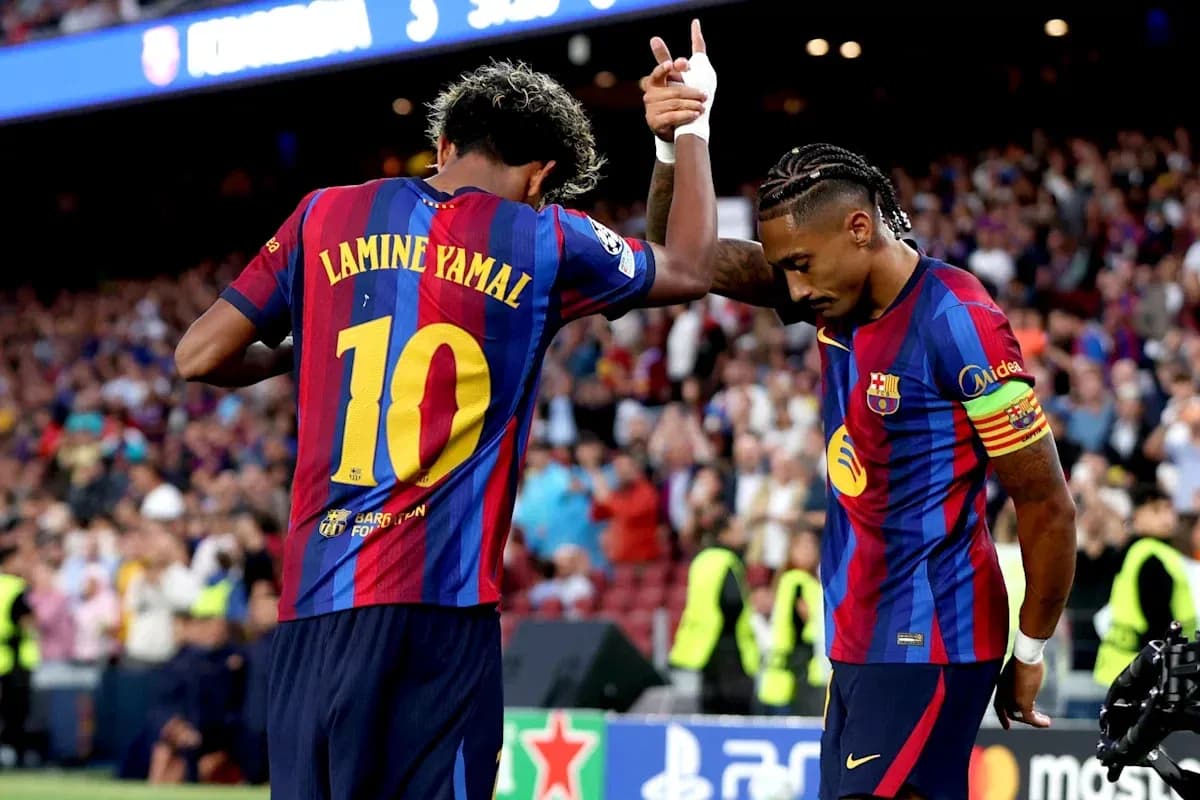
Hansi Flick’s side opened their Champions League campaign with a 5-1 statement win, a night of ruthless attacking football that felt less like a group-stage opener and more like a warning to the rest of Europe. Raphinha struck twice, Karim Adeyemi, Lamine Yamal and Gabriel Jesus added one each, and every surge forward carried menace.
The scoreline told one story. The manner of it told another.
Raphinha sets the tone
From the outset, Barcelona attacked with a sharpness that has not always been guaranteed in recent European nights at home. Raphinha, buzzing on the right, set the tempo.
The Brazilian winger’s brace underlined his growing influence. He spoke afterward about not chasing individual prizes, insisting he “doesn’t talk about the Ballon d’Or” and only talks about Barcelona, but his football did plenty of talking. At home, he said, you need an “almost perfect” game. He went out and delivered one.
His movement dragged Feyenoord’s back line into uncomfortable areas. His finishing punished them when they failed to adjust. Every time he cut inside, the visitors braced.
The pressure finally told. Then it told again.
Lamine Yamal answers the noise
If there is a name that hangs over this Barcelona side right now, it is Lamine Yamal’s. Flick did not dodge the subject. “Of course, Lamine Yamal deserves the Ballon d’Or,” the German declared, before quickly adding that he is “very, very happy with the team” as a whole and still wants to “analyze what we can improve.”
The teenager, once more, backed up the hype. His goal felt almost inevitable, the product of constant threat and fearless decision-making. Raphinha, delighted that Lamine “found the net again,” framed it as part of the standard now expected at home: relentless, almost flawless attacking play.
On a night of milestones, Yamal’s performance was less about numbers and more about aura. He played as if the rain, the occasion, and the weight of Flick’s praise simply didn’t exist.
Gabriel Jesus breaks his duck
One of the loudest roars of the night came not for a wonder goal or a late flourish, but for a first.
Gabriel Jesus finally opened his Barcelona account, and he did it on the Champions League stage. The Brazilian’s debut strike in blaugrana colors adds another dimension to Flick’s attack: a forward who thrives in tight spaces, links play, and now has the relief of that first goal out of the way.
For a striker, that moment matters. The celebration said as much. So did the reaction of his teammates, who swarmed him as if they knew a small weight had just slipped from his shoulders.
Milestones at the back
While the forwards soaked up most of the spotlight, this was also a landmark evening for the men behind them.
Joan Garcia, now firmly installed as Barça’s first-choice goalkeeper, reached 50 appearances for the club. In a side that has shifted shape and personnel in recent seasons, his rise to the No. 1 role has brought a sense of continuity. Fifty games is not a lifetime, but it is long enough to establish trust.
Ahead of him, Pedri quietly hit 250 matches in the blaugrana shirt. The Canary Islander has gone from bright prospect to the heartbeat of the midfield in what feels like the blink of an eye. Two hundred and fifty games at his age is not just a statistic; it is a testament to how indispensable he has become.
Jules Kounde, meanwhile, matched Eric Abidal as the Frenchman with the most appearances for Barcelona: 193. It is a number that places him alongside a club legend and underlines how central he has been to the reconstruction of this back line.
Flick’s standard, Barça’s ceiling
The scoreline glowed, the milestones stacked up, and the crowd went home happy. Flick, though, kept one eye on the bigger picture.
He spoke of being “very, very happy with the team,” but he also stressed the need to review and refine, to look at “what we can improve.” That blend of satisfaction and demand fits a club that measures itself not by group-stage wins, but by where it stands in May.
Barcelona did more than beat Feyenoord. They played with conviction, with variety, and with a swagger that has too often gone missing in recent European campaigns.
If this is only the start of their Champions League journey, how high can this version of Barça climb when the rain stops and the stakes rise?