
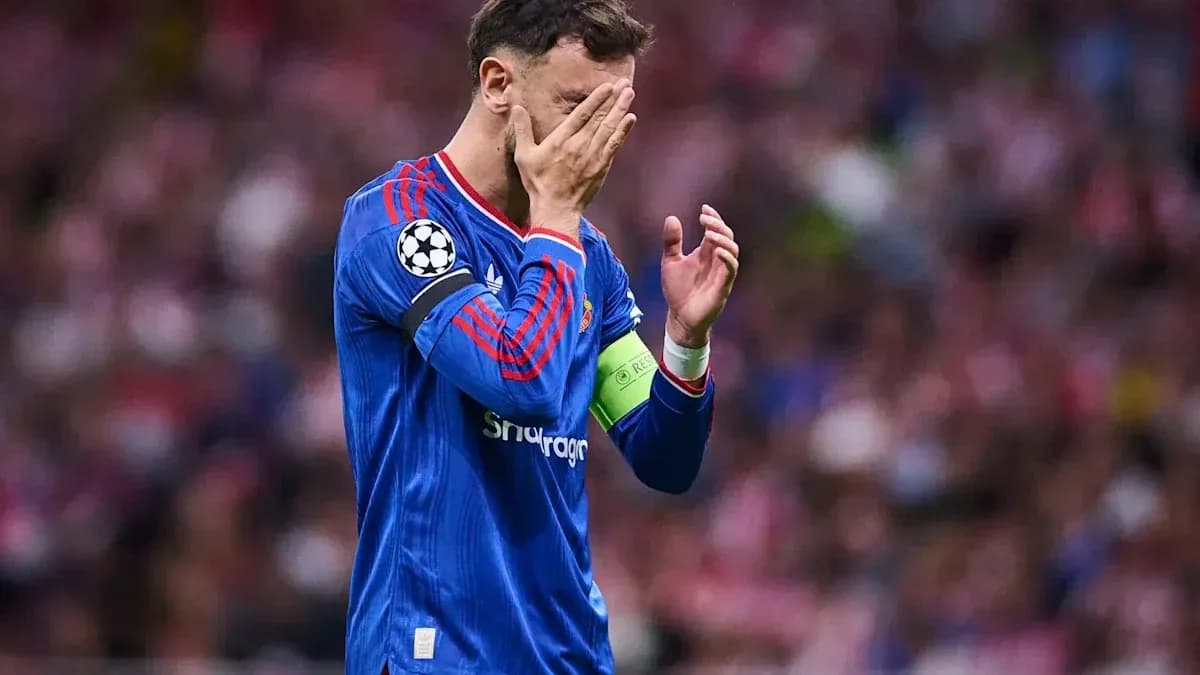
Bruno Fernandes: The Contract Dilemma Facing Manchester United
At a club drowning in big problems, one issue keeps bobbing back to the surface: Bruno Fernandes.
Manchester United’s captain, creative hub and emotional barometer is locked in a contract stand-off that cuts right to the heart of what this club wants to be. Not just this season. For the next five years.
The backdrop could hardly be more volatile. Supporters still rail against the Glazers, accusing the owners of running a super-club like a side project. Michael Carrick has become the latest manager chewed up by the Old Trafford machine, the 12th man to vacate the dugout since Sir Alex Ferguson walked away. He didn’t even last a year after being upgraded from interim to permanent, leaving in the wake of United’s worst league start in four decades.
Now Mauricio Pochettino has been handed the keys and the wreckage. Former Chelsea, former Tottenham, now tasked with fixing a squad that has been expensively assembled, poorly balanced and still short of a reliable goalscorer since Cristiano Ronaldo left in November 2022.
And right in the middle of that mess stands Fernandes, weighing up his own future.
A Captain Stalling, a Club on Edge
United have already seen two contract offers pushed back across the table. The first arrived in the summer, when talks opened. The second has also been rejected, with his current deal running to June 2027 after his last extension in August 2024.
That alone would be tense enough. The complication is timing.
Under FIFA rules, once a player moves into the final six months of his contract, he can negotiate a pre-contract with foreign clubs. For Fernandes, that threshold would come on 1 January 2027, opening the door for a free transfer abroad before the season is even done.
United do have one safety net. Buried in his current deal is a unilateral option to extend it by 12 months, taking him through to June 2028. Trigger it before January 2027 and they block any pre-contract talks. They also buy time: time to negotiate, time to convince, time to sell the project.
But that mechanism carries a sting. Use it against a player who has carried the club since 2020 – more than 200 goals and assists in all competitions – and it starts to feel less like commitment and more like compulsion. A clause instead of a conversation. Protection for the club, irritation for the captain.
For a player who has dragged United through countless grim afternoons, that’s a dangerous line to walk.
Still the Beating Heart
Strip away the noise and one truth remains awkwardly clear: this team still leans heavily on Bruno Fernandes.
Even in a stuttering campaign, the numbers keep coming. Six goal contributions in nine Premier League games so far, including a hat-trick against Ipswich earlier in the season. When United need someone to force the issue, it is usually the captain who shows up on the ball, on the scoresheet or in the referee’s ear.
Last season underlined his importance in bolder ink. In a malfunctioning side, Fernandes helped drag United to Champions League qualification and swept up the FWA Footballer of the Year and PFA Players’ Player of the Year awards. He set a new Premier League record with 21 assists in a single season. That is not just influence; it’s architecture.
Even this term, amid another crisis-laden campaign, he has found ways to tilt games. A goal and an assist in a comeback win over Roma in the Champions League. A contribution again in the draw with Aston Villa. When United wobble, he is usually the one trying to steady the frame.
Yet this season has also shown the other side. United are in the relegation zone. Fernandes has not consistently hit last year’s heights. There have been spells when his decision-making has frayed, his performances dipped, and his emotional volatility has grated. Reports of disagreements with Carrick over tactics, particularly after the 4-1 humiliation against Como in the Champions League, only added more static to an already noisy picture.
The player who once felt like the solution is suddenly part of the debate.
Money, Years and the INEOS Equation
At the core of the negotiations lie two familiar fault lines: salary and contract length.
By next year, Fernandes will be 33. United want to keep him. INEOS, now shaping the club’s sporting direction, are wary of tying themselves to another long, heavy deal for a player on the wrong side of 30. They prefer shorter commitments. He wants terms that reflect not just what he has done, but what he still believes he can do.
From Fernandes’ perspective, the argument is straightforward. He is captain. He is one of the Premier League’s most productive midfielders. He has been United’s most reliable source of goals, assists and leadership through years of drift. He wants a contract that matches that status.
From the club’s side, the caution is equally easy to understand. Age is undefeated. However well a player looks after himself, the physical drop-off usually begins in the early 30s. Fernandes’ game, built on sharp movement, relentless pressing and constant involvement, is not immune to that curve.
The cautionary tales are close at hand. Liverpool’s decision to hand Mohamed Salah a lucrative two-year extension in April 2025, on the back of a 29-goal, 18-assist Premier League season, has already come under scrutiny as his output has declined. United cannot afford to repeat that kind of miscalculation on another ageing star.
Yet there is a different kind of risk here. If financial prudence becomes the reason they let their captain walk, the cost of replacing his output, his leadership and his familiarity with the league could dwarf the savings on the wage bill.
This is not just an accounting exercise. It is a statement about what United value.
Three Roads, No Easy Exit
So where do United go from here? The board essentially face three routes, each strewn with hazards.
- Pay up and build around him
The first option is the boldest: meet Fernandes’ demands, hand him a more attractive long-term deal and make him a central pillar of Pochettino’s rebuild.
That would give the new manager a powerful ally in the dressing room, a captain who understands the club and a player who has repeatedly delivered at least 20 goals and assists in every full season since he arrived. It would also send a message to the squad and to the league that United still back their best players.
The risk is obvious. If his performances tail off sharply in his mid-30s, the club could be saddled with a huge contract for a fading force, limiting their flexibility in the market.
- Trigger the extra year and buy time
The second option is to pull the lever on that one-year extension, keeping him at Old Trafford until 2028 without committing to a fresh, long-term deal.
On paper, it looks pragmatic. United would prevent him from entering the final six months of his contract, avoid losing him for nothing and gain time to judge his performances under Pochettino before making a definitive call.
But football isn’t played on paper. If Fernandes feels the club are hiding behind a clause instead of engaging with his concerns, the relationship could sour. For a player who has given as much as he has, being effectively “held” by a unilateral option could feel like a breach of trust. United would be protecting an asset while alienating a leader.
- Cash in and move on
The third path is the cleanest on a spreadsheet and the messiest emotionally: sell him next summer.
There would be no shortage of interest. Top European sides and Saudi Arabian clubs will be watching his situation closely. A sale would bring in a significant fee, free up wages and allow INEOS and Pochettino to reshape the squad in their image.
But then comes the question nobody at Old Trafford can answer easily: who replaces him?
Not just his numbers, but his role as captain, his creative responsibility, his willingness to take the ball when the stadium is tense and the team is fragile. In the current market, finding a younger midfielder who can replicate his output and adapt instantly to the Premier League is a gamble of the highest order.
A Divided Fanbase, a Single Brutal Question
The debate in the stands mirrors the one in the boardroom.
One camp insists United must do everything to keep their captain. Another argues he symbolises the club’s stagnation: too much complaining on the pitch, too dependent on a system built around his freedom, not always aligned with collective discipline.
Both sides have a point. Fernandes’ visible frustration can sometimes reflect the chaos around him; on other days, it only adds to it. He can be the solution and part of the problem in the same 90 minutes.
Yet when you strip sentiment away and look at the market, a cold reality emerges. Very few available players can match his sustained output over several seasons. Goals, assists, chance creation, leadership under pressure – these are not easily bundled into one signing.
Losing him would mean more than losing a name on a teamsheet. It would mean losing the one player who has consistently shouldered responsibility during United’s bleakest stretches.
Pochettino, INEOS and the Test of Ambition
Perhaps the most sensible short-term play is also the hardest to execute: persuade Fernandes to commit to the immediate future, work under Pochettino for at least another season and judge the project from there.
That would give the new manager time to embed his ideas, decide whether his captain still sits at the centre of his tactical blueprint and allow the club to plan a succession strategy with clarity rather than panic.
It would also give United breathing space in the market. Instead of scrambling to replace their captain in a single window, they could identify and develop a long-term heir with less desperation and more design.
Because this is the real question hanging over Old Trafford: not simply whether Manchester United should keep or sell Bruno Fernandes, but whether they have a serious, realistic plan for replacing everything he brings if they let him walk away.
For a club that has spent a decade lurching from one short-term fix to another, the answer to that will say more about their future than any contract signature ever could.





