Caleb Wilson: The New Hope for the Chicago Bulls
On an August night outside the United Center, the past and the future of the Chicago Bulls stand almost eye to eye.
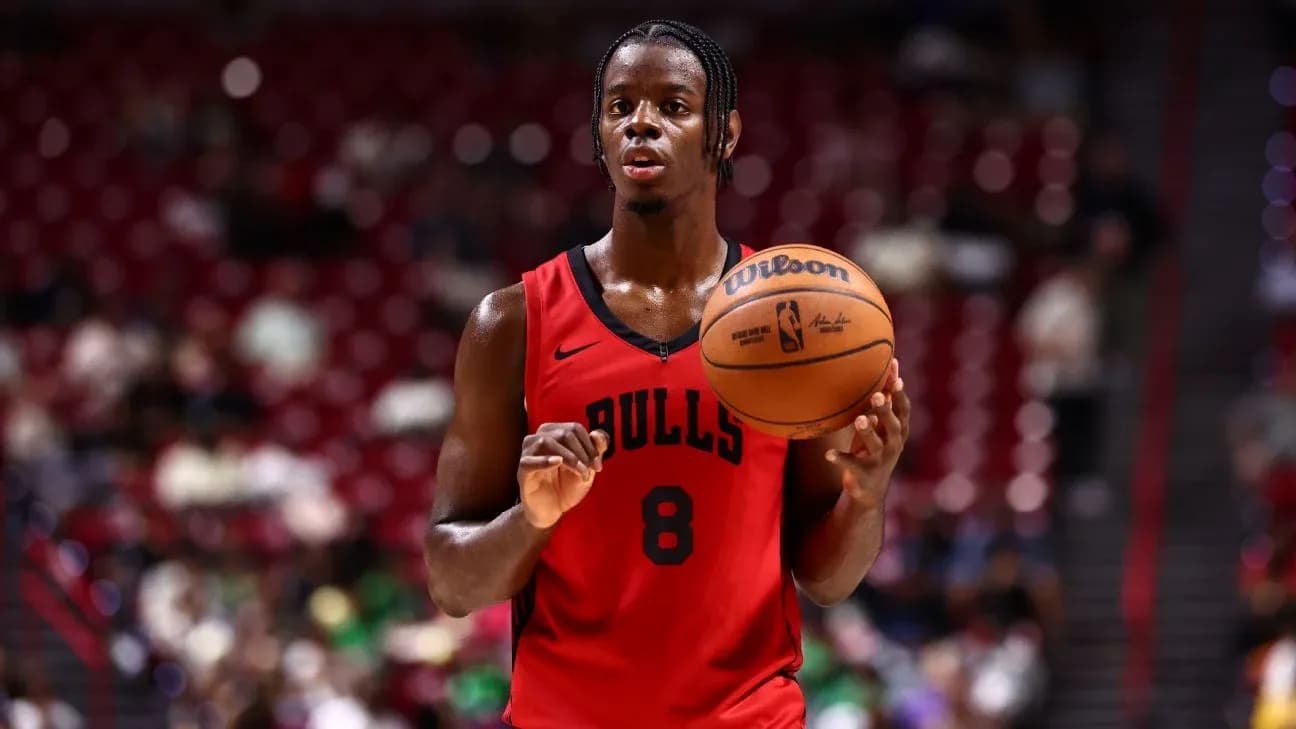
Fans swarm the atrium for Bulls Fest, snaking around corners for a chance to meet a 20-year-old who hasn’t played a real NBA minute yet but already carries a franchise’s hunger on his shoulders. Caleb Wilson steps in front of the Michael Jordan statue, screams for the camera, tongue out, feeding a hype video as the crowd roars.
Jordan in bronze behind him. A kid in Bulls red in front of him. The juxtaposition is impossible to miss.
A new face for a faded giant
The Bulls have been wandering for nearly a decade, missing the playoffs in eight of the past nine seasons, trying and failing to shortcut their way back to relevance. In June, they chose a different path.
They took Wilson, the explosive North Carolina forward, with the No. 4 pick in the 2026 NBA draft. The hope is simple and enormous: that he becomes the new face of the franchise and the anchor of a slow, deliberate rebuild.
The hype started to spike in Las Vegas.
In his first summer league game, Wilson detonated. Thirty-five points. Seven made 3-pointers. It was the second-highest scoring rookie debut in summer league history, the kind of box score that cuts through the usual July noise and forces people to pay attention.
Game 2, he went viral. Wilson rose over 6-foot-11 Jonas Aidoo and hammered down a dunk that instantly lived on every highlight reel of the summer.
By Game 4, Hall of Famer Kevin Garnett sat courtside to see the kid people had already started mentioning in the same breath. Both are 6-foot-10. Both wiry at 215 pounds. Both built on long limbs and violent athleticism.
Warriors forward Draymond Green went even further on his podcast.
“I actually think his floor is Kevin Garnett,” Green said. “And man, if that's your floor, oh my god. Do you know how great KG was? I actually think with Caleb Wilson, Kevin Garnett could be his floor. That's how special I think Caleb Wilson is.”
Teams usually roll their eyes at summer league overreactions. Wilson’s performance cut through that skepticism.
“He looks,” one Bulls source told ESPN, “like we got a dude.”
Chicago is betting he’s more than that. They see him as a pillar in an organization that has been stripped down and rebuilt almost from the top.
Bryson Graham arrived as the new head of basketball operations with a reputation for drafting well and finding young talent. He hired Tiago Splitter as head coach, a former big man with a track record in player development. The front office then added veterans like Norman Powell and Nic Claxton to steady the locker room.
But everyone inside the building knows the real project: Caleb Wilson.
“We just want to see internal growth from our young guys and even from our veteran players,” Graham told ESPN. “We just want to see a team that's going to go out there, represent this city well, play hard and obviously continue to grow and continue to develop.”
The Bulls aren’t pretending they’re ready to climb the Eastern Conference right away. Internally, there’s no mandate to chase a play-in spot. After years of quick fixes, the message from the decision-makers is patience.
Wilson’s message is not.
“I expect to have Rookie of the Year, honestly,” he said. “I'm going to work hard. I'm going to do what it takes. I feel like the team is really good for me and how I envision to play.”
The shot that changed everything
The most startling part of Wilson’s summer league debut wasn’t the 35 points. It was the way he got them.
Seven 3-pointers. More than he hit in his entire freshman season at North Carolina.
Shooting was supposed to be his flaw. Scouts questioned his range, and an injury-shortened college season that kept him out of the NCAA tournament didn’t help. It’s part of why he went behind AJ Dybantsa, Darryn Peterson and Cameron Boozer in the 2026 class.
Wilson’s explanation for the sudden jumper? Context and sweat.
At North Carolina, the system didn’t ask him to shoot from deep — he averaged just 1.1 attempts from 3 per game. Once the season ended, he started remaking his shot.
“I'm glad I didn't shoot 3s in college,” Wilson said this summer. “Because if I did, I wouldn't be here. I don't know where I'd be. I don't think I'd be a Bull.”
His season ended in February with a broken thumb and a left wrist fracture. The cast locked his thumb straight; he couldn’t move it. But he could still hold a ball. So he did, over and over, drilling form and repetition even when he couldn’t fully grip it.
Now he estimates he’s firing between 2,000 and 2,500 3-pointers a day.
Inside the organization, the numbers from Vegas mattered. The work behind them mattered more.
Wilson cried before his professional debut — five months to the day since his college season ended — because he’d been waiting so long to get back on a court that counted. While other top picks in his class shut it down after two or three games, Wilson lobbied to keep going. He texted Graham asking to play the second night of a back-to-back for Chicago’s third summer league game.
He finished the event averaging 23.5 points, 7.3 rebounds, 1.3 steals and 2.5 blocks in four games, earning a spot on the all–summer league first team. When told his 35-point opener ranked among the highest-scoring debuts in the event’s history, he brushed it aside.
They’d lost.
Back in Chicago, the obsession hasn’t slowed. Wilson has barely left since the draft. He hits the practice facility in the morning, then returns around 8 or 9 p.m. with fellow first-rounder Dailyn Swain, the No. 15 pick, for late-night sessions that often run to midnight.
“Everybody highlights his athleticism, which is generational,” Swain said. “But he can do a lot of things. He's really good facing up at the elbow, jab. He has a really good midrange shot. He's been knocking down 3s, so he's widening his arsenal.”
A coach built for a project
Graham’s first big move in charge was choosing the coach who would shape this new era. He landed on Splitter, whose vision aligned with his own: player development first.
Splitter’s brief run as interim coach in Portland last season produced a surprise. He took the Trail Blazers to the playoffs as the No. 7 seed in the West. When he arrived in Chicago, though, he and Graham didn’t sell that as a template to copy. This job is different. This job is about building.
Graham leaned on Splitter’s résumé with young players. In Portland, he helped Deni Avdija grow into an All-Star. As a development assistant in Brooklyn in 2019, he worked closely with Jarrett Allen. In Houston in 2023, he helped guide a young Alperen Sengun.
“The first thing you do is connect,” Splitter said. “That's the foundation of everything you do, especially at this level. If you don't have that, it's really hard to demand and make them respect you. The foundation is [to] connect with the players in different ways.”
With Wilson, that connection started quickly. They bonded over music. Splitter was struck by the rookie’s range — a 19-year-old picking up guitar and bouncing from hip-hop to classical to country in his spare time.
“Very interesting young guy,” Splitter said. “You see how his brain functions and the variety of things he can have a conversation about.”
Splitter took the reins for Chicago’s first two summer league games in Vegas, wanting to set the tone himself. For a young coach still shaping his own identity, it was a rehearsal for the pressure that comes with trying to resurrect a starving basketball city.
Wilson’s early read on him is blunt.
“He's really detailed,” Wilson said. “He knows what he wants you to do and he's pretty serious. Most coaches, you have coaches that are joking around and stuff like that. Tiago's pretty serious and he knows what he wants.
“I’d rather have someone who's serious and straightforward with me, so I know what I can do better.”
In Vegas, Splitter put the ball in Wilson’s hands. The rookie functioned as the primary ball handler and de facto point guard — a wrinkle Garnett never had in his Hall of Fame career. That responsibility will ease once the real season starts. Josh Giddey, Powell and third-year forward Matas Buzelis, who started 77 games last season, will all share creation duties.
For Graham, surrounding Wilson with proven pros is part of the plan.
“It builds a healthy environment,” he said. “It gives the younger guys confidence, too, because they know that, when it is going bad, they have some guys that have done it, some guys that have won and had success and they can learn. It's just really important for the overall development of our younger players and the health of our team.”
Splitter has shown he can bend his style to his roster. In France, he pushed Paris Basketball into the EuroLeague playoffs with an up-tempo attack. In Portland, he leaned into defense as the team’s calling card.
Chicago gives him a blank canvas.
“You have to adapt your system to the players you have,” Splitter said. “Yes, I have a vision. I have a certain way I want to play, but you also have to explore what they do best. That's what we're going to do here.”
That’s the mandate: build a system that brings out Wilson and the rest of this young core, then grow with them.
The work before the wait
As they do every year, Bulls players gathered in Miami recently for a player-run minicamp ahead of training camp. It’s part chemistry lab, part proving ground.
Wilson walked into that setting with the weight of a city’s expectations and the confidence of someone who has already decided what he wants from this league.
“I do expect to win,” he said. “Whatever it takes to win is what I'm going to do.”
Outside the United Center, the lines at Bulls Fest curl around the building for a glimpse of the rookie who might drag the franchise out of the wilderness. Inside, a new front office, a new coach and a 20-year-old with a rebuilt jumper are trying to make sure this isn’t just another false dawn.
Chicago has seen legends cast in bronze. Now it waits to see what this kid can carve out in flesh and blood.