Canelo Alvarez Reclaims Super-Middleweight Title in Riyadh
Under the Riyadh lights and the weight of a legacy briefly questioned, Canelo Alvarez walked last, walked slow, and walked like a man who had heard every doubt. Ninety minutes later, he walked out a three-time super-middleweight world champion.
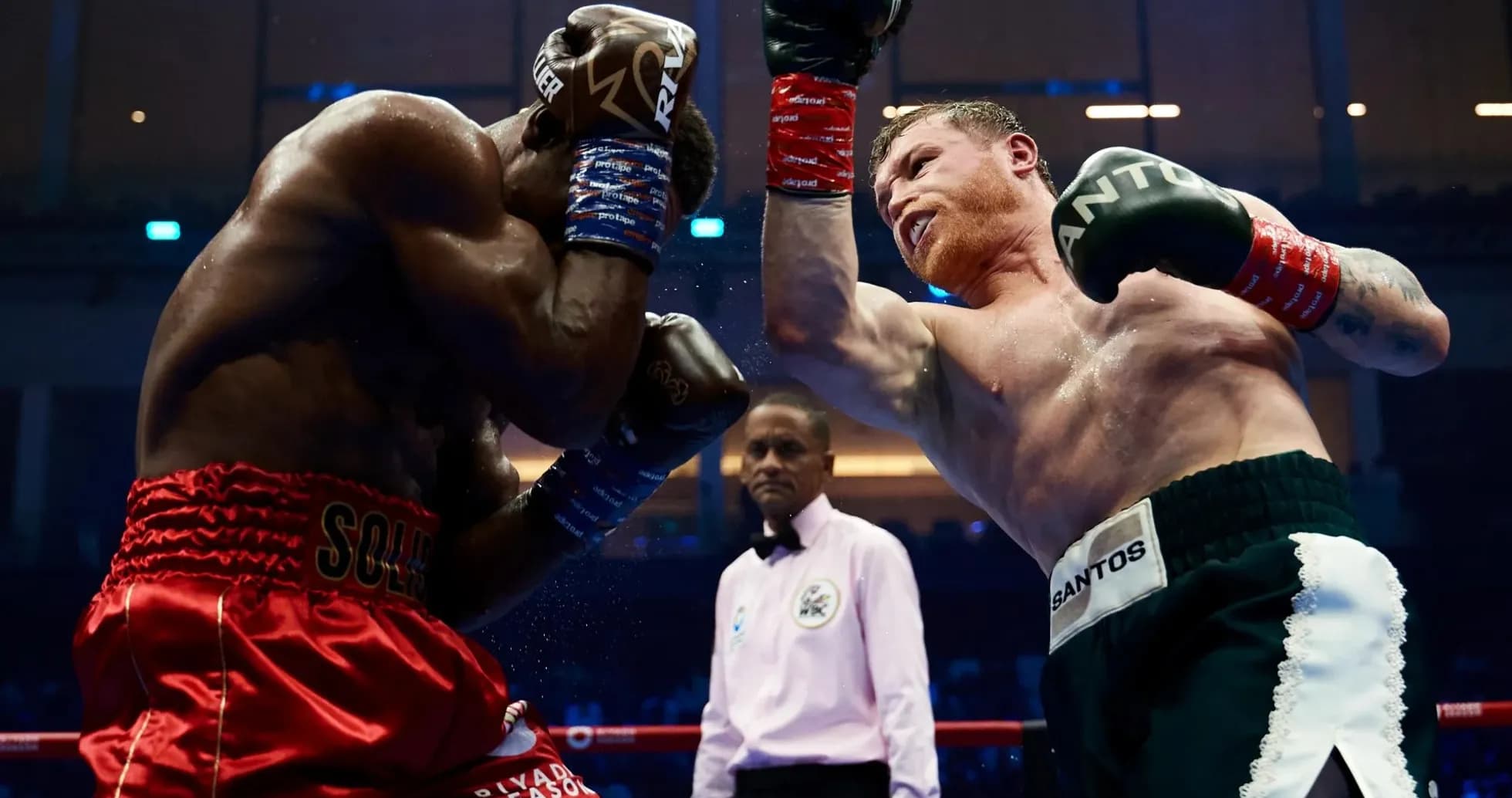
The Mexican star outpointed Christian Mbilli by unanimous decision to reclaim the WBC super-middleweight title at 168lbs, with scores of 115-112, 116-111 and 117-110. It was not chaos. It was control. A calculated dismantling of a dangerous puncher who never quite solved the puzzle in front of him.
Only months removed from defeat to Terence Crawford and whispers that the peak had passed, Alvarez came to Saudi Arabia needing more than a belt. He needed authority. He found it in 12 rounds of disciplined, high-class boxing.
“I knew he was a strong fighter, but he didn't throw a lot of punches because it is difficult to throw punches with me,” Canelo said in the ring, the new belt resting on his shoulder and the noise rolling around him. “It feels like my dream, now I've won the title again. I'm so proud of my team. Eddy Reynoso made me the champion that I am.”
When Oleksandr Usyk and Turki Alalshikh stepped through the ropes to congratulate him, it underlined the point: the sport still moves when Canelo moves.
A slow burn that belonged to Canelo
From the opening bell, this was less a brawl and more a high-stakes board game.
Mbilli came out as advertised – front-foot, aggressive, trying to herd Alvarez to the ropes. The Frenchman swung heavy in the early exchanges, particularly in the second, when a straight shot down the middle snapped Canelo’s attention. But the challenger’s response was telling: a whipping left hand to the body, a reminder that he would not be bullied.
The first three rounds played out like a tease. Canelo stood his ground, jab sharp, feet set, reading Mbilli’s rhythm. When Mbilli tried to pin him, he met tight defence and subtle pivots. When he overreached, Canelo looked to counter. At times the Mexican even waved him in, a flash of supreme confidence that said: this is my pace, not yours.
Mbilli, though, stayed busy. He threw in volume, trying to catch the judges’ eyes with pressure and work rate. Alvarez, more selective, landed the cleaner, more precise shots. It made the early going difficult to score, a split-screen of quality versus quantity.
By the halfway point, the pattern had settled. Canelo was beginning to find his rhythm; Mbilli was still trusting his engine.
The turning of the screw
Round six brought a shift. Alvarez opened up with a sharp combination that drew an audible gasp from the crowd. The fight remained a chess match, but the Mexican’s pieces were now moving with more freedom. He upped his output, earned applause, and started to dictate when the exchanges happened.
In the seventh, the gap widened. Canelo dropped back, invited Mbilli on, and picked him off with straight shots and a textbook uppercut that snapped the champion’s head and drew a wry smile. It was Mbilli’s way of saying he was unfazed; the replay would say otherwise. It was the Mexican’s best round to that point, and it felt like the moment the tide truly turned.
Then came the controversy.
In the eighth, with Alvarez boxing smart off the back foot and Mbilli’s attacks growing more predictable, the referee stepped in. After punches appeared to land to the back of Canelo’s head – Alvarez gesturing that it had happened three times – Mbilli was docked a point. The Frenchman shook his head in disbelief. Harsh or not, it handed Alvarez a significant advantage in a fight that had been competitive on the cards.
From that moment, Mbilli faced a steep climb. The pressure was still there, but the variety wasn’t. Canelo, now fully in command of distance and timing, began to show an impressive work rate of his own. He picked Mbilli off as he marched forward, slipping, parrying, and countering with the calm of a man who had seen every style before.
Mbilli runs out of road
By round nine, the champion needed more than effort. He needed breakthroughs that never came.
The deducted point loomed large as Alvarez’s jab and counters kept scoring. Mbilli was urged forward by his corner and his own ambition, but his attacks often came straight down the line, easy for Canelo to read and smother. The Frenchman’s famed relentlessness met a wall of experience.
Into the 10th, fatigue began to creep into Mbilli’s legs. He no longer surged with the same conviction. Canelo, in contrast, looked comfortable dipping in and out of range, controlling the tempo and the geography of the ring. Every time Mbilli tried to raise the pace, he found a veteran who knew exactly when to engage and when to make him miss.
By the 11th, the equation was brutal. Mbilli needed a knockout. Canelo had never even been knocked down in his career. That statistic never looked under threat. The Mexican boxed neatly, countering as Mbilli stumbled in, the Frenchman swinging for a shot of dreams that refused to materialise.
The final round brought one last push. Alvarez, having largely neutralised his man, still wanted a show. He waved Mbilli in, demanded exchanges, and the pair traded in brief bursts as the clock ran down. Mbilli emptied what remained of his tank, landed a solid shot that drew a late gasp, but the outcome felt sealed.
Canelo had done more than enough. The scorecards confirmed it. The legend had his belt back.
A night for Mexico in Riyadh
It was not just Alvarez who flew the Mexican flag high in Saudi Arabia.
Earlier in the night, Jaime Munguia survived a huge scare to retain his WBA super-middleweight title against Nikita Zon. The judges had it 116-112, 116-112 and 117-111, numbers that hardly captured the chaos of the middle rounds.
The sixth in particular may go down as one of the rounds of the year. Munguia looked on the brink, absorbing a ferocious onslaught yet somehow staying upright, refusing to fold when many would have crumbled. From there, he steadied himself and closed the show like a seasoned champion, banking round after round as Zon faded late.
By the 12th, with trainer Eddy Reynoso sending him out with clear instructions to seal the final session, Munguia controlled the action. Zon still absorbed shots well but no longer had the sustained fire to flip the script. A knockdown call against Munguia in the 10th was waved off as a push, drawing boos from the crowd and underlining how thin the margins felt in real time.
On paper, it ended as a wide decision. In reality, Munguia had to walk through the fire to keep his belt.
The undercard delivered its own drama: Rafael Espinoza stopped Ricardo Blandon in the third to retain his WBO featherweight title; Reito Tsutsumi needed just two rounds to halt Raymundo Rojas Garcia at super-featherweight; Carl Jammes Martin edged David Picasso by split decision at featherweight; Sultan Almohammed, Bek Nurmaganbet, Brayan Leon Salgado and Carlos Emilio Rojo Vazquez all added stoppages or clear points wins to a stacked Riyadh bill.
But the night belonged to one man.
Canelo Alvarez came to the Middle East with questions hanging over him and left as a three-time super-middleweight world champion, talking already of a short rest and another return. At 168lbs, the belt is back on his shoulder. The only real question now is who dares try to take it from him.