Carolina's Streak Ends as Georgia Dominates the Boards
The noise in the Smith Center never really dipped. The numbers did.
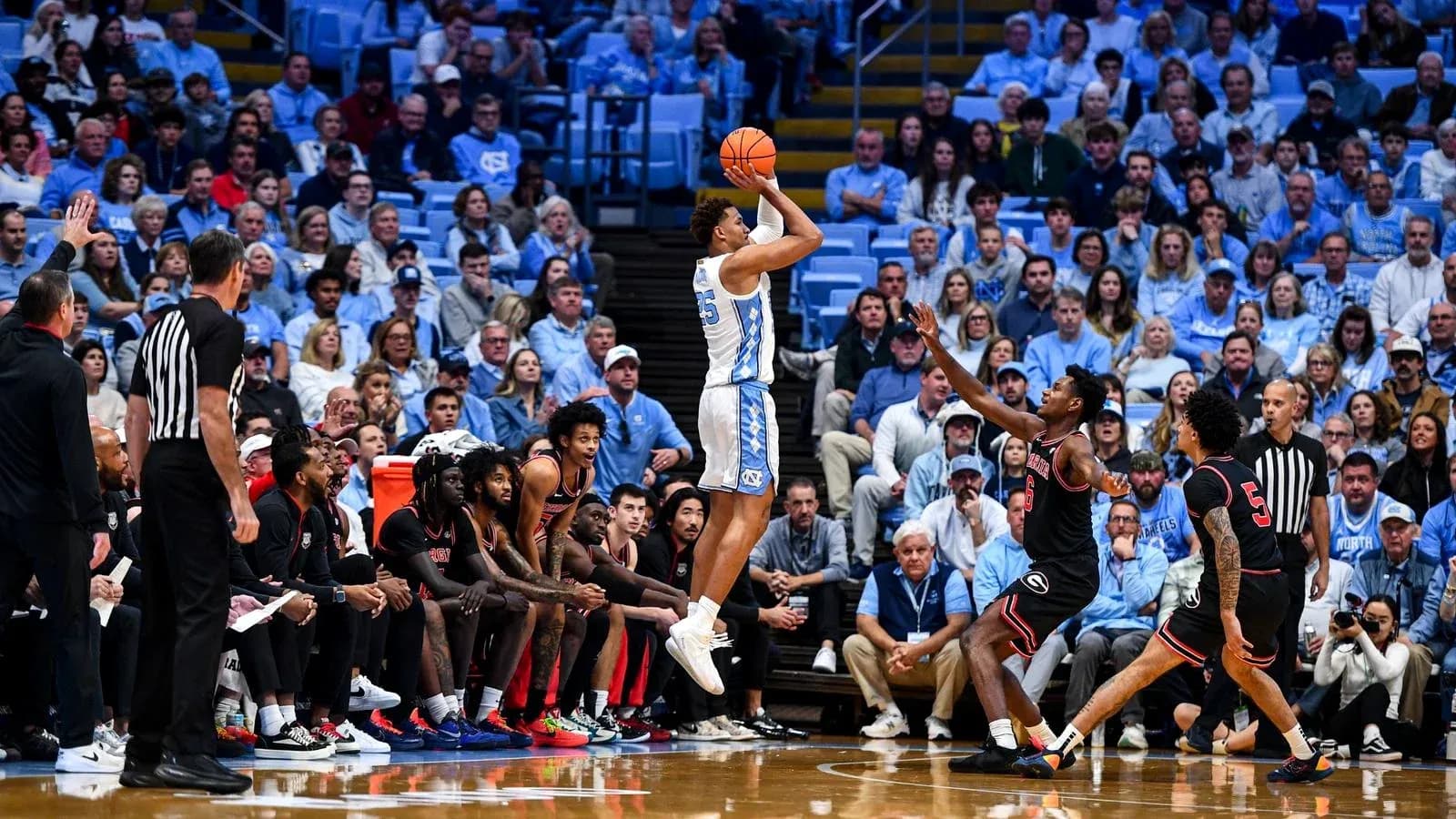
On a night that should have stretched a home winning streak to 22, Carolina instead watched Georgia walk out with a 78–70 win and most of the loose balls that mattered. The Tar Heels led by three with five minutes left, had a clean look to stretch it to six, and missed. From there, the game turned sharply and never came back.
Georgia closed like a veteran NCAA Tournament team. Carolina closed like one still trying to figure out what it wants to be.
A lead, an open look, and a collapse
That missed three with five minutes remaining felt like a hinge point. Up three, the Smith Center on edge, the shot in rhythm. Miss.
From that possession on, Carolina went 3-for-11 from the field. Georgia, by contrast, either scored or chased down the offensive rebound on almost every trip. The Bulldogs didn’t just answer; they suffocated.
The final three minutes became a rebounding clinic in all the wrong ways for the home side. Georgia turned second chances into a key field goal and two more free throws, exactly the kind of gritty points that decide tight games. By the end of it, the visitors had 18 offensive rebounds and squeezed 15 second-chance points out of them—13 of those after halftime. They won the overall battle on the glass, 52–43, and they won the game in the process.
Living – and dying – by the three
Carolina’s offense never found a reliable Plan B.
The Tar Heels launched a school-record 38 three-pointers. Some came in late-game scramble mode, but a large chunk arrived while the outcome still hung in the balance. They made only nine. That’s 23.7 percent from deep on a night when the perimeter became their default option rather than their complement.
The numbers inside the arc offered no rescue. Carolina went 15-for-35 on two-point attempts, missed a string of finishes at the rim and closed at 32.9 percent shooting overall. When the threes weren’t dropping, there was no consistent counterpunch—no steady midrange game, no dominant interior presence, no stretch of ruthless drives to the basket.
The one place they did generate dependable offense was the free throw line. Carolina went 13-for-19 overall, but even that well slowed after the break, with just 5-for-7 in the second half. Sayon Keita, Alex Samodurov and Jarin Stevenson combined for only one free throw attempt, a stark number for frontcourt players in a game that begged for physicality.
Brown shines, then disappears
Terrence Brown did everything he could to drag UNC through the second half. For long stretches, he was the one Tar Heel who looked entirely comfortable with the moment.
Brown poured in a team-high 21 points, knocked down four three-pointers and constantly threatened to knife into the lane and draw contact. He also drew a team-best five fouls, the kind of aggressive, attacking performance that Carolina desperately needed.
Then, just when the game tightened, his influence vanished. Brown did not take a shot in the final 5:17. As Georgia surged and Carolina’s offense constricted, their most effective scorer became a spectator.
Adams rebounds, finishing fails
Michael Malone searched for answers in the closing minutes and turned to freshman Maximo Adams in place of Stevenson. It was a nod to one thing Carolina did consistently well: let Adams chase the ball.
The Chapel Hill native’s shot again deserted him—he finished 1-for-8 from the field, 0-for-3 from three—but he grabbed 11 rebounds, underscoring his status as Carolina’s most reliable presence on the glass. Stevenson, meanwhile, went 2-for-7 and 0-for-3 from deep but did collect seven boards.
Malone will leave the arena stewing over the missed chances around the rim. The Tar Heels had multiple opportunities to finish plays in tight and simply did not convert. On a night when the perimeter betrayed them, those blown layups and short attempts carried extra weight.
A brutal end to a brutal half
The damage started well before the final five minutes. Georgia’s 9–0 run to close the first half turned an already uneven performance into something historically poor.
Carolina trudged into the locker room having shot 9-for-36 from the field in the opening 20 minutes, including 5-for-20 from three. That 25 percent mark from the floor tied the third-worst shooting half in Smith Center history, which now spans 601 games. The building has seen some bad nights. This one joined the list.
Ironically, the game began with the kind of defensive burst that usually fuels Carolina basketball. Georgia had protected the ball impressively in starting 3–0, but the Tar Heels forced turnovers on the Bulldogs’ first three possessions. Those giveaways became some of Carolina’s best offense in the first half.
UNC turned eight Georgia turnovers into seven points before the break and finished with 12 points off 12 Bulldog miscues. A few of those transition chances helped build a nine-point lead with 10:35 left in the first half. Then the pressure evaporated. Carolina did not force a single turnover in the final 9:38 of the game, allowing Georgia to run its sets, crash the boards and dictate the final act.
Old opponent, new questions
This was the first meeting between Carolina and Georgia since November 1998, a gap that felt almost surreal given the programs’ profiles. The next one won’t take as long; the teams are set to meet again in Athens in November or December of 2028.
By then, this loss will be a line in a media guide. Right now, it stings a lot more than that.
The defeat snaps a 21-game Smith Center winning streak and leaves Malone with a full week to sift through what went wrong before Marshall arrives next Friday. Two home games in four days—Marshall on Nov. 20, then King Rice’s Monmouth on Nov. 23—will test how quickly this group can respond.
The message is simple enough. If Carolina doesn’t rebound with more authority and find an identity when the three-point shots don’t fall, this won’t be the last time a winnable night in the Smith Center slips away.