
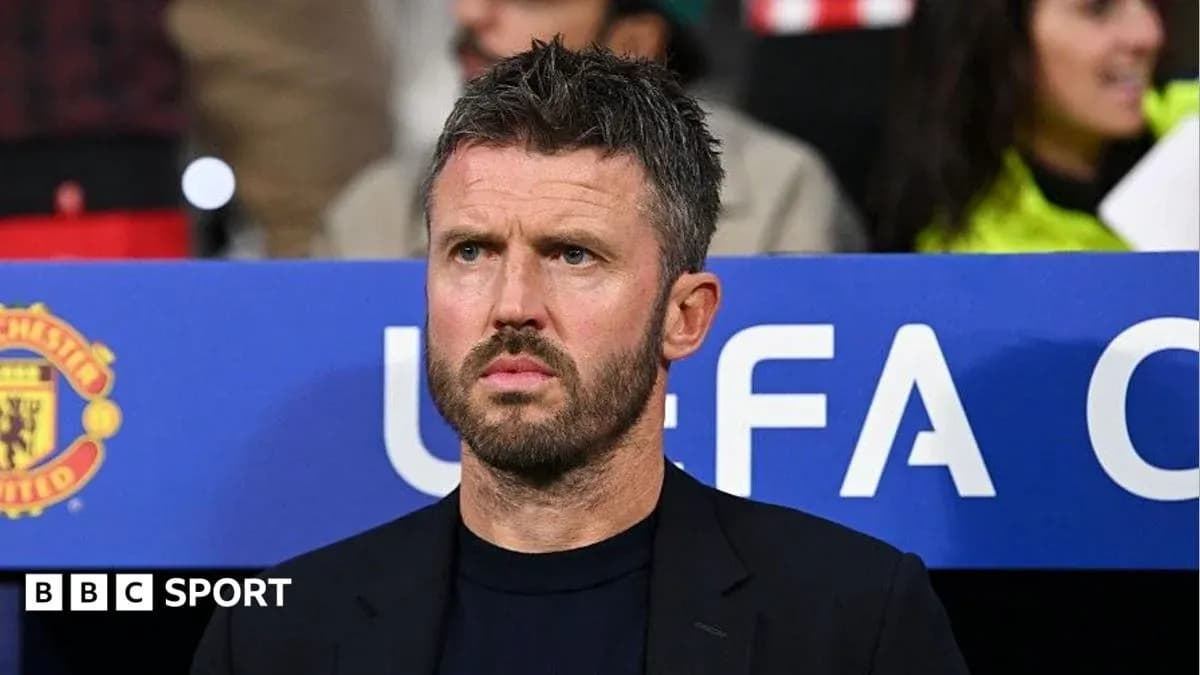
Michael Carrick's Press Conference: A Call for Manchester United's Identity
Michael Carrick walked into the press room at Carrington on Friday and made it clear this would not be business as usual.
Under severe pressure after a winless run stretching to seven games and a 4-1 humiliation by Como in the Champions League, the Manchester United manager did not wait for a first question. He took the floor himself, spoke for five and a half minutes, and tried to seize back control of a club drifting badly on and off the pitch.
This was not damage limitation. It was a plea, a warning and a reminder of what he believes Manchester United should be.
Carrick’s stand
“Recently we haven't had a good time, I think that's pretty obvious,” he began, his tone matching the bleak reality. “Wednesday was a bad night, and it hurt me to see us play like that. It was unacceptable.”
The words were sharp, the delivery emotional. Carrick framed the Como defeat not as a one-off collapse but as evidence United had strayed from their identity.
“My responsibility is to get a team on the pitch that represents this football club, and the supporters, and they can be proud of in the identity we show. We have gone away from that recently. It's important we all recognise that.”
This was the heart of his message. Results matter, but so does what United look like while chasing them. He spoke of foundations and values “etched for many years”, of resilience he insists still runs through the club.
“I've seen it with my own eyes, I've felt it, I'm know some of the individuals closely who have been a big part of that history,” he said, leaning heavily on the idea that standards were built, not gifted.
Then came the line that cut through the room.
“Entitlement cannot be at this football club.
“It was based on being humble, having humility, and hard work. We can never lose that, and I won't let us lose that.”
This was Carrick drawing a line in the sand. Against performances. Against attitudes. Potentially even against some of his most senior players.
The Bruno question
Inevitably, the focus turned to Bruno Fernandes.
The captain had already gone public with his own frustration in Italy, criticising tactics after the Como defeat. Defender Lisandro Martinez had taken aim at the club’s hierarchy. The noise around United was no longer just external.
Club sources insisted on Thursday that Fernandes would not be stripped of the armband or fined for his comments. Yet when Carrick was asked directly if he had considered dropping his skipper for Sunday’s Premier League game against Bournemouth at Old Trafford, he left the door wide open.
“The most important thing for me is the team, the squad and dynamics in the squad,” he said, notably firm. “It's about the football club. I'll always do what is best for the football club.”
No reassurance. No public backing. No guarantee that Fernandes starts.
Pressed again on whether he might remove the captaincy from the 32-year-old, Carrick did not budge from that line.
“I will always do what is best for the football club.”
He would not reveal whether he had spoken to Fernandes about his outburst.
“I don't think this is the time to go into too much detail,” he said, shutting down that thread but not the sense of tension.
The backdrop to it all is Fernandes’ own view of where United stand. Speaking to Sky Italia on Wednesday night, the Portugal international had challenged what he sees as an unhealthy obsession with the past.
“At this club, there's too much focus on what's been done in the past,” he said. “But we're not those people anymore. The club and the players need to understand that.
“Unfortunately for us - especially when it comes to the players - those who join expect to win trophies, win games, and reach the highest level, that's been very difficult at this club in recent years.”
In one corner, a manager leaning hard on history, values and tradition. In the other, his captain warning against living in the shadow of it. The contrast could hardly be starker.
Whether Carrick had seen or heard those specific remarks before he spoke on Friday remained unclear. His answers suggested he knew enough.
Dressing room under scrutiny
With senior players questioning tactics and direction, the next accusation is always the same: the dressing room has turned.
Carrick rejected that outright.
No, it's not,” he said when asked if the squad was split. “We just need to get back to doing what we do best.”
He did not elaborate on what that “best” currently looks like. The league table, the form, and that collapse in Como all say United are a long way from it. Yet Carrick continues to lean on the idea that the club’s core strength — that deep resilience he keeps referencing — can still be revived.
The manager also made a point of addressing a very different concern around his captain. Fernandes’ Cheshire home was burgled on Wednesday, adding a personal ordeal to a turbulent week.
Carrick said United were “doing everything” to support the midfielder and his family.
“Thankfully they weren't directly affected even though it is an awful situation,” he added.
It was a reminder that the storm around United is not just tactical and not just political. There are human lives being shaken in the middle of it.
A defining weekend
So Carrick goes into Sunday’s meeting with Bournemouth fighting on several fronts: to stop a slide on the pitch, to steady a fractured narrative off it, and to reassert what he believes Manchester United should stand for.
He has invoked the club’s past, its values, its resilience. His captain has warned against being chained to former glories. Somewhere between those two positions, United’s immediate future will be decided.
And if Carrick really means what he says about doing only what is best for the club, his next teamsheet — with or without Bruno Fernandes — will tell its own story.





