
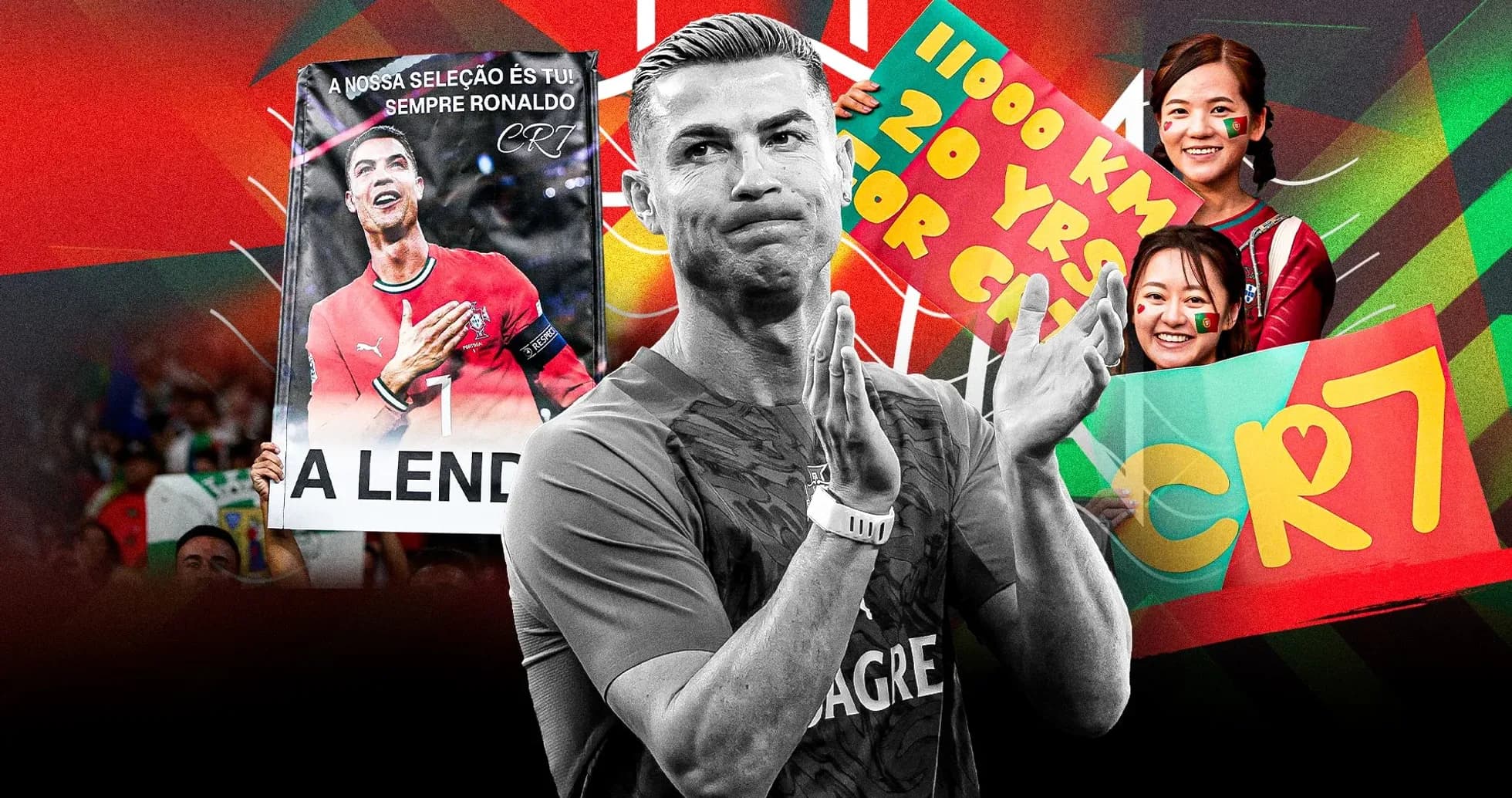
Cristiano Ronaldo's Impact on Portuguese Football and Future Prospects
Cristiano Ronaldo has never been shy about calling his own shots, but even he was ready to walk away from international football after this year’s World Cup. Decision made, mind set, legacy intact. Then came the flight home from the United States and a quiet intervention from FPF president Pedro Proenca, who convinced him to stay. One conversation at 30,000 feet kept the most marketable footballer on earth in a Portugal shirt.
On the pitch, though, the picture was already painfully clear.
For a third straight major tournament, Portugal’s players had strained around an immobile centre-forward. The team ran, pressed, combined. Ronaldo did not. From a purely sporting perspective, he had become a burden, a static focal point in a game that no longer tolerates passengers. From a financial perspective, he remained untouchable.
Proenca gave the game away last month at an FPF event. While publicly urging Ronaldo to continue, he called the Al-Nassr striker “the greatest asset” Portuguese football had ever produced. The word jarred, but it fit. At 39, Ronaldo was no longer the best option in the starting XI. He was still, by some distance, Portugal’s most valuable player.
Because Ronaldo is not just a footballer. He is a one-man industry.
Juventus did not sign him in 2018 simply for goals. They signed a global brand. Within 24 hours of his move to Turin being confirmed, the club’s online following swelled by 2.2 million. That is not a fanbase; that is a market.
Football finance author Marco Bellinazzo summed it up neatly: “The Ronaldo Effect is very real. It’s there for all to see.” Any club or federation with serious commercial ambitions needs a global icon. Ronaldo delivered exactly that, opening doors in North America, Asia and beyond, where sponsors care as much about reach and clicks as they do about trophies.
The numbers that followed his arrival at the Allianz Stadium told the same story. Six months after he landed in Turin, Juventus doubled the value of their kit deal with adidas, signing a seven-year agreement worth €357 million. By November 2019, they had also extended their partnership with JEEP, adding €25m per year to that contract. Ronaldo’s goals mattered, but his presence on billboards and timelines mattered just as much.
In the age of influencers, football found the ultimate one. Players followed him to Saudi Arabia too. Within months of his shock move to Al-Nassr in 2022, Karim Benzema and Neymar had joined the Saudi Pro League, drawn to the same gold rush and spotlight.
Portugal have surfed that wave for two decades. Their captain was not just a star; he was arguably the most recognisable face on the planet. Sports marketing expert Daniel Sa captured the scale of it after the World Cup, telling Lusa that, from a brand perspective, Ronaldo dwarfed the Portuguese national team and “countless others combined”.
His warning was stark. When Ronaldo goes, the media glare goes with him. “We’ll be falling down a high-speed escalator,” he said. For over 20 years, Ronaldo’s image has underpinned contracts, sponsorships and appearance fees. He turned a small country’s national team into a global billboard.
So when he finally announced his international retirement, the reaction from the business side of the game bordered on grief. Sa told EFE that Portugal were not just losing an extraordinary player, but “the greatest international amplifier of the Portugal brand”. In commercial terms, Ronaldo is irreplaceable. No academy graduate, no matter how gifted, can reproduce that scale of attention.
On the grass, though? That is a very different conversation.
It sounds counterintuitive when you are talking about the most prolific scorer in the history of international football, but the early signs suggest Portugal may actually find it easier to breathe without him. The attack, freed from the gravitational pull of one man, already looks lighter, sharper, more modern.
Goncalo Ramos is not Ronaldo. Nobody is. Yet from the moment he exploded into the 2022 World Cup with a hat-trick against Switzerland – on the night he took the former captain’s place in the starting XI – he showed he could lead the line with a very different energy.
The circumstances of Ronaldo’s eventual exit only increased the scrutiny. The pressure on Ramos, now at AC Milan, is enormous. All eyes were on him in last month’s games against Denmark and Norway. He scored in both. Three goals in three consecutive starts, four in his last five caps. Those numbers throw a harsh light on the fact he played just 34 minutes at that World Cup while Ronaldo laboured on as the undroppable No.9.
Yet this new era is not just about how often Ramos scores. It is about how he moves.
He stretches defences. He presses. He drags centre-backs into places they do not want to go. That is why, when readers of Portuguese daily A Bola were asked to select their preferred XI for last month’s match against Wales, they chose Ramos ahead of Ronaldo. Not out of disrespect, but out of recognition that the team functions differently – and better – with a striker who runs.
For years, Portugal’s wide players and midfielders operated with a built-in handicap. They had pace and craft on the flanks, guile and control in the middle, but a centre-forward whose movement no longer matched the demands of the modern game. The balance tilted towards one man’s legend, not the collective’s potential.
That spell has finally broken.
There is no guarantee this “golden generation” will turn promise into silverware. Talent does not automatically translate into trophies. But their chances improve with a forward in his mid-20s, not one in his early 40s. The pressing is cleaner, the transitions quicker, the options richer.
None of this erases what came before. Ronaldo’s contribution to Portuguese football cannot be rewritten or reduced. They made history together: record-breaking goals, a European Championship, a Nations League, nights that changed how the world viewed Portuguese football. His goals will be missed. So will his magnetism.
It is also true that the Seleccao may never again be as globally popular – or as profitable – as they were in the Ronaldo era. The brand will shrink. The team, though, is already growing into the space he has left behind.
Portugal are losing their greatest amplifier. They might just be gaining their best version of themselves.





