
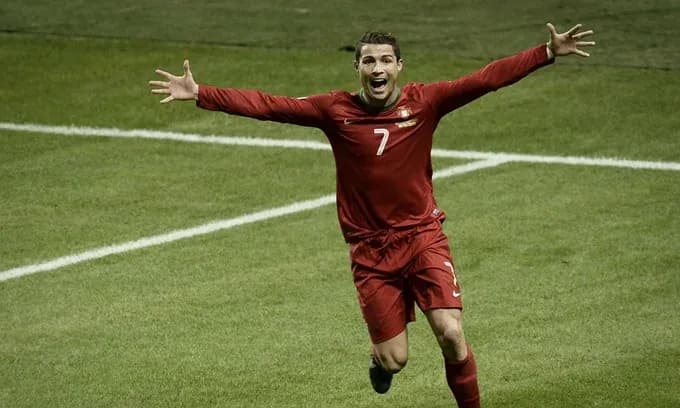
Cristiano Ronaldo: A Two-Decade Journey Redefining Portugal
On August 20, 2003, in a low-key friendly against Kazakhstan, an 18-year-old winger with bleached tips and impossible self-belief pulled on Portugal’s shirt for the first time. Cristiano Ronaldo had just swapped Sporting for Manchester United. Luiz Felipe Scolari still had Luís Figo and the old guard. This was supposed to be a gentle introduction.
It never stayed gentle with Ronaldo for long.
Within a year, he was at the heart of a home European Championship that felt like destiny. Euro 2004 opened with Greece as the supposed underdogs and Portugal as the hosts, the hope, the story. Ronaldo came off the bench, rose in stoppage time and powered in a header – his first goal for the national team. The stadium roared. The scoreboard didn’t care. Greece still won 2–1.
The kid kept coming.
Portugal pushed on, and in the semifinal against the Netherlands, it was Ronaldo who broke the deadlock, steering his country into their first major final. Lisbon crackled with belief. One more step, on home soil, to a first major title.
Greece ripped up the script again. A 1–0 defeat, a stunned stadium, and Ronaldo in tears on the pitch – a teenager’s heartbreak frozen in one of the defining images of his early career. The world saw a prodigy crying. Portugal saw the start of a long, complicated love story.
Dragging Portugal to Brazil
Fast forward nearly a decade. The boy had become the global superstar, but the stakes with Portugal had only grown heavier. Failing to qualify directly for the 2014 World Cup, they were thrown into a playoff with Sweden – Ronaldo against Zlatan Ibrahimovic, two egos, two empires, one ticket to Brazil.
In Lisbon, Ronaldo settled the first leg with a crisp, decisive strike. Advantage Portugal, but nothing secure.
In Solna, the night went wild.
Ronaldo opened the scoring after the break, seemingly putting the tie to bed. Ibrahimovic refused to accept the script, thundering in two goals to flip the game to 2–1 Sweden and turn the stadium into a cauldron. Suddenly, the World Cup looked far away again.
Then came the response that defined him.
Space in behind. Acceleration. Finish. 2–2 on the night, Portugal ahead on aggregate. Minutes later, another break, another ruthless strike. Hat-trick complete, 3–2 Portugal, Sweden silenced. Across two legs, Portugal scored four goals. Every single one belonged to Ronaldo.
He didn’t just carry them to Brazil. He dragged them there.
From Lisbon’s tears to Parisian redemption
Euro 2016 began like a bad joke for a team that had grown used to suffering. Three group games, three draws. Portugal never looked convincing, always looked vulnerable. But when the chaos rose, Ronaldo stepped into it.
Against Hungary, Portugal trailed three times. Each time, the tension spiked. Ronaldo responded with two goals – one a deft flick, the other a clean, driven finish – to haul his team to a 3–3 draw and keep them alive. It wasn’t pretty. It was survival.
The campaign gathered pace. In the semifinal against Wales, he climbed above everyone to head Portugal into the lead, a familiar sight by now. From there, they controlled the game and walked into another final, this time against hosts France in Paris.
The narrative felt familiar: Ronaldo, the talisman, the man for the moment. Instead, the final twisted in a different direction. A heavy challenge, a knee that wouldn’t cooperate, and by the 25th minute, Ronaldo was on the turf, tears streaming down his face as he left the pitch on a stretcher.
The captain was gone. The team stayed.
Portugal dug in, refused to be overrun, and dragged the game into extra time. Then Eder, a striker few expected to write history, stepped up from distance and lashed in a stunning winner. Portugal had their first major international trophy. The boy who cried in 2004 now returned to the touchline as a one-man technical area, urging, shouting, living every second.
When the final whistle went, it was Ronaldo who lifted the trophy high, the pain of Lisbon finally washed away in Parisian night air. Portugal were champions of Europe. The scars had found their answer.
Sochi, Spain, and a 33-year-old still rewriting limits
By the time the 2018 World Cup arrived, Portugal were reigning European champions, and Ronaldo was 33 – an age when most forwards start to slow, if not fade. He chose another path.
In Sochi, against Spain in one of the tournament’s glamour fixtures, he seized the stage in four minutes. A burst into the box, a foul drawn, a penalty won. He buried it himself. One chance, one goal.
On the stroke of halftime, he struck again. A low drive that David de Gea failed to handle turned a half-chance into a second goal. Portugal led, Spain wobbled, and the World Cup had its first epic.
Spain responded like champions, turning 1–2 into 3–2. Time ebbed away. Then Ronaldo stood over a free kick in the 88th minute, 25 yards out, the game slipping away.
He curled it over the wall and into the top corner with surgical precision. Hat-trick complete. 3–3. A classic secured.
At 33, he became the oldest player to score a World Cup hat-trick. It felt less like a statistic and more like a statement: the clock might tick, but he wasn’t done bending it.
Benched in Qatar, and the hardest role of all
Qatar 2022 opened with another record. Ronaldo scored in his fifth World Cup, the first male player ever to do so. The milestone should have been a celebration. Instead, it became the prelude to one of the most jarring chapters of his international life.
Fernando Santos, frustrated by Ronaldo’s reaction to being substituted in the group stage, made a brutal call before the Round of 16 against Switzerland. The captain was dropped. Goncalo Ramos started.
The gamble paid off in the most emphatic way. Ramos scored a hat-trick in a 6–1 demolition, while Ronaldo entered only in the closing stages, reduced to a supporting role in a show he once owned.
Santos stayed firm for the quarter-final against Morocco. Again, Ronaldo began on the bench. Again, he came on early in the second half, this time chasing a game that had tilted away from Portugal. Morocco held their ground, defended with ferocity, and closed out a 1–0 win.
When the final whistle blew, Ronaldo walked off in tears once more, this time not as the young prodigy or the injured captain, but as the aging legend forced to watch his World Cup dream fade from the sidelines.
Nations League glory and a mountain of records
The story didn’t end there. With Portugal, it rarely did.
In 2019, the newly created UEFA Nations League offered a different kind of stage. Ronaldo treated it like any other. In the semifinal against Switzerland, he produced yet another hat-trick, a ruthless reminder that he still lived for nights when everything depended on him. Portugal then edged the Netherlands 1–0 in the final to become the competition’s first champions. Another trophy, another line in a bulging résumé.
The goals kept coming, and with them, history. In September 2021, against Ireland, he scored twice late on to turn a looming defeat into a 2–1 win and, in the process, overtook Ali Daei’s longstanding mark of 109 international goals. Ronaldo became the all-time leading scorer in men’s international football, a record that felt almost inevitable yet still staggering in scale.
The timeline stretched even further. Six years after that first Nations League triumph, at 40, he was still there in another final, this time against Spain in 2025. With Portugal trailing, he struck in the 61st minute to level the game at 2–2. The contest went to penalties, and Portugal emerged as champions again. A second Nations League title, a reminder that his influence had outlasted generations.
The sixth World Cup, and a fractured farewell
By 2026, Ronaldo had become a constant of the World Cup. His sixth appearance set another record. When he scored, he became the first player to find the net in six different World Cups. No one had ever stretched their relevance on this stage so far.
Yet the one thing he wanted most remained out of reach. Portugal fell 1–0 to Spain in the Round of 16. Another World Cup ended without the trophy in his hands, the one gap in an international career otherwise stuffed with firsts and finals.
The months that followed were anything but serene. A clash with head coach Jorge Jesus turned the final chapter into a storm. Ronaldo left a September training camp early and went public with accusations of broken promises. For a player who had spent two decades as the emotional axis of the national team, it was a jarring, raw split.
On November 5, he chose his own ending. In a video message, he announced his retirement from international football, speaking of the honor and burden of wearing Portugal’s No. 7 for 23 years and acknowledging that it was time to pass the torch.
The numbers he left behind barely seem real: 234 appearances, 146 goals, world records in both categories for men’s international football. One European Championship. Two Nations League titles. A lifetime of nights when he seemed to bend games to his will – and a World Cup dream that never quite came home.
Portugal now moves on without the player who turned their jersey into a global symbol. The question that lingers is simple, and impossibly heavy: how do you follow an era that felt like a once-in-a-century event?





