Dwyane Wade's Transformation: Listening to Change in the NBA
Dwyane Wade has heard it all in NBA locker rooms. The jabs, the casual slurs, the punchlines that bounce off walls lined with championship banners. For years, it was just part of the background noise of a “masculine, toxic environment,” as he now calls it.
Then his daughter Zaya came out as a trans woman. The noise stopped sounding like jokes.
Wade recently opened up about how that shift in his personal life collided with the culture of the league he helped define, and how it forced him to listen differently to the place where players are supposed to feel most at ease.
“Long story short, when everything happened publicly… with Zaya, before we came out and talked about Zaya, obviously, you know, in the locker rooms, I started to like become a little different because I started listening a little bit differently,” Wade said. “And I, you know, I realized that masculine, you know, toxic environment that, you know, that we that we grew up in.”
The words around him hadn’t changed. He had.
Suddenly, the offhand remarks about the LGBTQ community weren’t just generic, faceless targets. They brushed directly against his daughter’s identity, her safety, her dignity. Where he once might have laughed along, he started going quiet. Where he once might have stayed in the circle, he began walking out of the room.
The conflict wasn’t a shouting match or a dramatic confrontation. It was internal at first — a Hall of Famer, the greatest player in Miami Heat history, feeling out of place in a space he had long ruled.
Wade’s evolution came against the backdrop of an NBA that has never had an active player come out during his career. Jason Collins made history by coming out, but only after he had already stepped away from the league, a decision shaped in part by the same culture Wade was now questioning from the inside.
A Quiet Shift, Noticed by a Brother
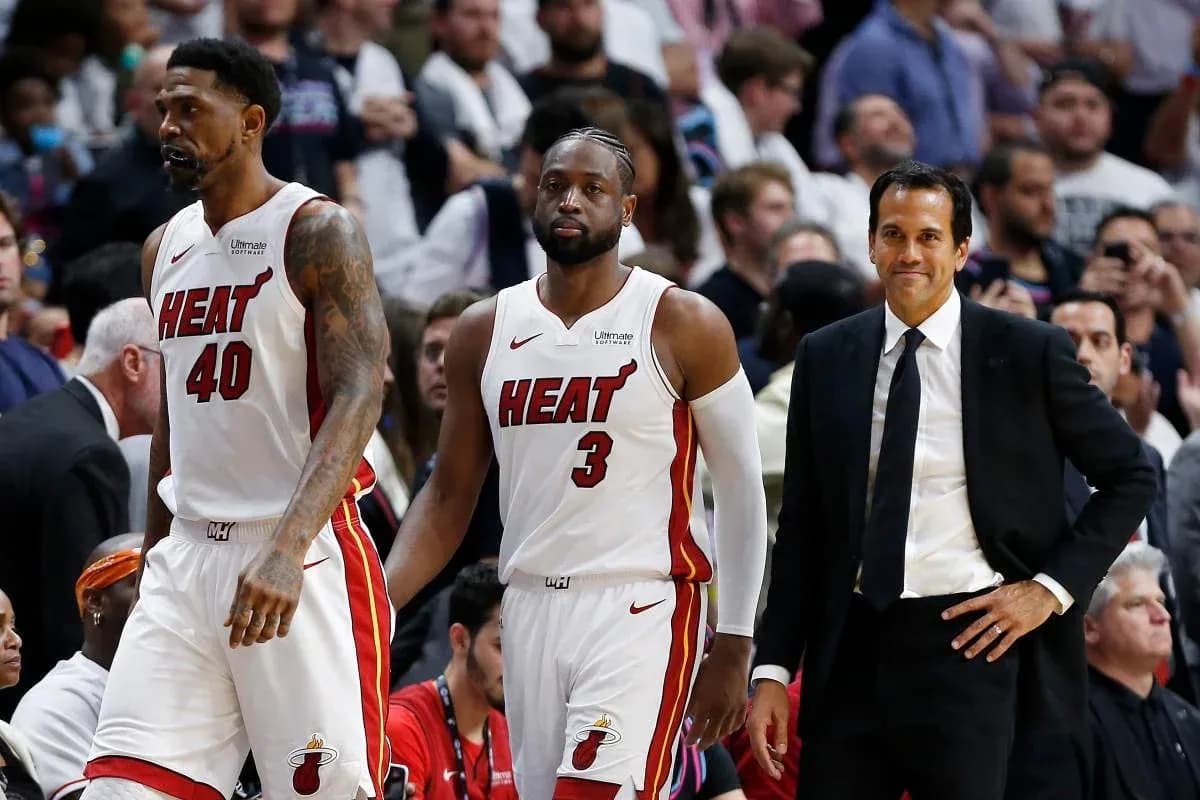
In Miami, if there was one player who could read Wade without a word, it was Udonis Haslem. The two spent well over a decade together, the heartbeat of a franchise defined by Pat Riley’s ruthlessness and Erik Spoelstra’s precision. “Heat culture” might be a buzz phrase now, but Wade and Haslem lived it before it had a name.
So when Wade stopped laughing, Haslem noticed.
“I remember having a conversation with UD because he seen that I was like I wasn’t in on the jokes no more,” Wade recalled. “I wasn’t laughing. I was leaving out of the locker room when I would hear certain things or whatever.”
The distance Wade was creating wasn’t about ego or status. It was about protection — of his daughter and of his own growing discomfort with language he once let slide.
“I had to sit and talk to him about it because, you know, just like I was at one point, he was in on the jokes at the same time. And this was my brother. And I started feeling a way about his uses of words and his uses of, you know, different communities.”
That conversation became the turning point.
Haslem didn’t push back, didn’t dig in, didn’t hide behind the old locker-room defense of “it’s just jokes.” He listened. He learned. He adjusted.
“And from that conversation that him and I had, like he didn’t know, right? He didn’t know,” Wade said. “And he eventually changed his thinking, his tone, his verbiage, and then his actions, right? And so like just the power of someone that he trusts to have a safe conversation with him in a safe environment.”
The change wasn’t about a public campaign or a viral moment. It was about one veteran looking another in the eye and explaining why certain words could no longer be shrugged off. It was about trust, built over years of playoff runs, practices, and shared sacrifices, now being used for something bigger than basketball.
Haslem’s response did more than make Wade feel comfortable. It reinforced what real leadership inside a team looks like: not just setting the standard for effort and toughness, but for respect.
Redefining “Heat Culture”
Miami is often held up as a model franchise, a place where details matter and excuses don’t. Riley’s presence looms large. Spoelstra’s system is relentless. The phrase “Heat culture” has become shorthand for accountability and edge.
Wade and Haslem added another layer to that identity — one that doesn’t fit neatly into a highlight reel.
Their private dialogue reflected a subtle but significant shift: that toughness doesn’t have to come at the expense of empathy, that a hard-nosed locker room can still be a safe one, and that growth inside that space can start with a single uncomfortable conversation.
Wade has since become one of the most visible allies of the LGBTQ community in sports, praised widely for the way he supports Zaya and uses his platform to challenge the norms he once accepted. This wasn’t some distant cause for him. It was his family. His child.
And when the culture of the NBA locker room finally collided with that reality, he chose not to look away.
The all-time great shooting guard helped Miami raise banners and build a reputation that stretches across the league. Now, long after his last game, he’s trying to influence something harder to measure: whether the next generation of players will walk into a locker room that sounds just a little different from the one he grew up in.