
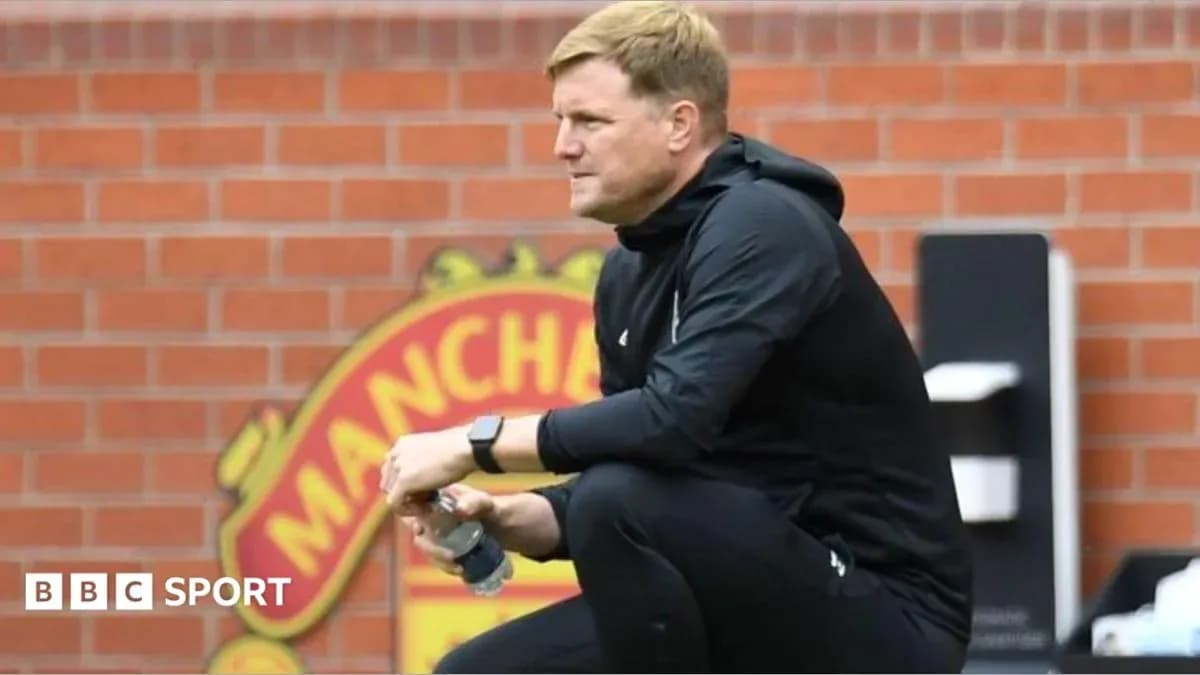
Eddie Howe: The Potential Next Manager of Manchester United
When Sir Jim Ratcliffe bought into Manchester United in early 2024, he sold a simple idea to a weary fanbase: strip the club back to a British core and rebuild from there. It sounded romantic, even logical, in an era of super-clubs stitched together from every corner of the globe.
Less than two years on, reality is biting.
Michael Carrick, the first permanent British managerial appointment of the Ineos era, is fighting for his job. Performances have sagged, results have followed, and the mood around Old Trafford has curdled again. The project that was meant to restore a sense of identity has instead raised an awkward question: if this is what “going British” looks like, is Ratcliffe ready to double down?
United’s hierarchy are already acting as if the answer might be yes.
Howe in the frame
If Carrick cannot arrest the slide – with Saturday’s home game against Chelsea looming large – the club have started to weigh up a familiar, and increasingly polarising, name: Eddie Howe.
On paper, his candidacy makes sense. Speak to players and staff who have worked with Howe and a consistent picture emerges. They talk about a coach obsessed with detail, a man who lives on the training pitch, chiselling away at individuals until they improve. They talk about his insistence on culture, about standards, about repetition until a team’s habits become muscle memory.
His CV backs that up. When Howe first took over Bournemouth in January 2009, they were staring down relegation from League Two. Six years later, he had them in the Premier League. Not briefly, not as tourists, but as a side that learned how to survive and then belong. He left, for the second time, in 2020 with the club having spent five seasons in the top flight – an extraordinary stretch for a club of that size.
Newcastle was a different kind of rescue job. Appointed in 2021 with the club in trouble near the foot of the Premier League, Howe dragged them away from danger and then accelerated. He took them into the Champions League twice and, in 2025, delivered the EFL Cup – Newcastle’s first major trophy in 56 years. That sort of drought-breaking moment tends to stick in the memory of executives looking for evidence a manager can handle pressure.
Yet Old Trafford is not Tyneside, and it is not the south coast. The scale is different. So is the scrutiny.
A divided audience
As Howe’s name has moved closer to the surface, the reaction has grown louder – and not always kind.
A portion of United’s fanbase has already made its feelings clear on social media: Howe, they argue, is not a big enough name to manage Manchester United. For a club that once built its identity on discovering the next great manager rather than buying the most glamorous one, it is a striking shift in attitude.
Some of the club’s former players have not exactly rushed to his defence either. Paul Scholes and Nicky Butt stopped short of endorsing Howe on their podcast, a hesitation that did not go unnoticed. It is worth remembering, though, that the same pair spoke positively about the 48‑year‑old’s potential when Ruben Amorim was sacked in January. The context has changed. The manager in the firing line has not.
Others from United’s past see it differently. Former captain Roy Keane has publicly backed Howe as a serious contender to replace Carrick. Darren Bent, Gareth Barry and Jack Wilshere have all spoken about him as the right profile for the job: modern, demanding, proven at building sides rather than just inheriting them.
As always at United, opinion is a contact sport. Look hard enough and you will find someone to argue every angle. The decision will not be made on talk shows or timelines.
It will be made by Omar Berrada, Jason Wilcox and Christopher Vivell.
Power, politics and the bill
The first call belongs to Berrada, the chief executive, and it is brutally simple: stick with Carrick or cut. Saturday’s meeting with Chelsea could tilt that balance. Another bruising defeat might leave sentiment impossible to salvage.
If the axe falls, money enters the equation quickly. Carrick and his staff will have to be paid off before United even look at the cost of their next head coach. That matters at a club that has burned through managers, compensation packages and pay-offs at an astonishing rate since Sir Alex Ferguson retired.
Howe is not a free agent in the traditional sense either. When he left Newcastle in the summer, the two parties agreed a compensation structure designed to protect the club from seeing him walk straight into another dugout. Multiple sources have told BBC Sport that any club – or national team – appointing him would need to pay a seven-figure fee.
The structure is sliding. The initial figure is understood to have been £6m, but that has already halved. The current price sits at around £3m and will continue to drop until an agreed expiry date, thought to be before the end of the season. After that, Howe can be appointed without Newcastle receiving a penny.
In a sport where transfer fees routinely hit nine figures, paying up to £3m for a coach of Howe’s calibre should not be a deal-breaker. Yet context matters. Given how much United have already spent hiring and firing managers, it would be no surprise if Berrada and sporting director Wilcox were keen to keep this round of upheaval as lean as possible.
Which path do United choose?
Inside the football department, the debate has already begun to harden into preferences.
Wilcox, now director of football, is understood to favour Howe. He sees a coach whose methods align with a long-term plan, a builder rather than a quick-fix specialist. Director of recruitment Vivell leans another way, towards Julian Nagelsmann, the former Bayern Munich and Germany coach whose reputation rests on high-intensity, tactical innovation at the very top level.
Their recommendations will land on Berrada’s desk. From there, they move up again. Ratcliffe, as minority owner, and co-chairs Joel and Avram Glazer will have the final say. The choice they make – British builder or continental tactician, Premier League grafter or Champions League name – will say more about the club’s direction than any press release.
What is striking is how much resistance Howe faces in some quarters despite his record. It is not entirely clear where the negativity has come from, beyond a general frustration that has started to wrap itself around almost every football decision since Ratcliffe’s minority takeover.
Wilcox himself has become a lightning rod. During the 3-0 home defeat by Bournemouth, some United fans turned their anger towards the director of football, a visible symbol of the new regime in the stands while the team unravelled on the pitch. In that climate, any candidate associated with his vision is likely to be scrutinised harder.
A club caught between eras
Part of the problem is structural. Very few managers in the modern game get the time Sir Alex Ferguson enjoyed at Aberdeen before he crossed the border in November 1986. He arrived at United with a decade of hard-won experience shaping a club in his own image. Today, patience is measured in months, not years.
United’s matchgoing fans have watched a decade of churn. Different executives, different managers, different ideas. Ratcliffe’s arrival was supposed to bring clarity. Instead, the sense of disillusionment has deepened. Erik ten Hag was backed. Ruben Amorim was backed. Michael Carrick has been backed. Each time, the cycle has repeated: a new project, a burst of optimism, a slow fade into the same old questions.
There is a growing belief among some supporters that no manager can truly succeed at Old Trafford while the current structure remains. Any new coach must somehow fuse a squad assembled by six permanent managers, each with distinct styles and conflicting priorities. It is less a team than a collage.
This is the landscape Howe would walk into if United decide he is their man: a fractured squad, a restless fanbase, an ownership split between old and new power, and a club still wrestling with its own identity.
For Ratcliffe and his inner circle, the decision is no longer just about whether Eddie Howe is good enough for Manchester United. It is about what they want Manchester United to be – and how brave they are prepared to be in finding out.





