
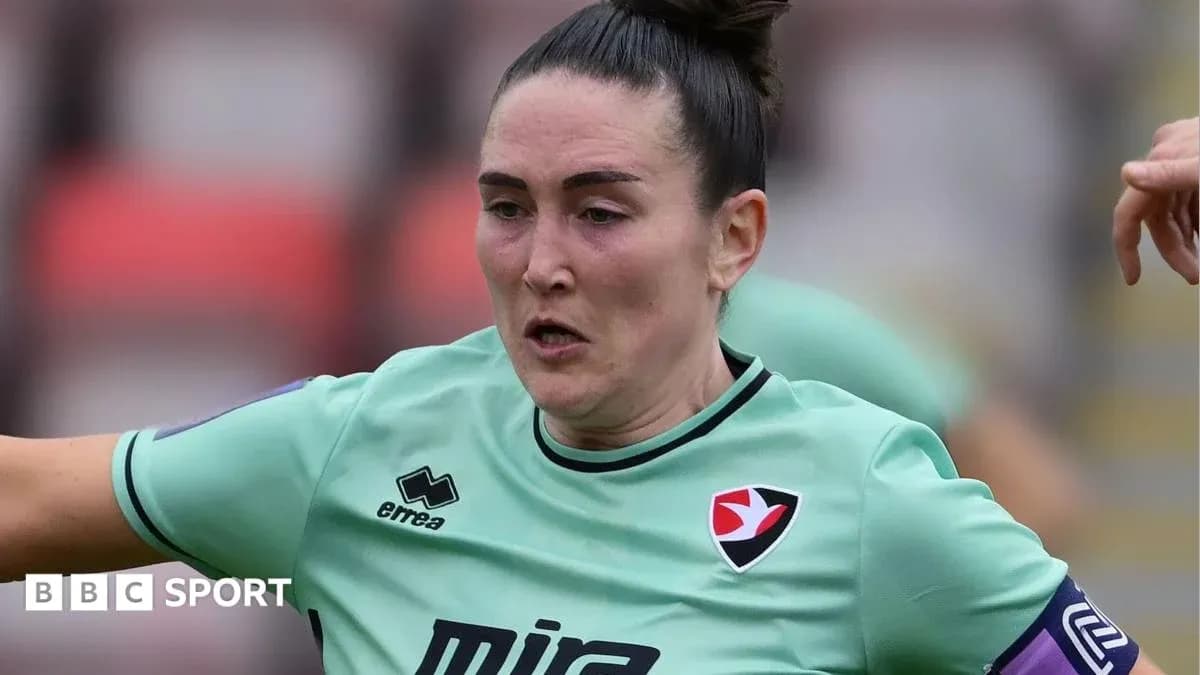
Emily Owen's Bold Exit from Cheltenham Town Women: A Call for Change
Emily Owen, the long-serving captain of Cheltenham Town Women, has launched a stinging attack on the club’s internal culture after announcing her departure, claiming one figure has created “a dictatorship where players feel psychologically unsafe”.
Owen, a central defender who spent four years at the club and made more than 130 appearances, confirmed on Monday she was leaving the Women’s National League Southern Premier side. At first, it looked like the usual farewell: a loyal servant moving on after a significant spell.
Then the tone changed.
After Cheltenham Town Women posted news of her exit on social media, Owen publicly challenged the narrative, insisting she was not simply moving on but walking away on principle. She said she left because of “a lack of an individual's principles and outright failures in processes”, adding that she “wanted to set the record straight” amid rumours about the reasons behind her departure.
In a strongly worded statement, Owen alleged that the power structure around the team had tipped dangerously in the wrong direction.
“One individual in particular has far too much control within this team, turning the environment into a dictatorship where players feel psychologically unsafe,” she said.
Her criticism did not stop there. Owen claimed that she was not alone in taking a stand, stating that three other players had already left the club “on moral grounds as boundaries were crossed, that shouldn't be crossed in women's football”.
The club, for now, is keeping its distance from the specifics. In response, Cheltenham Town Women issued a carefully framed statement stressing its commitment to player welfare but declining to engage with Owen’s individual allegations.
“Cheltenham Town Women are committed to ensuring that every player, member of staff and volunteer is treated with respect and feels safe, valued and supported within our environment,” a spokesperson said. “We will ensure that any concerns brought to our attention are treated appropriately, sensitively and in line with all relevant policies and procedures.”
No names, no direct rebuttal, no detail on any internal investigation. Just the promise that concerns will be handled through the proper channels.
For a club that has built a reputation as an ambitious presence in the women’s game, the accusations from a former captain cut deep. When a player with more than 130 appearances, a figurehead in the dressing room, walks away citing “moral grounds” and psychological safety, it raises questions that will not be answered by policy lines alone.
The next move belongs to Cheltenham Town Women: how they respond behind closed doors may define how the club is viewed in the women’s game for a long time to come.





