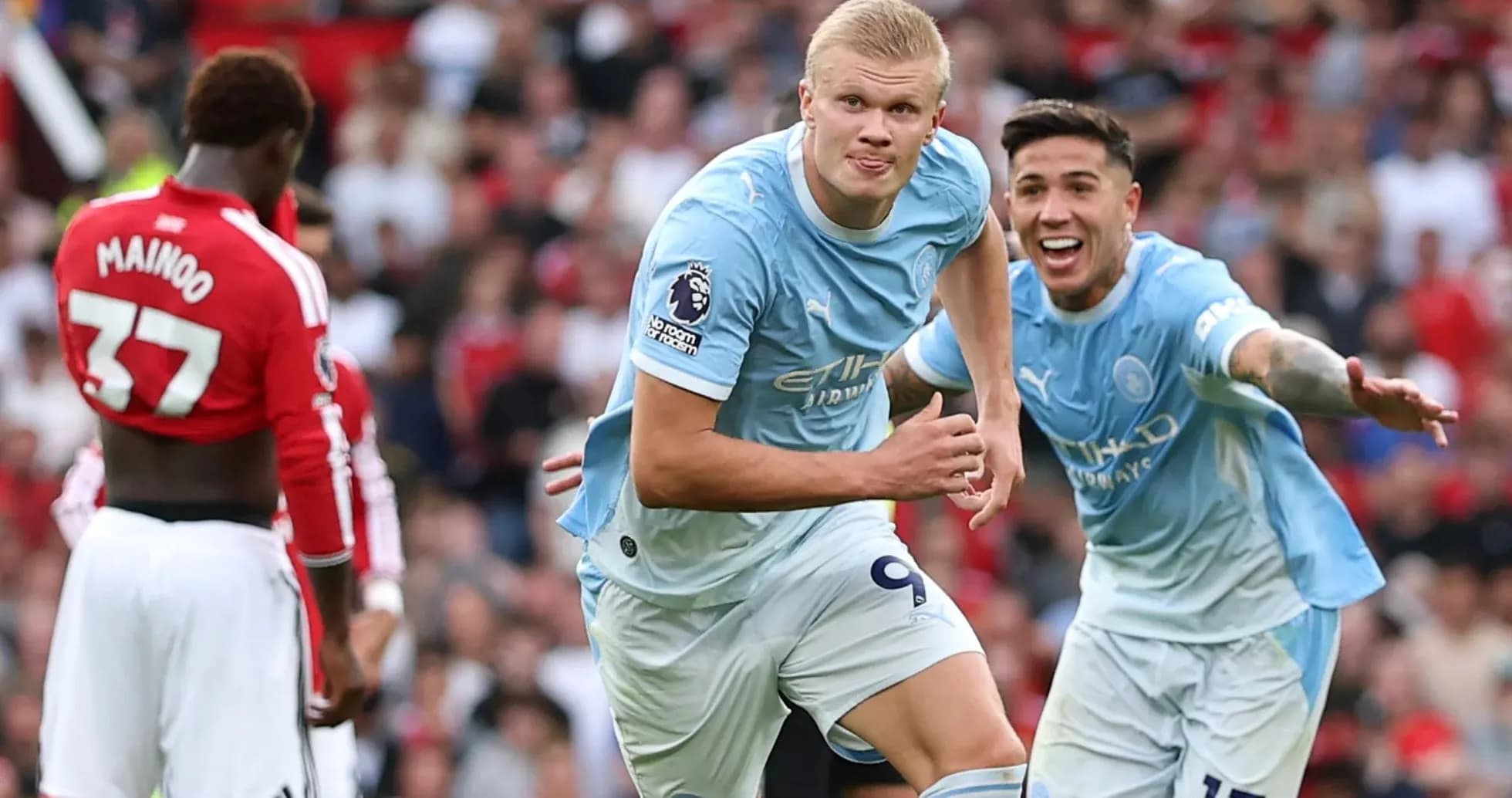
Erling Haaland's Controversial Derby Winner Sparks VAR Debate
Erling Haaland’s winner will live long in this derby – not for its beauty, but for the fury it unleashed.
On the hour, Manchester City’s No.9 did what he does better than almost anyone: exploded into space, took one touch, and lashed the ball into the roof of the net from a brutal angle. The Etihad roared, then fell silent. The assistant’s flag was up. Offside.
Seconds later, the mood flipped again.
VAR lines showed Patrick Dorgu’s outstretched boot had played Haaland onside as the United full-back diverted a low cross across his own six-yard box. The goal stood. City led. United seethed.
The confusion did not centre on Haaland. It centred on Enzo Fernandez.
City’s World Cup-winning midfielder had never bothered to get back onside. He drifted beyond United’s back line, the furthest player forward, and as the cross fizzed through the area he hurled himself at it, trying to make a diving header from six yards out. He missed the ball, but not the attention of Lisandro Martinez, who stepped towards him, leaving Haaland free to ghost in behind.
That was the crux: Fernandez didn’t touch it, but he clearly went for it. United argued he interfered with play. VAR did not.
The officials in the booth decided the goal should stand, judging that Fernandez’s action did not constitute an offside offence. On commentary duty for Sky Sports, Gary Neville watched the replays and immediately predicted what would follow: an apology, another high-profile admission of error in a marquee fixture.
He did not have to wait long.
Before that, though, came a blistering assessment from Michael Owen, speaking to GOAL ahead of his return to hosting ‘Match Officials Mic’d Up’ alongside referees chief Howard Webb. Owen has spent time inside the VAR hub, poring over incidents and listening to the process. He knows how messy it can be.
He also knows when something, in his view, is indefensible.
“I've sat in the VAR hub and gone through lots of decisions and it isn't easy. I mean it's 10 times harder than people think,” he said. “However, this was as straightforward as it gets really. I simply don't know how they can come to this decision.”
Owen revealed that the on-field call had been offside against Haaland, not Fernandez, and believes that initial flag skewed the subsequent check.
“What I do know is that the linesman gave offside for Haaland. So he gave offside for Haaland, I know that for a fact. So that can only have distorted their view in terms of they think, ‘right well we've got to check for Haaland, let's draw the lines, oh my word he's onside’.”
The anger sharpened when he turned to Fernandez’s role.
“But how they can't check, or if they do check, how they can't pull it up for an offside from Fernandez - he clearly makes a movement towards the ball. What movement is more obvious than a diving header! It's not a case of has he tried to touch that or not? He's flung himself for a diving header. It absolutely beggars belief. It doesn't get any more straightforward in my eyes.”
On the touchline, Michael Carrick saw his team fight with 11 men for barely half an hour. Phil Foden’s early dismissal for what was deemed a kick into the stomach of Bruno Fernandes had handed United a numerical advantage with more than 65 minutes left. They still walked away with nothing.
For a manager trying to build momentum in the opening weeks of the season, the sense of injustice cut deep.
“I can't understand how we are trying to help referees - putting so many layers behind them, so many people, so many bodies, so many screens and so many offices, to try to come up with the right decisions,” Carrick said after the 1-0 defeat.
“And if that's how the rule is interpreted, that you're not interfering with play because you have thrown yourself at the ball six yards from goal and pretty much nearly touched it, it's worrying if that's how the game is seen by those who are officiating it.”
Neville’s prediction landed late in the evening. Pro Ref issued a statement, and with it, a quiet admission that United’s anger had a foundation.
“It was established that Enzo Fernandez did not play the ball and therefore that makes any offside offence subjective, however, on this occasion, the VAR did not recognise the likely impact of his position and should have recommended an on-field review.
“Contact has been made with Manchester United this evening to acknowledge what we deem is an error of judgement. A review of the incident will take place.”
For United, it was a hollow comfort. The points were already in City’s pocket, the Haaland goal already inked into the record, the red card to Foden already a footnote to a controversy that swallowed the rest of the narrative.
This is not an isolated flashpoint. The season is barely weeks old and VAR has already muscled its way to the forefront of too many post-match debates. The technology that arrived promising clarity and calm now drags the game into fresh storms whenever interpretation collides with common sense.
Owen is far from alone in demanding something cleaner, sharper, more consistent. The question is no longer whether VAR can spot a boot playing someone onside.
It is whether the people using it can read the game in the way footballers, managers and supporters instinctively do – before the next title race, cup run or relegation battle swings on a decision that “absolutely beggars belief.”