
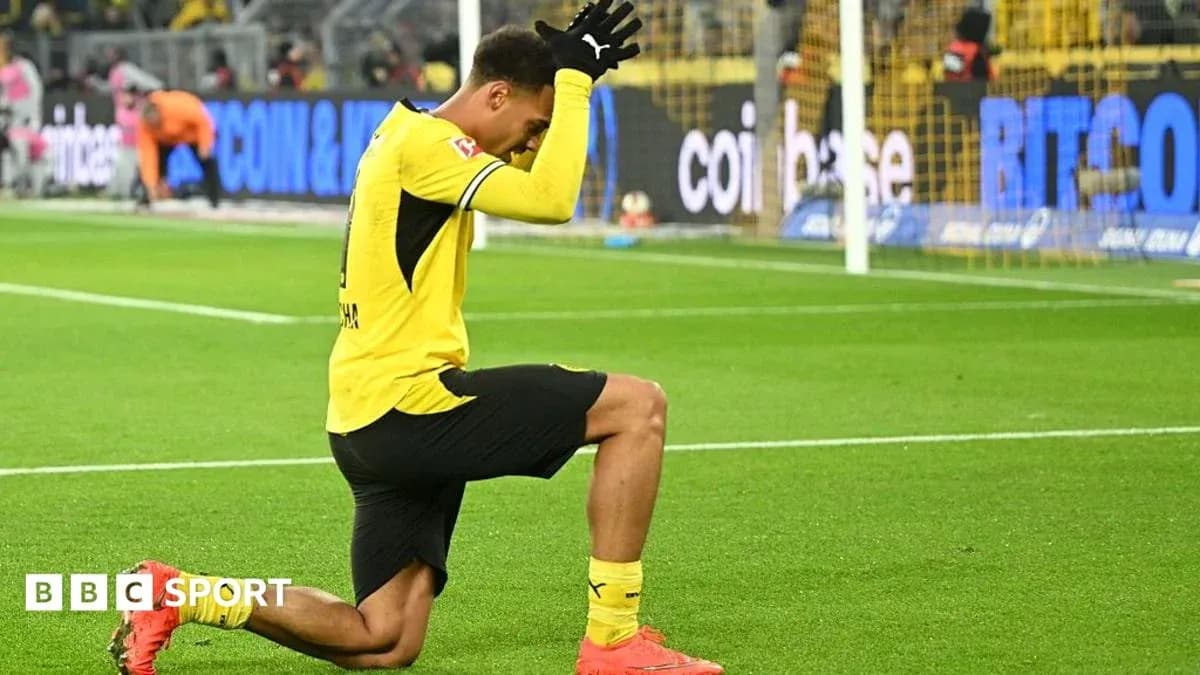
Felix Nmecha’s Controversial Celebration Sparks Backlash at Dortmund
Felix Nmecha’s celebration was supposed to be simple. A point to the sky, a mime of lifting a crown from his head and placing it on the turf. Two goals in a 2-1 win over Elversberg, a nod to his faith, and a moment of personal release after a difficult spell at Borussia Dortmund.
Instead, it has dropped him straight back into the crosshairs of his own supporters.
A gesture, a campaign, and a backlash
The controversy centres on what that celebration referenced. A Dortmund supporters’ group objected strongly, saying Nmecha’s gesture linked directly to “The King’s Return”, a campaign promoted by the Christian organisation Ballers in God.
The group accuses the campaign of pushing views that clash with the club’s stated values of tolerance and diversity. Citing a recent investigation by German broadcaster ARD, the fans say the campaign advocates “extremely conservative positions” on homosexuality and transgender identity, and portrays abortion as “Satan’s plan”.
For a club that repeatedly brands itself as open, inclusive and anti-discriminatory, that was enough to trigger a furious response.
Nmecha moved quickly to defend himself. He described the reaction as the product of “misunderstandings” and insisted the celebration “was not intended to promote myself or any organisation”. He stressed that his message “has never been about promoting intolerance, discrimination, or hate in any form.”
The images, though, were already circulating. So were the arguments.
Ballers in God steps into the spotlight
Ballers in God, founded by former Crystal Palace and Tottenham midfielder John Bostock, has grown into a visible presence within the game. The organisation promotes Christian beliefs and has attracted high-profile followers including England internationals Marc Guehi and Bukayo Saka, and former Brazil forward Kaka.
With its name now pulled into a heated debate in Dortmund, the group issued a carefully framed response.
“We are encouraged by player-led movements such as The King’s Return, where footballers themselves take the initiative to express their faith in Jesus,” it said. The statement underlined a desire “not only to share our hope, but to demonstrate love and respect towards everyone, including those who do not share our beliefs.”
“Our focus has always been, and will always be, to point people to Jesus with grace and love,” it added.
The wording was deliberate: firm on faith, softer on tone, and keen to distance itself from accusations of hate or discrimination without stepping away from its convictions.
Football’s fault line: faith, identity and visibility
This is not an isolated flashpoint. It lands in the middle of an increasingly tense debate about how football handles questions of faith, sexuality and public symbols.
Last year the Premier League withdrew from the Rainbow Laces campaign and ended its partnership with LGBTQ+ charity Stonewall, a move that immediately raised questions about the league’s long-term commitment to that form of visibility.
On the pitch, players have already been navigating the line between personal belief and institutional messaging. In 2024, then Ipswich captain Sam Morsy, a Muslim, explained that he did not wear a rainbow armband because of his “religious beliefs”. At Crystal Palace, Marc Guehi wrote “I [heart] Jesus” on his rainbow armband while captaining the side, blending the campaign’s symbol with his own faith.
At Manchester United, the tension went even further. The club abandoned plans to wear a jacket in support of the LGBTQ+ community after a player refused to take part.
Each incident adds another layer to a growing pattern: footballers are increasingly assertive about their religious identities at the same time as leagues and clubs face pressure to stand visibly with LGBTQ+ communities.
Dortmund’s dilemma
Dortmund now sits right in the middle of that storm. The club’s fanbase is known for its strong stance against discrimination and its vocal defence of inclusivity. When supporters argue that a player’s celebration points to a campaign they see as opposing those values, the club cannot simply shrug and move on.
Nmecha’s insistence that he does not promote intolerance will matter to some. To others, the link to a campaign criticised for “extremely conservative” positions is the problem in itself, regardless of intention.
Ballers in God, for its part, is trying to hold its ground: openly Christian, unapologetically evangelistic, but publicly stressing “love and respect towards everyone”.
This is where modern football now lives. Between the armband and the Bible verse. Between the rainbow and the crown. Between a club’s brand of tolerance and a player’s expression of faith.
The next time a player scores and reaches for a gesture that means everything to them, how many people in the stands will already be wondering what battle it might start?





