Fifa's Financial Dispute: Uefa and Concacaf Demand Transparency
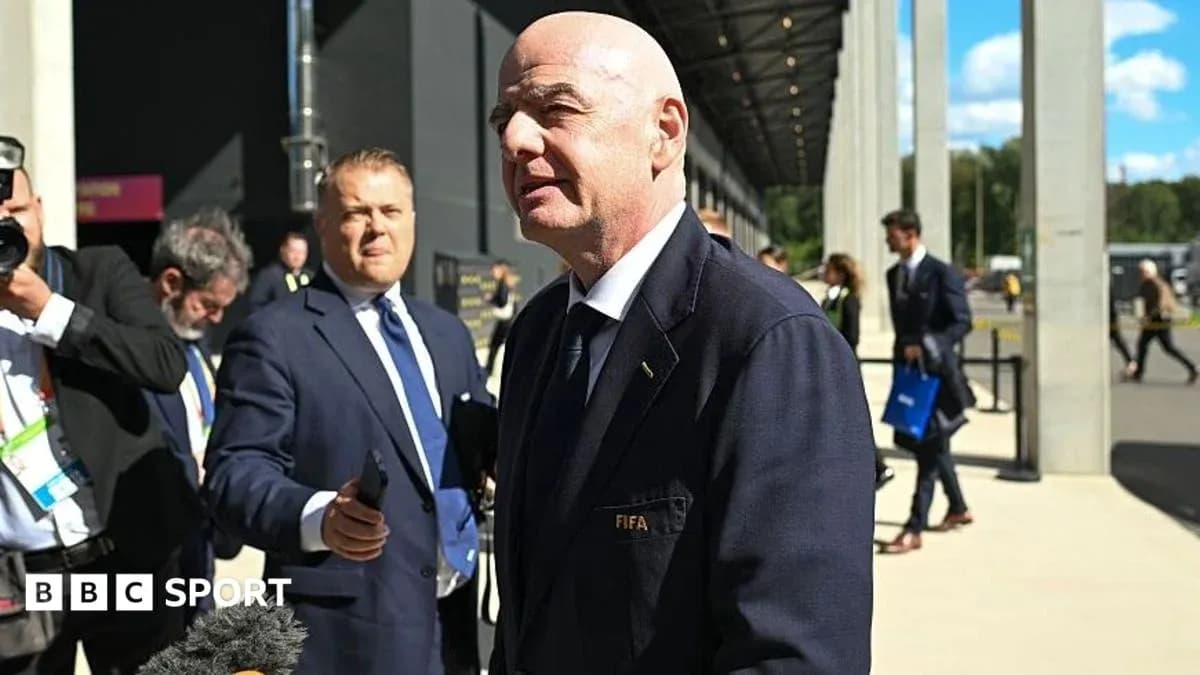
Uefa and Concacaf have moved their dispute with Gianni Infantino into open daylight, demanding that Fifa unlock billions from its bulging reserves and hand at least $10m (£7.5m) to every one of its 211 member associations.
The joint letter, seen by BBC Sport and signed by Uefa president Aleksander Ceferin and Concacaf chief Victor Montagliani, lands just weeks after Infantino’s ambitious – and now abandoned – private equity plan, Fifa Forward Enterprise (FFE), collapsed under fierce internal resistance.
Cash in the bank, questions on the table
Ceferin and Montagliani’s message is blunt. Fifa, they say, is on track to close the 2023-26 cycle with reserves of around $6bn (£4.5bn) – “considerably more than is required” to see the organisation through to the 2030 men’s World Cup.
Their proposal: Fifa should “make at least $10m available to each of its 211 member associations over the 2027-30 cycle”, ring-fenced for infrastructure and football development. A one-off release, costing $2.11bn (£1.57bn), on top of the money Fifa already distributes in that period.
The subtext is clear. If the money is already there, why was FFE ever needed?
FFE would have created a new company to manage commercial and ticketing rights for all Fifa competitions – including World Cups – with 21% of that entity sold to an outside investment firm. The plan promised a huge influx of capital, but also a partial sell-off of football’s crown jewels. It lasted just four days before being scrapped, as national associations lined up against it.
“These resources belong to football”
In their letter, Ceferin and Montagliani say their financial analysis of Fifa’s published accounts and budgets “raised doubts” that the FFE proposal was necessary to generate greater resources for the game. The review, they stress, was “deliberately conservative”, and they argue that an even larger distribution from reserves could be considered by the Fifa Council once year-end figures are confirmed.
They go further, calling for an “independent review” of Fifa’s finances, with “full access to the underlying figures and assumptions”. The tone is not accusatory, but it is unmistakably challenging.
“Fifa currently holds billions of dollars in accumulated reserves,” the letter reads. “These resources belong to football and exist to serve the game and its 211 member associations.
“Prudence should not prevent a careful examination of whether a portion could responsibly be released to the extent those reserves exceed Fifa’s foreseeable needs.
“Releasing part of these reserves would demonstrate that member associations should not have to choose between development and good governance; between investment and integrity; or between financial support and the ability to consider proposals on their merits.
“Development is an institutional responsibility of Fifa – not a matter of individual discretion.”
That last line cuts to the heart of the political struggle: who controls the purse strings, and on what terms.
Infantino’s failed pitch
The timing of the intervention is no accident. When the FFE project surfaced in the days after the World Cup final, Infantino tied it directly to fresh money for federations. Back the deal, he told members, and they would receive $40m (£30m). He set a 19 September deadline to sign up if they wanted an initial $20m (£15m).
The backlash was swift. Many associations, already wary of long-term commercial entanglements, questioned why Fifa needed to sell part of its future revenue when its reserves were soaring. Within four days, the plan was gone.
Now, Uefa and Concacaf are not only arguing that FFE was unnecessary, they are effectively presenting an alternative: open the vault, share the wealth, and do it under tighter scrutiny.
A second letter, also seen by BBC Sport, has been sent to the presidents of the remaining confederations – Asia, Africa, South America and Oceania – urging them to support the motion. If they do, Infantino faces coordinated pressure from across the global game, not just from Europe and North and Central America.
Pressure from inside the council
The challenge is not coming solely from confederation presidents. On Tuesday, Football Association chair Debbie Hewitt, who also serves as a Fifa vice-president, wrote to Infantino and Fifa secretary general Mattias Grafstrom with her own set of demands.
Hewitt called for all documents related to the FFE plan to be released, and for the Fifa Council to receive a written explanation over the cancelled suspension of United States forward Folarin Balogun at the World Cup.
Her message was precise: make all documents available before the next Fifa Council meeting on 15 October.
So, Infantino now faces a twin assault – one on the financial strategy he tried to push through, another on transparency and governance around both money and disciplinary decisions.
A battle over what Fifa should be
At its core, this is no longer just a row about a scrapped private equity deal. It is a fight over Fifa’s identity in an era of record revenues.
Is Fifa primarily a guardian of the game, obliged to distribute its wealth widely and transparently? Or is it a global entertainment powerhouse, free to leverage future rights to maximise long-term income under the president’s vision?
Ceferin, Montagliani and Hewitt have made their answer plain. They want the reserves unlocked, the books opened, and the council fully informed before any new grand project appears on the table.
The next move belongs to Infantino – and it will be watched, and counted, by 211 associations who now know exactly how much money is sitting in Zurich.