
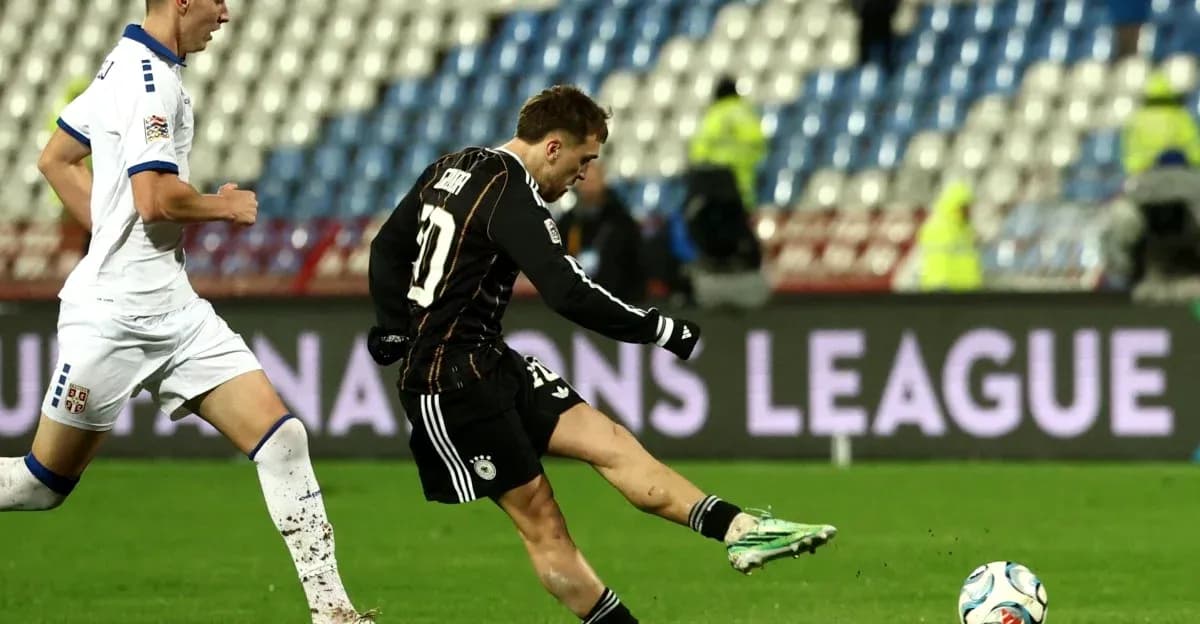
Germany Dominates Serbia in Nations League Opener
This was supposed to be just the Nations League. A sideshow. A soft launch for Jürgen Klopp’s Germany.
Instead, it felt like the first real statement of a team ready to matter again.
Germany went to Belgrade, dominated Serbia, and walked away with a 3–1 win that looked, at times, like a training exercise in controlled aggression. They had 79% of the ball, dictated every rhythm, and leaned heavily on players who, not long ago, were being questioned, doubted, or quietly shuffled out of the spotlight.
On this night, those same players took it back.
A Right-Back Question That Won’t Go Away
If there was one German player who summed up both the promise and the problem of this new side, it was Philipp Treu.
The Freiburg right-back never stopped running. He hunted the ball, chased lost causes, stretched the pitch, and played like a man determined to prove he belongs in this new Germany. Defensively, his effort was relentless.
Then he recovered the ball. And too often, the move died.
Treu has all the physical tools of the modern attacking full-back, except the attacking part. Once he wins it, he looks short of ideas. The overlaps are there, the energy is there, the willingness is there. The final action is not.
This isn’t a call to drop him. It’s a bigger indictment of where Germany have been for years. A football culture that insists on proactive, front-foot play still finds itself relying on a right-back who doesn’t truly threaten in the final third. Klopp now has a tactical puzzle on his hands: how to harness Treu’s work rate without watching those gains evaporate the moment the ball hits his feet.
For now, the question lingers: how long can a team with such attacking ambition accept such limited attacking output from a key position?
Malick Thiaw Ends a Decade-Long Search
Germany have spent the best part of ten years looking for a dominant aerial defender. In Belgrade, Malick Thiaw stepped forward and made a compelling claim to that role.
Klopp had flagged it before kick-off: Serbia would go long, early and often. So he turned to Thiaw over Nico Schlotterbeck, trusting the Newcastle defender to deal with the barrage. The call paid off.
Thiaw barely put a foot wrong. He won duels in the air, duels on the ground, and picked up just a single yellow card in a performance that oozed control. He even threatened at the other end, twice rising to meet crosses — once from a set piece, once in open play — hinting at another dimension to his game.
What really stood out, though, was what he did with the ball. At times he looked like a centre-back channelling Joshua Kimmich: calm in possession, deliberate with his passing, refusing to rush. Every touch seemed calculated, every pass chosen rather than improvised.
With Jonathan Tah alongside him, Thiaw looked like he’d been there for years. Ninety minutes, no drama, no late wobble. For once, leaving Schlotterbeck on the bench didn’t feel like a gamble. It felt like a plan.
Joshua Kimmich, the Quiet Conductor
Watch Germany in Belgrade without tracking Joshua Kimmich and you might think he had a quiet night. Watch it again, this time with your eyes locked on the captain, and the entire game changes shape.
Germany’s 79% possession didn’t happen by accident. It happened because Kimmich decided the ball would belong to him and to his team. He stitched together attacks, kept the tempo exactly where he wanted it, and erased most of Serbia’s attempts to break out before they even developed.
The standout moment came on Brajan Gruda’s goal. Kimmich drifted to the right, manipulated the space, and triggered the passing sequence that ended with Gruda’s ruthless finish. It wasn’t an assist on the stat sheet, but it was an assist in everything that mattered.
Just as striking was his partnership with Aleksander Pavlović. The pair mirrored the chemistry they’ve shown at Bayern, a Kloppian double pivot that blended contrast and balance. One dropped, one stepped. One screened, one probed. It looked natural, inevitable, and crucially, sustainable.
This shouldn’t be a temporary experiment. On this evidence, it should be Germany’s default.
Florian Wirtz Finds the Freedom He Craved
Florian Wirtz has carried the label of “golden boy” for years, but labels can get heavy when the confidence dips. In Belgrade, the weight seemed to fall away.
Serbia made a baffling choice: they didn’t really mark him. Wirtz responded by turning the spaces between their lines into his personal playground.
He popped up everywhere — between the lines, wide, deep, high. He offered himself for every line-breaking pass Kimmich and Pavlović could slide through. Once on the ball, he drove at defenders, pulled them out of shape, and kept firing off shots whenever the angle opened.
He didn’t just play as a classic No. 10. He morphed from creator to connector to finisher, sometimes in the same move. For defenders, that’s a nightmare: you can’t pin him down to one threat, because he keeps becoming another.
Yes, Serbia were poor. Yes, they gave him far too much room. But confidence doesn’t ask for context. If Wirtz keeps moving and thinking like this, the conversation will shift from whether he can become that golden boy again to how far he can push that ceiling.
Brajan Gruda Steals the Stage
On a night when Klopp’s tactical imprint was obvious and several senior players shone, a 22-year-old on loan at RB Leipzig walked in and took the spotlight.
Brajan Gruda’s senior debut for Germany was more than just promising. It was decisive.
His goal in the second half didn’t just tilt the game. It slammed it shut. Gruda picked up the ball in his own half, surged past Serbia’s midfield, glided through the defensive line, and unleashed a sharp, precise strike from just outside the box. It was the kind of goal that silences a stadium and ignites a dressing room.
You could feel the shift. Germany already had control; Gruda gave them edge.
Leipzig’s recruitment eye has long been admired, whether they own a player or borrow him. Gruda’s display against PSV Eindhoven had already put him on Klopp’s radar. This performance justified the call-up in full.
With Kimmich ensuring Germany never really lost the ball, Gruda became the spear tip. He attacked every gap, attacked every defender, attacked every duel. One-on-one, he looked unplayable at times. He pressed with fury, ran with intent, and, yes, crossed the line of aggression on occasion. But this is a Germany side that has often been accused of being too tame. A little edge isn’t a problem. As long as the cards stay the right colour, it’s a weapon.
Klopp could easily have been the “man of the match” for the structure, the bravery in selection, the clarity of roles. He didn’t get it. He didn’t deserve it. Not on a night when a debutant walked onto the international stage and outshone every other attacker on the pitch.
Germany came to Belgrade with questions about their future. They left with new ones — the good kind. How far can Thiaw go at the heart of this defence? How long before Kimmich–Pavlović becomes untouchable? Is this the version of Wirtz that terrifies Europe again? And after a debut like that, just what kind of ceiling does Brajan Gruda have?





