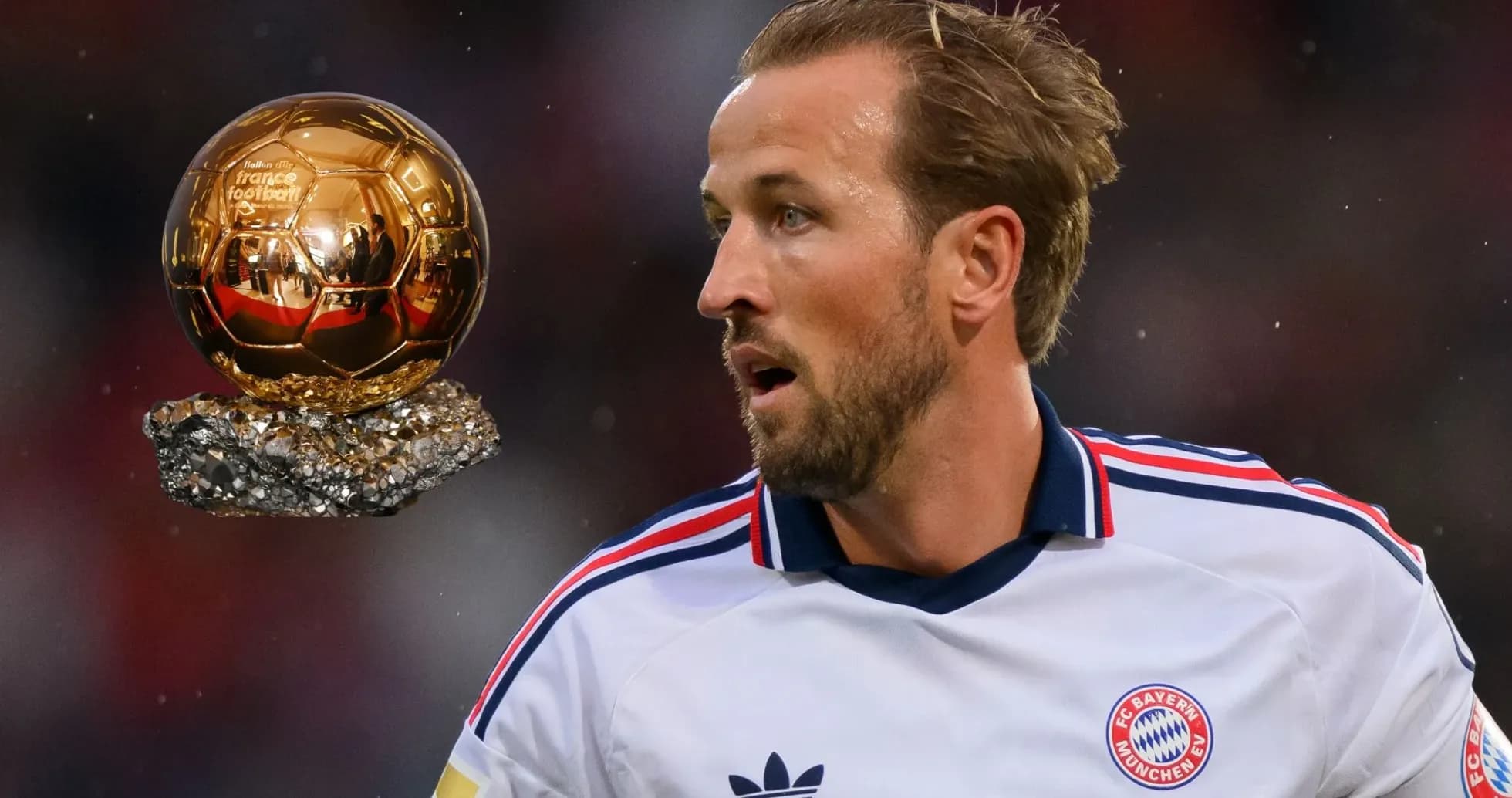
Harry Kane: The English Footballer's Shot at the Ballon d'Or
Harry Kane stands on the brink of a prize that has eluded English football for 25 years. The numbers are absurd, the timing feels right, and the stage could hardly be grander: the Ballon d’Or at the London Palladium on October 26.
For a nation that gave the game to the world, England’s record with the Golden Ball is surprisingly sparse. Stanley Matthews in 1956. Bobby Charlton in 1966. Kevin Keegan in 1978 and 1979. Then Michael Owen in 2001. Four winners in roughly three-quarters of a century. That’s it.
Plenty have threatened to join that group. Billy Wright, Duncan Edwards, Johnny Haynes, Jimmy Greaves, Bobby Moore, Gary Lineker, Alan Shearer, David Beckham, Frank Lampard, Steven Gerrard, Jude Bellingham – all close, all on the podium, none holding the trophy.
For a decade and a half, it barely seemed to matter who challenged. Lionel Messi and Cristiano Ronaldo turned the Ballon d’Or into a private duel, taking 13 titles between them and dragging the bar for greatness into previously unimaginable territory. Eight wins for Messi, five for Ronaldo, and a generation of players left applauding from the shadows.
That era has finally loosened its grip. New names have begun to carve their own space. Rodri and Ousmane Dembele have stood tall in recent polls, their World Cup and Champions League triumphs in 2026 pushing them into the conversation and hinting at a reshaped hierarchy. Both are in contention again.
Yet the favourite wears Bayern red and England white.
Kane’s case is brutally simple. Sixty-one goals for Bayern last season. Twelve more for England. Seventy-three in total for club and country. A second Bundesliga title. A level of consistency and ruthlessness that even he admits once belonged only to the game’s two modern giants.
Those 73 goals take him beyond anything Ronaldo ever produced in a single campaign. Only Messi, with 82 in his greatest year, has gone higher. When Kane calls his own numbers “silly”, he is not exaggerating.
Owen, the last Englishman to win it and now an ambassador for Casino.org, understands better than most what it takes to break through that ceiling. He knows how rare this kind of opportunity is.
“There’s only four of us that have won it in its history,” he told GOAL, reflecting on the Ballon d’Or’s long timeline. “What is the history? 75 years or something? So, we’re talking every 20 years, just under 20 years is the average anyway. So, we’re pushing that average at the moment, because it’s 25 years since I won it.
“Obviously, Harry’s got a good shot at it. I do think it’s quite an open year, but I do think Harry Kane’s got a great chance of winning it. It’d be a fabulous achievement if he did.”
The field is hardly weak. Kylian Mbappe, already a World Cup winner and global icon. Lamine Yamal, the teenage phenomenon rewriting age records. Michael Olise, whose rise has been steep and stylish. Khvicha Kvaratskhelia, the electric winger who has lit up Europe. Rodri and Dembele, serial winners with medals to match their influence.
But the argument keeps circling back to Kane: the volume of goals, the weight of responsibility, the sense that he has stepped into that rarefied space where output looks almost Messi-Ronaldo-like.
Kane himself speaks with the calm of a man who knows he has done everything possible.
“Not that long ago, I was that fan wanting to become a professional footballer, and I am here now and winning awards and the Ballon d'Or is the same,” he told TNT Sports, conscious of how far he has travelled.
“Of course, now it is out of my hands, it is down to the voters and the people who decide it. The season I had was my best season by far, and we'll have to wait and see. It is a weird one because I am already focused on this season now, and the next season. Can I be better? Can I improve? But I also want to appreciate what I did.”
That tension defines the modern great. Celebrate, but not for long. Reflect, but never stand still.
Kane also understands the nature of the debate he has walked into.
“The thing with football opinions – there are so many opinions, so many arguments for different players, and people love this player because ‘he’s fast’ and ‘he’s got great IQ’ and ‘his finishing is great’,” he said. “So I think that is what makes football special, all those debates, and the Ballon d'Or is definitely one of them. I'm happy that I am in contention, so we will have to wait and see.”
The conversation around this year’s award feels less scripted than in the Messi-Ronaldo years. No preordained winner, no sense of inevitability. Just a pack of elite players with different claims: trophies, influence, moments, and, in Kane’s case, sheer relentlessness in front of goal.
For England, the possibility hangs heavy with symbolism. A quarter of a century since Owen. Half a lifetime since Keegan went back-to-back. An entire era of English stars who shone without quite being crowned.
Now, an English captain, leading the line for club and country, stands one vote away from joining Matthews, Charlton, Keegan and Owen on that elite roll of honour.
If Kane’s name is read out at the Palladium, it will not just close a 25-year gap. It will confirm that an English forward has finally matched the “silly” standards set by the greatest of all time.
The numbers say he deserves it. Soon enough, the voters will reveal whether history agrees.