Heavyweight Throne Changes Hands at O2 Arena
The heavyweight throne changed hands under the bright lights of the O2 Arena, but before Filip Hrgovic broke British hearts in the main event, a violent, messy, and often gripping undercard had already set the tone.
It was a night of blood, bruises, and careers nudged in very different directions.
Guido Vianello vs Moses Jolly – Jolly denied in harsh draw
The first bell of the night brought heavyweight ambition and heavyweight chaos.
Moses Jolly, the unbeaten Welsh prospect with the size and swagger to match the occasion, stepped up against former Olympian Guido Vianello, a man still trying to convince the sport he’s more than a nearly man after defeats to Efe Ajagba and Richard Torres Jr.
From the outset, both made their intentions obvious. Jolly went downstairs with purpose, thumping the body, while Vianello answered with the cleaner, more eye-catching shots upstairs. It was raw, untidy, but compelling.
By the second round, the fight looked like it had skipped the feeling-out process entirely. Both men were already marked up, trading in close, throwing ragged combinations that carried genuine jeopardy. Technique frayed as adrenaline took over.
Jolly’s confidence surged when he detonated two savage overhand rights that Vianello somehow absorbed amid the mauling and clinching. The Welshman blew a kiss to the crowd, bounced to the music in his corner, and looked like a man enjoying his big-stage arrival.
His early investment to the body began to tell by the middle of the fourth. Vianello was breathing hard, visibly uncomfortable, but he stayed dangerous. Smart counters and clever work on the inside kept him alive in a fight that looked on the verge of slipping away.
The Italian found his best spell in the sixth. Jolly’s output dipped to single jabs, his earlier relentlessness replaced by a slower, more hesitant rhythm. Vianello seized that opening, timing counters as both fighters grew increasingly tired and scrappy.
They entered the final round with everything on the line. No knockout came, though both tried to summon one from exhausted legs and heavy lungs. When the referee’s score of 76–76 was announced, the verdict landed like a thud.
A draw. Officially even. Unofficially, it felt like Jolly had done enough with his early dominance to deserve more than a shrug from the scorecard.
Constantin Ursu vs Ben Vaughan – Blood, cuts, and a brutal finish
The British welterweight title defence for Constantin Ursu was never going to be pretty. It turned out to be far more savage than that.
Facing Ben Vaughan, a man rebuilding after a points loss to Bobby Dalton in an English title bid, Ursu walked into a challenge that quickly became a test of nerve as much as skill.
Vaughan started fast. The challenger roughed up the champion, crowding his work, taking away the space Ursu needed to find his timing and that rear uppercut he kept searching for. For two rounds, it was Vaughan’s fight: busy, physical, disruptive.
Ursu’s jab slowly shifted the rhythm. It snapped into Vaughan’s face, bloodied his nose, and began to set up the cleaner work. Technically, Ursu was the sharper operator, but he kept getting clipped by shots he shouldn’t have been anywhere near. His defense, loose and risky, left questions even as he worked his way in.
Vaughan hammered the body with intent, trying to take Ursu’s legs from under him. For a while, it looked like a smart, grinding plan.
Then the champion found another gear.
In the fifth, Ursu’s accuracy told. He opened a horrible cut above Vaughan’s left eye, blood streaming down and into the eye socket. The sight of damage seemed to lift Ursu. He began to punch with more authority, landing almost at will as the round closed.
The sixth descended into a blood-soaked war. Ursu picked up a cut of his own on the right eye, but neither man blinked. They stood in the pocket and traded, Ursu’s shots carrying the heavier venom, Vaughan refusing to fold.
By the start of the eighth, both fighters rose from their stools coated in each other’s blood. The atmosphere crackled. It felt like the kind of fight that might only be settled by someone staying down.
Instead, the ringside doctor and referee stepped in.
Vaughan’s cut, now a gaping wound, was deemed too severe to allow him to continue. The stoppage handed Ursu a TKO in the eighth and preserved his status as British and Commonwealth welterweight champion.
He left with the belts and the win. He also left with scrutiny. His willingness to trade, his lapses in defence – they’ll all be discussed. But on this night, he survived a serious push from a determined challenger.
Nelson Hysa vs Thomas Narmo – One punch, one statement
Heavyweight power returned with a different flavour when Nelson Hysa shared the ring with Thomas Narmo, “The Last Viking”, in a battle of undefeated knockout artists.
On paper, 25-0 Hysa against a 14-0, 14 KOs Narmo promised violence. In the ring, the opening exchanges were cautious. Two huge men pawed with jabs, probing, feinting, searching for a mistake rather than charging in.
Narmo offered one.
As he pulled out of range with his chin high, Hysa spotted the flaw and let a sly grin slip. He had read the tell. He knew the opening would come again.
When it did, the fight was over almost before it had truly begun.
In the second round, Hysa uncorked a thudding overhand right that crashed through Narmo’s defenses and sent “The Last Viking” toppling to the canvas. Narmo beat the count, but his legs, his eyes, his balance – none of them were really back.
The referee took one look and made the only sensible call. No heroic punishment, no needless drama. Fight over.
Hysa walked away still unbeaten, still WBO Global champion, and with another ruthless finish on a growing record that will soon demand bigger names and bigger nights.
Sam Noakes vs Denys Berinchyk – Noakes walks down the technician
The chief support pitted raw force against ring craft.
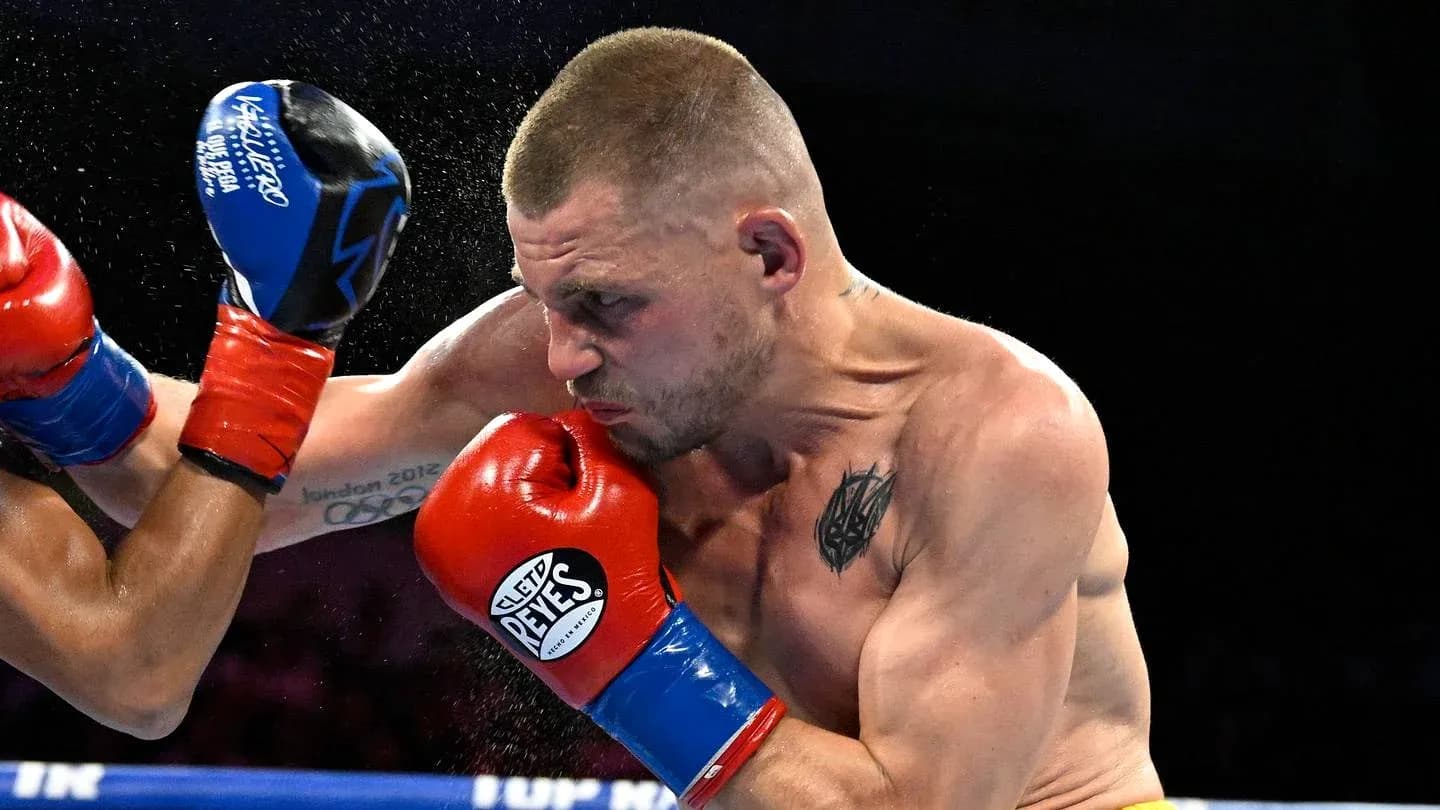
Sam Noakes returned to the big stage with something to prove after his punishing loss to Abdullah Mason, having reset with a quick stoppage win at York Hall. Across from him stood Denys Berinchyk, the former WBO lightweight champion, stripped of his belt in brutal fashion by Keyshawn Davis in his last outing.
Berinchyk wanted no part of a firefight early. He circled, skipped, slid along the ropes, his feet constantly in motion. He flicked out a sharp, educated jab and refused to plant long enough for Noakes to set his feet and detonate.
Noakes stalked him with bad intentions in every punch, but clean contact proved elusive. The Ukrainian made the most of the large ring, gliding away, countering only when Noakes strayed too close.
In the fourth, Berinchyk added another layer, switching southpaw and snapping in a couple of stinging left hands. Noakes kept trying to drag him into the kind of war Berinchyk clearly didn’t want, closing the distance where he could and digging to the body in an effort to sap those spring-loaded legs.
The tide began to shift in the fifth. Noakes started to herd rather than chase, cutting off angles, stepping cleverly to his left and right. He trapped Berinchyk in the corners, using a stiff jab to pin him and then letting his hands go in twos and threes, head and body. It wasn’t domination, but it was control.
With each passing round, the ring seemed to shrink around the former Olympic silver medallist. Noakes forced him to stand and trade more often, and Berinchyk’s reddening face told the story of the accumulating damage.
The Ukrainian’s fast hands never left the fight. He still snapped back combinations that made Noakes think twice, forcing the Englishman to accept he would sometimes have to take one to land one. Yet the size, strength, and steady body work of Noakes appeared to trouble Berinchyk more and more.
Heading into the final round, the contest remained competitive, but the balance leaned towards Noakes. He had outlanded Berinchyk over the stretch, dictated the geography of the ring, and imposed his physicality.
Berinchyk rallied late, standing closer, firing uppercuts and lead hooks, finally accepting the exchanges he had spent much of the night avoiding. It was brave, it was skilled, but it came too late.
All three judges sided with Noakes, awarding him a unanimous decision that repositions him firmly in the world-title conversation at lightweight.
On a night when the main event rewrote the heavyweight script, the undercard quietly did its job: it built reputations, exposed flaws, and nudged a handful of careers towards far bigger questions.