
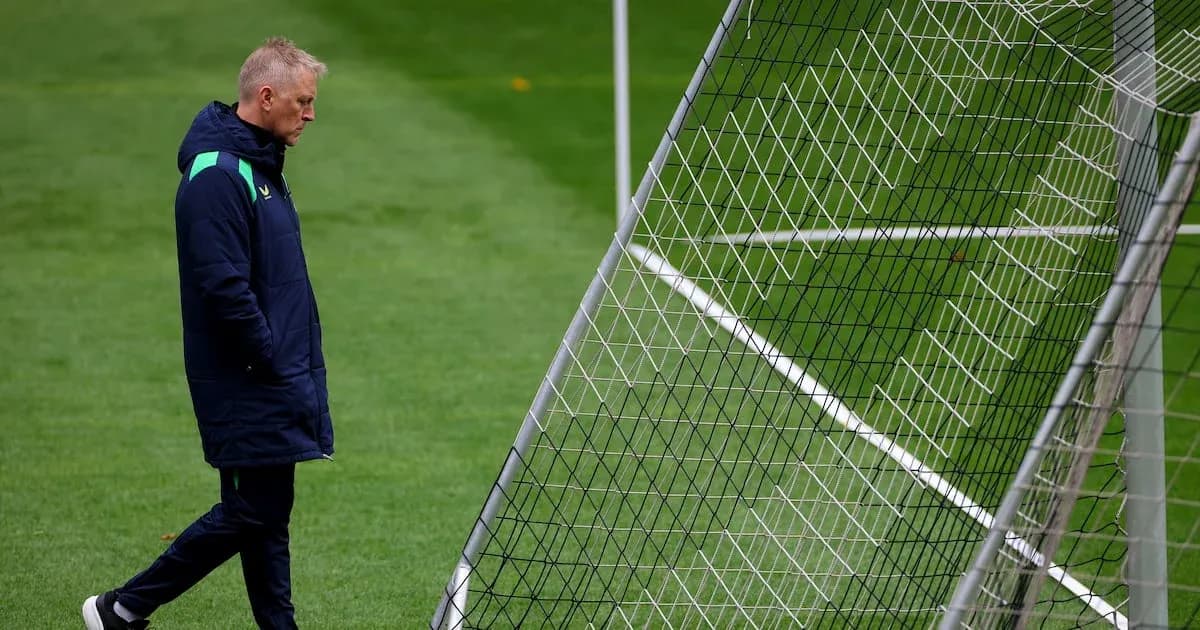
Heimir Hallgrímsson's Quiet Revolution in Ireland Football
Heimir Hallgrímsson walked into Linz with the air of a man who has already lived through the worst of it. After the chaos and acrid emotion of the Israel saga, the question that hovered over his Ireland reign from the start returned with fresh force: what happens when an Icelander’s icy logic collides with Ireland’s habit of emotional whiplash?
For now, logic is winning.
A reset in Linz
On Friday, Hallgrímsson outlined a quiet revolution. Nothing dramatic, no grand speeches or chest-beating. Just a series of small, deliberate jolts to a set-up that had started to feel heavy with the residue of last month.
The players arrived a day later than usual. The team meeting schedule has been ripped up and redrawn. A new coach, Pete Shuttleworth, has joined the staff. Even the branding around the team hotel has been shuffled.
The changes extend beyond the pitch. Media duties have been trimmed. Long-standing content embargoes – those sacred stones of the Irish press landscape – have been kicked over. Hallgrímsson wants everyone unsettled, in a good way.
“We want to challenge everybody in the camp to think, ‘growth mindset’,” he said. “We should always challenge ourselves to improve our working environment. These guys deserve that their environment is improving. That is how everyone should be: players, staff, coaches ... media.”
That last word landed with a trace of grit. Where some of his predecessors raged at the media, Hallgrímsson sounds more like a disappointed schoolteacher. The emotion from Israel hasn’t vanished; it’s just been dissolved into his solution for progress, leaving a faint, bitter residue.
From fatalism to “win or learn”
What marks Hallgrímsson out from many who went before him is how openly he leans into the language of growth. The “growth mindset” idea, popularised by American psychologist Carol Dweck in the 1970s, argued that intelligence and ability aren’t fixed – they can be developed through effort, experience and, crucially, the willingness to learn from failure.
The theory dovetailed neatly with American myths of equality and social mobility, and it spread. It has seeped so far into Western culture that even Samuel Beckett’s bleak “Try again. Fail again. Fail better.” has been hijacked by self-help evangelists as a motivational slogan.
Irish rugby got there long before Irish football. That team, largely drawn from fee-paying schools where Dweck’s ideas filtered into the educational bloodstream, embraced the vocabulary of “work-ons” and “learnings” until it became second nature. Rugby built a culture in which mistakes were raw material.
Football went the other way. For decades, Ireland’s default setting has been fatalism. The 1-1 draw as destiny. The proud boast of being “hard to beat” as a ceiling, not a platform. The weary refrain – “we just don’t have the players” – trotted out by managers who found comfort in limitation.
Hallgrímsson’s worldview cuts across that. His version of Ireland’s motto, which he credits to Dara O’Shea, is stark: “win or learn”. Nothing is final. Every defeat is a data point, not a death sentence.
And he can back that up with more than slogans.
Evidence of change – and the cracks that remain
Since the 5-0 hammering by England at Wembley, Ireland have developed a sturdier core. They now compete properly in every game. The defensive structure looks more balanced. They’re no longer as easily ripped apart on the counter-attack. The soft underbelly at set pieces, a glaring weakness, appeared to be addressed last month.
Yet the same tape keeps looping.
Ireland’s biggest problem heading into Austria is not talent, shape or spirit. It’s concentration. Standards sag across 90 minutes, and the lapses are costing them dearly.
Two-goal leads have been squandered with infuriating regularity – Austria at home, then, more painfully, the collapse away to Czech Republic. Against Israel, the first halves carried promise; the second halves dissolved into something far more ragged. The second half away to Kosovo only looked good because the first 45 minutes had been so poor.
This is not a team that can claim it doesn’t know what’s going wrong. The patterns are obvious. That’s where the growth mindset bites hardest: if you say you believe in learning from mistakes, you can’t pretend not to recognise your own.
Austria: the next examination
Austria present a familiar problem with a slightly altered cast. Their squad is thinned by injuries, but they still guard a three-year unbeaten home record. They press high, they harry, they punish hesitation.
Ireland know this too well. The Dublin collapse in the reverse fixture began with Liam Kitching lingering on the ball, Patrick Wimmer pouncing, and the first Austrian goal flowing from that moment of indecision. If Ireland don’t handle the press in Linz, the same story writes itself again.
On paper, Ireland have enough to go there and win. Not scrape a draw, not “put in a shift”, but win – if they can finally stitch together a full 90-minute performance instead of a patchwork of good intentions and bad habits.
If they don’t, the mirror turns unforgiving. The other side of the growth mindset is brutal: recurring shortcomings are not fate, they’re complicity.
That is why the old fixed mindset still holds a strange allure. In a world of learned helplessness, failure is never your fault. The question now is whether this Ireland team is ready to give up that comfort – or whether Linz becomes just another lesson they refuse to learn.





