Houston Rockets: Striving for Greatness
The Houston Rockets arrive at this season in a familiar but uncomfortable place: too talented to be dismissed, too unproven to be trusted. Fifty-two wins and a first-round exit last year. Fifty-two wins and a first-round exit the year before. The fence they’re sitting on is starting to splinter.
This time, the room for excuses is shrinking.
They’ve doubled down on the present. Bogdan Bogdanović has arrived to space the floor. Marcus Smart brings edge and structure to a backcourt that has often lived on chaos. Bruce Thornton adds another young guard to a rotation already teeming with energy and ambition.
The core is the same, but the message is different. This is no longer a plucky, overachieving group. This is a team expected to be there in May — and daring to whisper about June.
The Durant Question
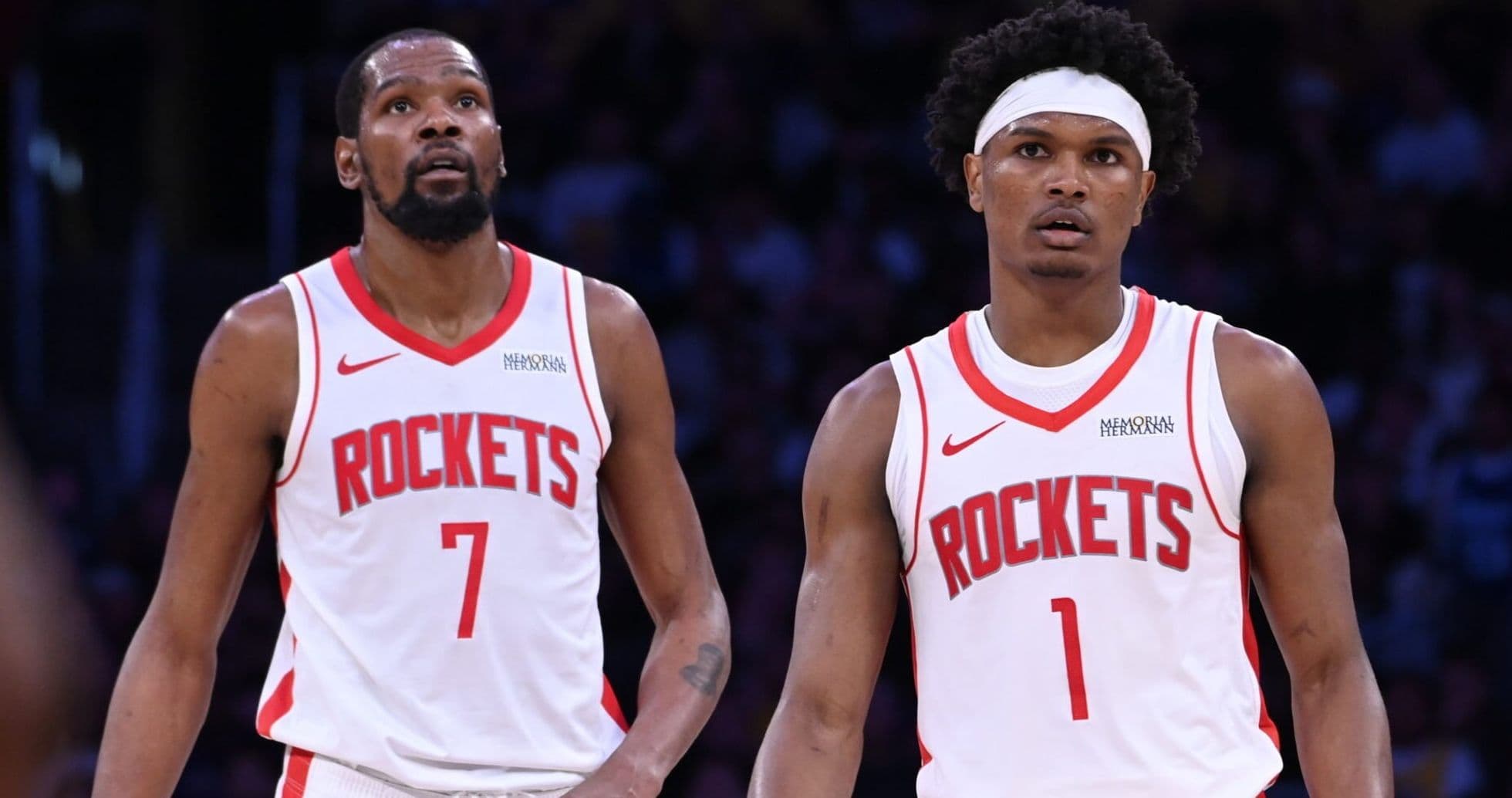
Everything still begins, and possibly ends, with Kevin Durant.
For two straight seasons, he has dragged Houston to 50-plus wins, testing the limits of what a superstar in his mid-30s can carry on his shoulders. If he keeps defying the calendar, the Rockets have a chance to punch through the glass ceiling that has stopped them in the first round.
If he finally blinks? The West is unforgiving. A small dip from Durant can turn a 52-win team into one clawing just to stay out of the Play-In.
Durant isn’t the only variable. Fred VanVleet returns after losing a season to injury, and his re-entry changes the shape of everything. His pick-and-roll control, late-game poise and perimeter shooting can steady an offense that too often relied on Durant isolation heroics. But he’s also a 6-0 guard rejoining a roster that has built a historic identity on size and relentlessness on the glass.
That identity is real. Houston has led the league in rebounding percentage in each of the last two seasons. Last year’s 54.5% mark was the best in 30 years of play-by-play data. That is not a quirk. That is a weapon.
Even after Steven Adams went down in January, the Rockets still finished second in offensive rebounding percentage the rest of the way. Their second most-used lineup — Tari Eason alongside the four full-time starters — vacuumed up 58.9% of available rebounds, the best figure for any lineup with at least 200 minutes in 19 seasons of lineup tracking.
That’s dominance. That’s extra possessions, extra chances, extra life.
VanVleet’s return will help the offense flow, but it will also test how much of that bruising advantage Houston is willing to sacrifice. Smaller guards mean fewer long arms flying at the glass. The trade-off could define their season.
The Ifs Around the Core
Durant’s battle with time is the headline, but the Rockets’ ceiling lives in the margins around him.
Alperen Sengun continues to climb. His development from clever passer to full-blown offensive hub is one of Houston’s biggest internal bets. If he takes another step as a scorer without losing his vision, the Rockets can attack from the elbow, the post and the perimeter with equal menace.
Amen Thompson sits on the edge of something bigger. In one sense, he’s already “broken out” — a five-year, $208 million rookie extension before camp is as loud as an organization can speak. They see him as a pillar, not a prospect.
He’s already a terror at the point of attack, an on-ball defender who can swallow space and disrupt rhythm. When he locks in, opposing guards feel it in their legs by the fourth quarter.
The question is the other end.
Thompson’s offensive game remains under construction. He can get downhill, he can pressure the rim, but to become the two-way force Houston needs, he must find a reliable way to score when the paint is crowded and the stakes are high. The Rockets believe in the work. They believe in the hours. Many players have built jump shots mid-career; Thompson is trying to do it at the front end.
If that jumper arrives sooner rather than later, Houston’s entire trajectory changes. A wing with elite defense, real playmaking and a credible shot beside Durant and Sengun? That’s not just a nice story. That’s the skeleton of a contender.
Jabari Smith Jr. lives in that same space of uncertainty. Is he the long, switchable, floor-stretching forward who can swing playoff series, or just a tease of what might be? Houston doesn’t need him to be a star, but it does need him to be real.
A Brutal West, A Narrow Path
The Rockets’ fate isn’t theirs alone. The Western Conference is a minefield.
Two straight first-round exits have underlined the point: 50 wins don’t guarantee anything. Houston will need to be great — not just solid, not just “dangerous” — to be playing in June.
They’ll get an early measuring stick.
On Oct. 23, they host the Spurs, one of the title favorites. It’s a perfect opening exam: size, talent, and championship expectations on the other bench. Houston will learn quickly whether its physicality and depth can stand up against the league’s elite.
By Nov. 20, the Rockets will already have been through a gauntlet. A 17-game stretch brings them the Nuggets twice, plus the Spurs, Thunder, Celtics, Wolves, Heat and Pacers. It’s the kind of run that can harden a team or expose it. No hiding, no soft spots.
On Nov. 28, the spotlight shifts to a marquee duel: Durant against LeBron James and the 76ers. So much shared history, so many playoff collisions in other uniforms. There’s a chance this is the last season we see them share the floor. For Houston, it’s more than nostalgia — it’s another test of whether Durant can still match the very best on command.
January brings emotion of a different kind. On the 13th, Durant returns to Oklahoma City to face the Thunder, the franchise where his legend began. That building always hums differently when he walks in. The Rockets will need to manage the noise and the narrative around a night that will be about far more than the standings.
Then, late in March, another kind of drama: Rockets vs. Pistons on the 25th. Amen Thompson against Ausar Thompson. Brothers, competitors, both on teams that expect to be in the playoff picture by then. It’s the kind of game that feels bigger than a regular-season date in spring, especially if seeding is on the line.
Sharpening the Shot
For all their muscle and length, the Rockets know they must modernize their offense around Durant.
They’ve gone straight to one of the game’s most trusted voices. Chip Engelland, the renowned shooting coach who helped shape title teams in San Antonio, is now in Houston. His task is clear: turn potential into production from beyond the arc.
Engelland will work closely with Thompson and with Reed Sheppard, the young guard eager to carve out a bigger role. Both represent the future of Houston’s perimeter game. Both need refinement, repetition and confidence.
The front office has given Engelland a proven weapon to work with as well. Bogdanović arrives as a veteran marksman, a steady, efficient threat from the 3-point line who can punish defenses for loading up on Durant. His presence should stretch the floor, open lanes for Sengun and Thompson, and give VanVleet a trusted outlet.
Suddenly, this is a team with range to match its rebounding, with a shooting specialist overseeing the next phase of its evolution.
The pieces are here: a generational scorer still fighting the clock, a point guard returning to stabilize the attack, a rising big, a defensive whirlwind on the wing, shooting help, and a rebounding edge no one in the league has matched in three decades.
The question is no longer whether the Rockets can be good. They’ve proved that.
The question now is whether this is the year “good” finally stops being enough.