
Humanoid Robot Football Carnival in Nanning: A New Frontier
In Nanning, the future of football doesn’t arrive with a roar from the stands. It hums quietly on servos and silicon.
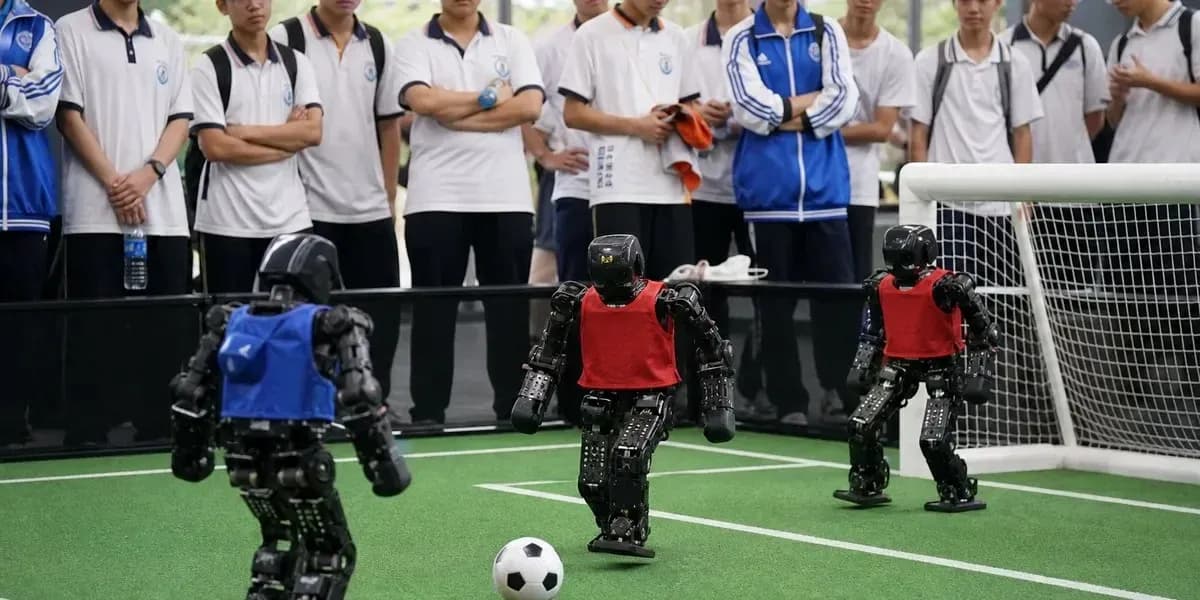
The first humanoid robot football carnival for secondary school students kicked off on Thursday in the capital of the Guangxi Zhuang Autonomous Region, turning a corner of southern China into a testing ground for the sport’s next frontier. More than 40 students from 10 educational institutions have traded boots and bibs for code and controllers, stepping in as tacticians and engineers rather than strikers and centre-backs.
Three-a-side, no joystick
The rules are simple. The challenge is anything but.
Matches are played three-on-three, but the youngsters are not dribbling or shooting themselves. Every team fields Booster K1 humanoid robots, and once the whistle goes, the machines are on their own. No remote controls. No last-second human corrections. The robots run fully autonomously, guided by artificial intelligence that the students help configure and refine.
It turns a familiar game into something closer to a live lab. Every misstep, every delayed turn, every hesitant shot is a line of code exposed. Every clean interception or well-timed run is a glimpse of how quickly this technology is learning to move through space the way athletes do.
Organizers describe it as the largest and highest-level humanoid robot football event ever staged for secondary school students in Guangxi. On the ground, it feels like something more: a dress rehearsal for how sport, science, and education might collide over the next decade.
Football, but make it a showcase
This carnival doesn’t stand alone. It has been deliberately woven into the 23rd China-ASEAN Expo, which runs in Nanning from September 17 to 21.
While one part of the city talks trade, investment, and regional cooperation, another watches robots jostle for position and chase a ball under the watchful eyes of teenagers. The football is the hook, but the program stretches well beyond the pitch: scientific events, interactive demonstrations, China-ASEAN exchanges, and activities designed for parents and children all orbit around the same core theme—artificial intelligence as a shared language.
One of the expo’s three exhibition zones this year is devoted entirely to AI and exchanges in the field, framed by the theme: “CAFTA 3.0 Opportunities, Better Life.” On the exhibition floor, that message appears in charts, prototypes, and policy. On the robot pitch, it takes the shape of a sliding tackle from a Booster K1 that has just “learned” where the danger is.
Kids on the touchline, code on the grass
For the students, this is not just a spectacle. It is a competition, and a classroom.
They stand on the sidelines not as passive spectators but as de facto coaching staffs and technical teams, watching how their humanoid line-ups read the game. The three-on-three format strips football down to its basics: space, timing, decision-making. It exposes the strengths and flaws in each AI model with brutal clarity.
The pressure on the robots is obvious. The pressure on the kids is quieter, but real. Every team uses the same Booster K1 hardware, so the difference comes from how well each school’s young minds can teach their machines to think.
The carnival sits at a crossroads: between sport and science, between regional diplomacy and local education, between the roar of traditional football and the whirr of its robotic cousin. Today, it is a novelty framed inside an expo. The real question is how long it will stay that way—before humanoid football stops being a sideshow and starts shaping how the next generation understands the game itself.