
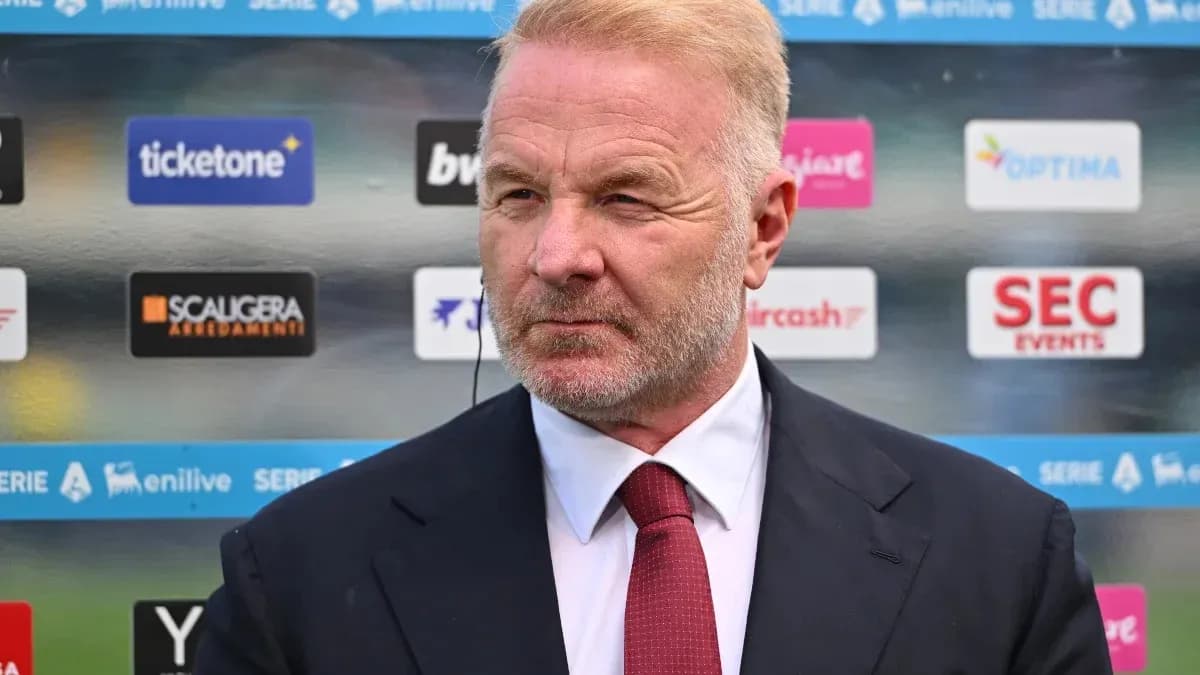
Igli Tare Discusses Rafael Leao’s Decline at Milan and Joe Gomez Transfer Failures
Igli Tare has offered a stark insight into Rafael Leao’s final months at Milan and revealed how a late Liverpool U-turn wrecked the club’s plans to sign Joe Gomez.
The former Milan director, dismissed in May alongside Max Allegri, CEO Giorgio Furlani and Geoffrey Moncada after missing out on the Champions League, painted the picture of a club scrambling to adapt on and off the pitch – and a star forward drifting away from the game that made him.
‘Football was no longer a priority’ for Leao
Tare arrived at Milan ahead of the 2025/26 season with a reputation for sharp talent work. Leao, from the outside, looked like the jewel: a match-winner, a personality, a face of the project.
Up close, Tare saw something different.
“I had only known of Leao from the outside, but when I got the opportunity to get to know him in person, I thought he was an extraordinary guy,” he told Sky Sport Italia’s Calcio Unplugged podcast. He spoke with warmth, but the verdict was unforgiving. “He was the player we all expected more from. I think football was no longer a priority for him. That’s how to read the situation.”
Leao’s life had started to stretch beyond the pitch. The Portugal international released a rap album last year, pushed into fashion, and built a profile that did not depend on 90 minutes every weekend. Milan, meanwhile, needed a leader in their front line and a player willing to carry the weight.
“I think he was focused more on his life outside of football, so music, fashion, things like that,” Tare said. “I never doubted his love for Milan, you could tell he suffered at not performing consistently, he had a lot of fitness problems, so always had the handbrake on.”
The image is striking: a gifted forward playing with a permanent drag on his game, never quite at full throttle. Tare described how he tried to break through that barrier.
“I tried to have more individual meetings with him than any other Milan player, and every time I got the sense he wanted to do more. But wanting to is sometimes not enough.”
By then, the club already knew the end was coming. Leao’s contract, running to June 2028, had become a financial fault line. The Rossoneri were unwilling to match his wage expectations, and the market did not explode as many had expected.
It took the entire window – and a fair amount of anxiety – for Milan and Leao to finally find a way out, with Galatasaray stepping in late. Asked if there had been a chance to sell him a year earlier, in 2025, Tare was blunt: “No concrete offers ever arrived for him.”
For a player once valued among Europe’s elite wide forwards, that silence said as much as any press release.
System change chaos and the Gomez near-miss
Leao was not the only story of that turbulent period. Behind the scenes, Milan’s transfer strategy for the summer of 2025 veered off course in the final days of the window.
“It was difficult for us because we decided to change system five days before the end of the transfer window,” Tare explained. Allegri’s late decision to move from a 4-3-3 to a three-man defence turned a carefully drawn plan into a race against time.
“Going from a 4-3-3 to a three-man defence made it hard for us to find someone of that level in five days.”
The pressure told in defence. Targets slipped away, one by one. Manuel Akanji chose Inter, and the reason cut deep: Milan were out of the Champions League, Inter were not. In a market where top centre-backs pick their stage as much as their salary, that mattered.
So the focus shifted to Joe Gomez. On paper, he was the ideal fit: experienced at the highest level with Liverpool, comfortable in a back three, capable on the ball. Tare revealed that an agreement between the clubs was in place.
Then the dominoes stopped falling.
“We were a bit unlucky, first because Manuel Akanji went to Inter as we weren’t in the Champions League, then we had an agreement with Liverpool for Joe Gomez. However, when Marc Guehi’s move from Crystal Palace to Liverpool collapsed at the last minute, Liverpool pulled out.
“We had been waiting only for that move for us to sign the paperwork.”
One failed transfer in England, and Milan’s defensive rebuild crumbled. With the window ticking into its final hours, the club had to abandon the idea of a ready-made leader at the back and pivot to a different kind of signing.
“In order to avoid being without centre-backs, we signed Odogu at the last minute as a signing for the future.”
It was a compromise, born of necessity rather than design, and emblematic of a summer where the margins went against Milan: a star forward whose focus drifted beyond football, a tactical shift made days before the deadline, a Champions League absence that cost them one defender and a collapsed deal elsewhere that cost them another.
By the time the season ended without a Champions League place and the axe fell on Allegri, Tare and the rest of the hierarchy, the verdict was already written. The question now is whether Milan have learned enough from those missteps to stop history repeating itself in the next window.





