Ireland Squad Naming Raises Ethical Concerns Amidst Political Turmoil
The naming of an Ireland squad has rarely felt like this.
On Thursday, when Heimir Hallgrímsson reads out the list for the games against Israel, the usual debates about form, tactics and fringe players will sit in the shadow of something far heavier. Every inclusion will look routine. Every omission not linked to injury will be scoured for meaning. Not footballing meaning, but moral.
For most players, the chance to pull on the green shirt is still the pinnacle. This time, that pride collides with a burden they should never have been asked to carry. Because the Football Association of Ireland, through what can only be described as institutional cowardice, has pushed the decision down the line. Instead of taking a stand, it has left individual footballers to decide whether they will play against a state accused of genocide.
That is not just unfair. It is a dereliction of duty.
The old line that “politics has no place in sport” collapses instantly under even the lightest scrutiny. Politics runs through every part of public life. Stadiums are built with public money, federations rely on state backing, players become national symbols. Sport is not some sealed-off arena of innocence. It never has been.
Those who insist there are precedents that justify playing on in this situation ignore the scale and nature of what is happening. In the lifetime of many watching Ireland, there has never been a genocide backed so openly by western powers as Israel’s onslaught on Palestine. Some will argue that the genocide charge has not yet been legally proven. But international law moves slowly, as it should. Conscience cannot wait for a final judgment years down the line.
The evidence of deliberate, sustained terror is there. On that basis, the genocide accusation stands as a live, pressing reality. That is the context in which Ireland is preparing to play football.
When institutions face decisions of genuine weight, the responsibility lies with those at the top to inform themselves, to look unflinchingly at the facts, and then to act. Genocide is the gravest crime in international law. Faced with that, the default position for any sporting body serious about ethics should be simple: you do not engage. You do not normalise. You do not play.
The idea of lining up for a friendly handshake and a national anthem against Israel ought to feel unthinkable.
It did once. Last November, the FAI board said as much. It formally asked UEFA to ban Israel. In doing so, it sent a clear message: no national team, no group of players, should be put in this position while state-backed brutality continues. That stance earned praise. It looked like principle. It looked like leadership.
That was then.
The moment Ireland were drawn to play Israel, the high ground vanished. The principle was quietly boxed up and moved out of sight.
The FAI’s retreat has to be viewed in a wider Irish context. The Government’s prolonged stalling on the Occupied Territories Bill set a tone. If those in power drag their feet on concrete action, it becomes easier for every other institution to do the same. Sport has followed that lead.
The FAI is not alone. The GAA has stained its own reputation by refusing to end its commercial partnership with Allianz, despite the controversy over the company’s links and the accusations aimed in its direction. Allianz has rejected the allegation that it is complicit in genocide, but the broader picture is clear: Irish sport has chosen commercial and competitive continuity over a clean, unequivocal stand.
Irish football, though, occupies a different space. A national team carries a particular weight. When the FAI confirms that the games against Israel will go ahead, it gives Israel something it badly craves: normality, fixtures, business as usual. A stage.
The matches on September 27th and October 4th will be played. The results will go into the record books. The goals will be replayed. Yet in any moral ledger, the scoreline is irrelevant. Once the ball is kicked, there is only one winner, and it is not Ireland.
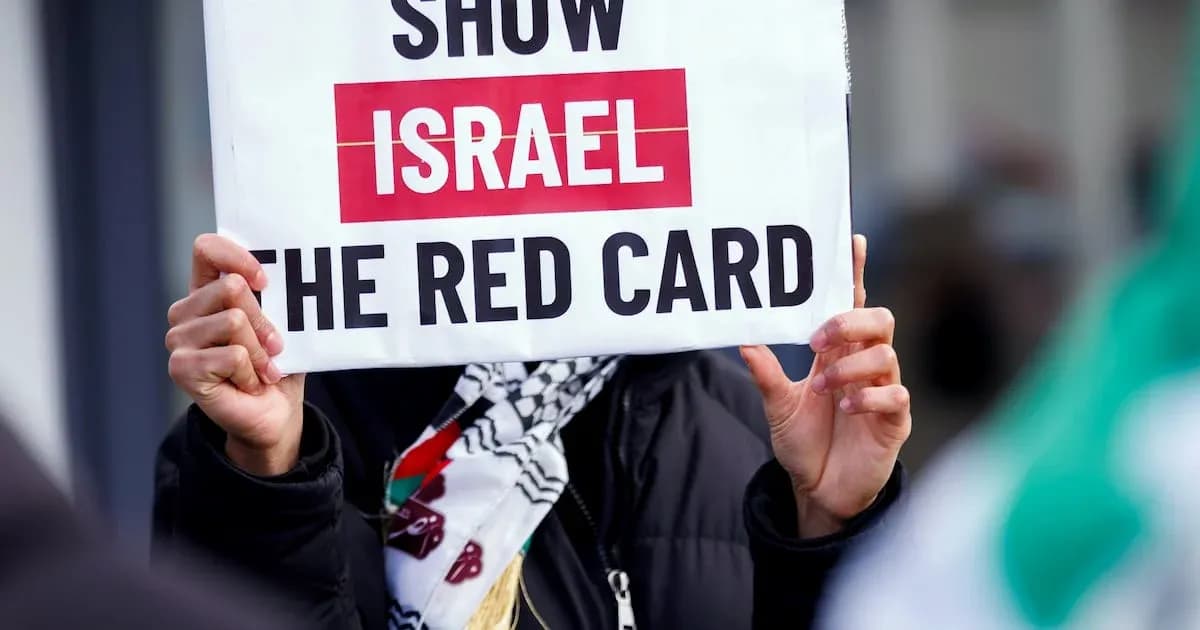
Protesters have marched, argued, petitioned. They have tried to force the FAI back towards the position it once claimed as its own. They have failed. The board has imposed its will. On paper, it has won the argument. In reality, Israel has won something far more valuable: the validation of being played.
Government carries its share of blame. From the outset of this war, it has fallen short of its own rhetoric on human rights and justice. Each hesitation, each half-measure, has provided cover. The FAI has found that cover ready-made, wrapping itself in the language of obligation and process.
When Taoiseach Micheál Martin spoke in February in support of the games going ahead, his comments jarred with the gravity of the situation. He spoke of “rejuvenation” and “a journey ahead for the Irish team”, wished them well, and praised recent performances. It was the language of form tables and optimism, deployed at a moment when the central issue was whether Ireland should play at all.
So the countdown continues. We move closer to a pair of fixtures where points, rankings and prize money sit on one side of the scales, and the lives of tens of thousands of civilians – including more than 25,000 children – sit on the other.
The balance should be obvious. The choice should be easy.
Yet here we are, with principle exposed as a cheap, expendable commodity, traded away once the draw was made and the financial and sporting calculations began.
The squad will be named. The games will be played. And Irish football will have to live with the question it has chosen not to answer: what is the value of a result when the real cost is paid far from the pitch?