
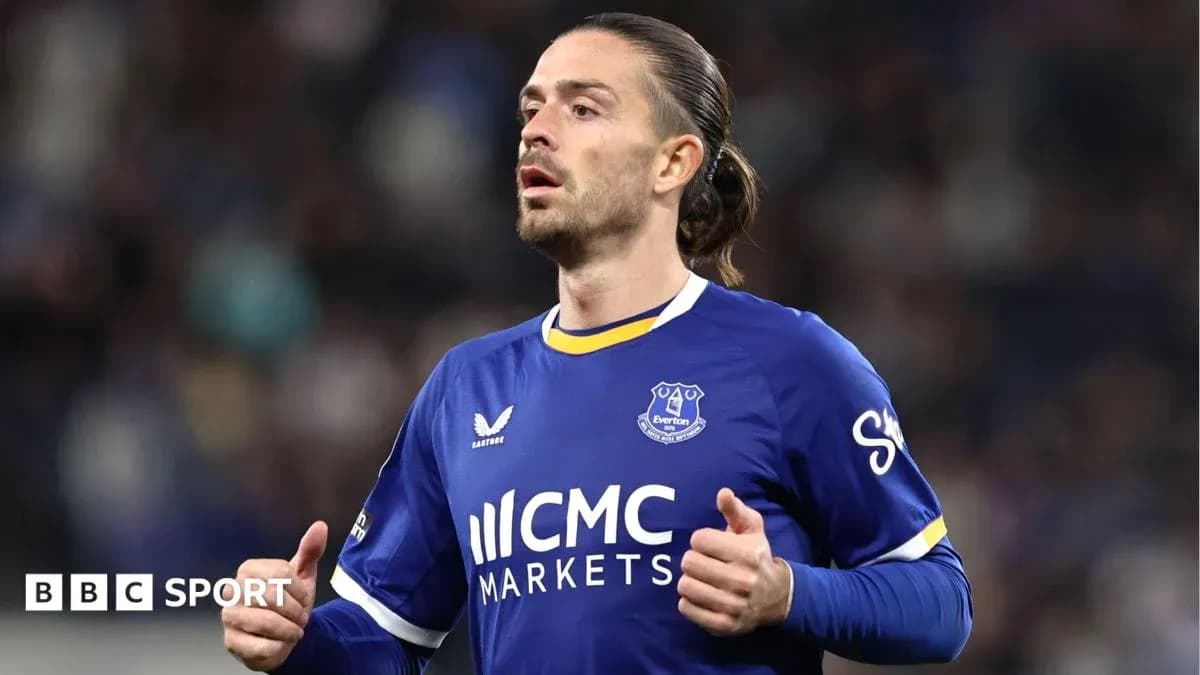
Jack Grealish's Everton Journey: From Homecoming to Hard Line
Jack Grealish’s white Lamborghini slid through the gates at Finch Farm an hour before the transfer window shut and, for a moment, it felt like Everton had their summer back.
Supporters flocked to the car. Grealish climbed out grinning, the same swaggering, everyman superstar whose first loan spell had been cut short by a broken foot but had still left a mark. Autographs, selfies, a sense of unfinished business. When he finally drove away in the early hours with the deal done, it felt less like a temporary arrangement and more like a homecoming.
Now, that romance is on the line.
From homecoming to hard line
Grealish’s omission from the squad for the Carabao Cup tie against Newcastle United was not disguised, not dressed up as “rotation” or “managing minutes”. Everton called it what it was: a “breach of club discipline”.
The offence was simple and stark. He failed to turn up for training on Monday.
For a 31-year-old who once became Britain’s first £100m footballer when he left Aston Villa for Manchester City in 2021, it is a brutal misstep. His exile from City at the start of the final year of his contract had already underlined how far his stock had fallen at the Etihad. This latest lapse now drags that uncertainty into his supposed sanctuary on Merseyside.
Everton’s choice to go public before kick-off underlined the severity. This was not an internal slap on the wrist. It was a line in the sand.
The stakes are obvious. If Grealish cannot make it work here, at a club where he is adored and indulged within reason, the slide away from the Premier League elite will be hard to arrest.
Moyes, a thin squad and a thick file
This is not being framed inside Goodison as a dramatic “last chance” ultimatum. David Moyes simply cannot afford that luxury. He has just 18 senior players after a messy, underpowered transfer window and is in no position to discard a potential match-winner.
But the pressure on Grealish has just ratcheted up. Again.
Moyes, a strict disciplinarian with clearly defined standards, has backed the club’s decision. The punishment was agreed at a high level but with his full support. Talks have taken place with Grealish. The message could hardly be softer in tone or firmer in meaning: no repeat.
BBC Sport understands there have been occasional issues with Grealish’s time-keeping in the past, though nothing on this scale. Inside the game he is widely regarded as a hard trainer, someone who looks after himself physically. That only deepens the frustration. This was not a player spiralling out of control. This was a senior professional making an avoidable mistake at the worst possible time.
Moyes has already had to juggle an ownership group, The Friedkin Group, who edged away from serious squad investment as they prepared to put the club up for sale. Every signing, every loan, had to be weighed. Grealish’s injury history, his wages, even his character were all debated before Everton moved again for a player who insisted Merseyside was the only place he wanted to be.
Now that careful gamble hangs in the balance.
A big win without their big name
The timing could hardly be more awkward for Grealish. While he sat out, Everton produced arguably their most complete performance of the season, beating Newcastle 3-1 to book a quarter-final at League Two Fleetwood Town, the side who knocked out Premier League champions Arsenal in the last round.
They did it with 20-year-old Tyrique George buzzing down the left flank – the very territory Grealish might have occupied. George brought pace, directness, a tempo that fits Moyes’ blueprint. It was the kind of display that makes a manager pause when he next writes a team sheet.
Moyes chose his words carefully afterwards, but the subtext was loud enough.
“You probably know I'm not going to give any details. It's a club decision and I support it. It's something I don't want to speak too much about,” he said, before turning the spotlight on the group that had just delivered.
“The one thing about Everton is that they have got real good values. All the players stand behind it and accept the values, on the pitch and off the pitch, and I think the players did a good job.
“It is a small squad, but we are doing our best to keep challenging. We are not accepting any excuses for anything and I think the players are doing a great job. There was a humility about us.”
He never mentioned Grealish by name. He didn’t need to. Every phrase about values, humility, no excuses, landed where it was intended.
A bond under strain
That is what makes this rupture so jarring. Moyes and Grealish clicked almost instantly when the first loan was arranged in August 2025. Grealish spoke warmly then: “As soon as I spoke to the manager, I knew there was only one place that I wanted to go and that was Everton.”
On the pitch, he gave Everton a different gear. This was a player who had helped Manchester City to a Treble – Premier League, FA Cup, Champions League – in 2023. At Goodison he brought that big-stage composure and carried it until a foot fracture in a 1-0 win at former club Aston Villa in January ended his season.
His affection for Everton was obvious in the aftermath. Instead of returning to City for rehabilitation, he stayed at Finch Farm, working through his recovery among staff and team-mates he trusted.
That bond helped persuade Moyes to go back in for him this summer despite the red flags. Yet the return has been flat. Grealish has failed to score or provide an assist in eight appearances this season – two for City before his move and six for Everton – and his habit of taking the sting out of attacks jars with the intensity Moyes demands.
He missed the weekend defeat at Arsenal with what was described as “illness”. Then came Monday’s no-show.
For a manager operating with a “paper-thin” squad, as those around the club often describe it, watching one of his most experienced players rule himself out through indiscipline is infuriating.
The man behind the headlines
Inside Everton, that frustration is laced with genuine affection. Grealish is hugely popular in the dressing room and across the club’s staff. He is routinely described as kind, charming, someone who goes out of his way for people and relishes being part of the community.
The stories stack up.
Recently he made a £10,000 donation to a GoFundMe page for Everton supporter Leon Skapars, a 36-year-old father of three diagnosed with cancer. The family are trying to raise funds for treatment. Skapars’ wife, Crystal, spoke of what the gesture meant: “In that moment, Jack gave our whole family something we desperately needed, hope. What he has done for our family is something we will never forget. It makes us feel incredibly emotional.”
He has used his profile in other ways too. At the Daily Mirror’s ‘Pride Of Britain’ event, where he appeared to present awards, he reflected: “Footballers are classed as heroes - but these are the real heroes.”
In April, he extended his role as principal ambassador for Special Olympics Great Britain for another three years, having first taken it on in 2022. To mark the extension, he hosted five of the 10 Special Olympics GB athletes who completed the London Marathon at Everton’s Hill Dickinson Stadium, giving them a VIP experience, a stadium tour and time on the pitch with him.
At Finch Farm, he is often among the first to engage with Everton’s community work, including sessions with the Everton in the Community Down Syndrome team. He speaks frequently about the inspiration he draws from his sister Hollie, who has cerebral palsy.
This is the version of Jack Grealish that people inside Everton see most days. It is why the club has been so willing to stand by him.
The other side of the coin
Yet his career has never been free of off-field flashpoints.
In April this year he was photographed asleep at a Manchester rooftop bar, surrounded by drinks. He had broken no law, but the optics were poor for a player rehabilitating from injury and living in an age where every phone is a camera.
Back in March 2020, during his Aston Villa days, he was fined by the club and issued a public apology after breaking lockdown rules to visit a friend during the pandemic. Later that year, in November, he admitted two counts of careless driving in incidents that damaged a Citroen van and a Mercedes.
These moments do not define him in the eyes of those who know him best. Many in football, and particularly at Everton, will still offer glowing references about his personality and generosity. That is what makes this latest breach feel so needless, so exasperating for his supporters.
Because the pattern is clear. And the room for error is shrinking.
Now or never
Grealish is not yet at the “Last Chance Saloon” inside Everton’s corridors, but he is walking down that street. The club’s patience, while not exhausted, is being tested. Moyes’ squad is too small, the season too demanding, to indulge repeats of Monday’s absence.
He has held talks. The rules have been restated. The consequences are obvious. The path back into the team is still open, but narrower than before.
Everton’s win over Newcastle, and George’s emergence on the left, means Grealish will no longer walk into the side on reputation alone. He will have to fight for his place. He will have to run, track, press, and play at the speed Moyes demands. He will have to be on time.
For a player of his talent, in a club that has embraced his flaws as well as his gifts, this feels like a crossroads he cannot afford to drift past.
The Lamborghini arrival, the selfies, the sense of homecoming – they all still matter to supporters. But from here, they will judge him on something more basic, and far more brutal: does Jack Grealish still want to be the player they thought they were welcoming back?





