John Martin Addresses Controversies Surrounding Israel Fixtures
The Republic of Ireland’s autumn Nations League campaign is edging closer, but the football feels like the least important part of it.
Two dates are fixed in the calendar: Israel in Debrecen on 27 September, then the return game on 4 October in Backa Topola. Two “home” and “away” fixtures, both on neutral soil, one of them behind closed doors for Irish fans. On paper, it’s a standard UEFA double header. In reality, it has become the most politically charged assignment Irish football has faced in years.
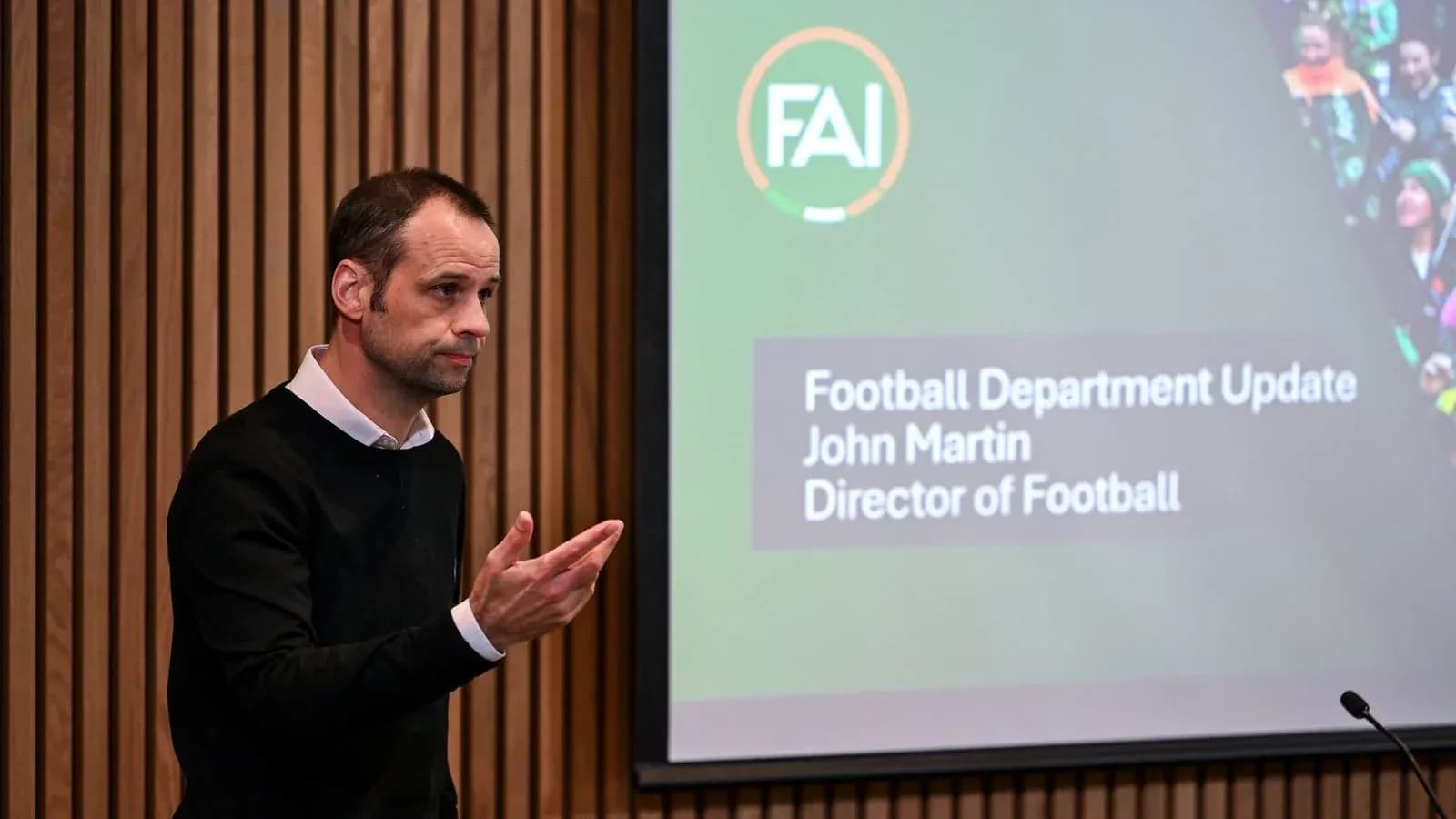
Inside the Football Association of Ireland, John Martin knows exactly where the spotlight is pointing. And he is trying to drag it away from the dressing room.
“It’s really hard on the players,” the FAI’s Director of Football said, stressing that the decision to fulfil the fixtures is not theirs. “People like me and David Courell made this decision, not the players.”
FAI stands over decision – but with clear reluctance
The association’s stance was formally set in July. At an extraordinary general meeting, delegates were asked to endorse the FAI board’s decision to play the Nations League games against Israel. Sixty-eight percent backed the board, 32% did not. The motion passed. The games would go ahead.
Since then, pressure has not eased. Campaigns and voices calling for a boycott continue to grow louder, targeting both the FAI and the players. The governing body has already moved to limit Irish fan involvement: no tickets for Ireland supporters for either match, with the September fixture in Hungary open only to Israeli fans and the October game in Serbia played behind closed doors for the “home” side.
Martin, though, did not pretend this is a comfortable position.
“We all agree, and the association has been on the record to say that we don’t want to be playing these games. That is the reality,” he said. “I don’t want to play the games, but for that to impact Irish football, that’s where I would maybe disagree with some of the voices.”
The fear is clear: sanctions. Non-compliance with UEFA competitions can carry heavy punishments, from fines and forfeits to longer-term damage to a country’s standing in European football. For Martin, that risk crosses a line.
“I think it’s for Irish football we will play the game,” he said. He accepts the anger, but he will not move the association off that position.
Shielding the squad
If the FAI’s decision is firm, Martin’s priority now is to make sure the players do not become collateral damage.
“It always falls on the players in a performance environment,” he admitted. This time, he insists, it should not.
He is blunt about where responsibility lies. “In this situation, the decision shouldn’t fall on the players because it’s not at the player’s decision. It was a decision made by the association, by the board and by the executive.”
So he offers himself – and Courell – as the lightning rods.
“People can criticise me and David, that’s fine,” Martin said. “We need to protect the players and look after the players because we shouldn’t find a situation where they’re being criticised.”
The FAI will not compel anyone to play. Martin confirmed that each squad member will be free to decide whether they make themselves available for the fixtures, with head coach Heimir Hallgrimsson tasked with handling the human side of that process.
“It’s a personal choice for the player,” Martin said. “We have a fantastic manager in person in Heimir who will manage that. But at all stages, we need to mind the player.”
That care, he stressed, is not new, but the stakes are.
“You should never forget the player,” he said. “It’s going to be really difficult because it does fall on them naturally because they’re on the pitch. But I would hope people can see that they’re following the lead of the association and following the decision that the association took, as opposed to putting them at the centre.”
The message is deliberate: judge the FAI, not the men in green.
Separate storm: third-party ownership probe
As the Israel fixtures dominate headlines, another issue has quietly landed on Martin’s doorstep.
The Sunday Times reported that the FAI is investigating alleged third-party ownership breaches involving Shamrock Rovers players Michael Noonan and Alex Noonan. The case stems from agent agreements and potential infringements of FIFA rules. Crucially, the period under scrutiny overlaps with Martin’s time as Shamrock Rovers CEO.
The complaint trail is already long. Earlier this year, the mother of Michael Noonan lodged a complaint with the English FA over agent agreements. Shamrock Rovers then announced they were working with FIFA to review two agreements, stressing that the club itself was not the focus of the case. That review has now been referred back to the FAI, which is seeking documents to establish the facts.
Martin, now an FAI employee, is not part of the team investigating the matter. He insists he has not been asked to step aside, despite the obvious questions around a potential conflict of interest.
“Absolutely not,” he said when asked if there had been any request to stand down temporarily.
On his time at Tallaght Stadium, he is emphatic. “I’m very comfortable about my time from Shamrock Rovers, exceptionally comfortable.”
He will not, however, be drawn into detail while the process runs its course.
“I can’t comment. I’ll leave that to other people to figure that out. It’s not something I’m worried about,” he said.
The tone is measured, but the line is firm. Martin wants to be seen as co-operative, not combative.
“I’ve been incredibly dignified, professional and respectful of the club. I intend to continue being dignified, professional and respectful towards the law because I think someone in my role needs that.
“I don’t think Irish football needs people to be talking public negatively about each other because that damages the perception of the game. I’m a naturally positive person. I’ve only good things to say about the club. It’s a situation I can’t talk about. But I’m in no way worried about it.”
Two controversies, then, circling the same figure at the heart of the Irish game. One about geopolitics and the price of defiance, the other about contracts and compliance. Both will test how far Irish football can bend without breaking.