From Joke to Six-Figure Offers: The Chimpanzee Fight Proposal
Cole “Wavy” Johnson thought he was making a joke.
One offhand claim on social media — that he, a 1-0 amateur MMA fighter from Minnesota, could beat a chimpanzee in a fight — has spiralled into one of the most disturbing, and potentially dangerous, viral spectacles the combat-sports world has seen.
Within days, the post reportedly drew millions of views. Then came the messages. Strangers, Johnson says, began contacting him with serious financial offers to turn the fantasy into a real event.
From online joke to six-figure offers
Johnson claims the first concrete proposal landed quickly: more than $500,000 to fly to an undisclosed country and fight a chimpanzee.
The terms, as he tells it, were as stark as they were surreal. The bout would be staged abroad. The animal would be an adult male. No sedation. Teeth and claws intact. People on standby with tranquillizers “in case” things got out of hand.
That initial deal, he says, collapsed when he decided the would‑be promoter wasn’t trustworthy. The money, the location, the logistics — too many red flags.
Yet the story didn’t die. Johnson now insists another group has stepped in with an even bigger offer, though he has refused to reveal the figure. A promotional website has reportedly appeared, complete with a countdown clock ticking toward September 11. Social media posts have stoked talk of a possible pay-per-view.
It all sounds like the blueprint for a grotesque new frontier in spectacle. But for now, there is no independent confirmation that any of it will actually happen, or that a legitimate, sanctioned contest is even being planned.
Johnson himself has admitted the original claim was a joke. The circus that has followed is very real.
Why experts say this is a nightmare scenario
Strip away the shock value and the viral noise, and one question remains: what happens if a human actually steps into a cage with a chimpanzee?
The issue isn’t whether an MMA fighter can “out-technique” an animal. It’s that conventional combat skills are built for opponents who share the same rules, the same anatomy, the same basic understanding of what a fight is.
A chimpanzee does not.
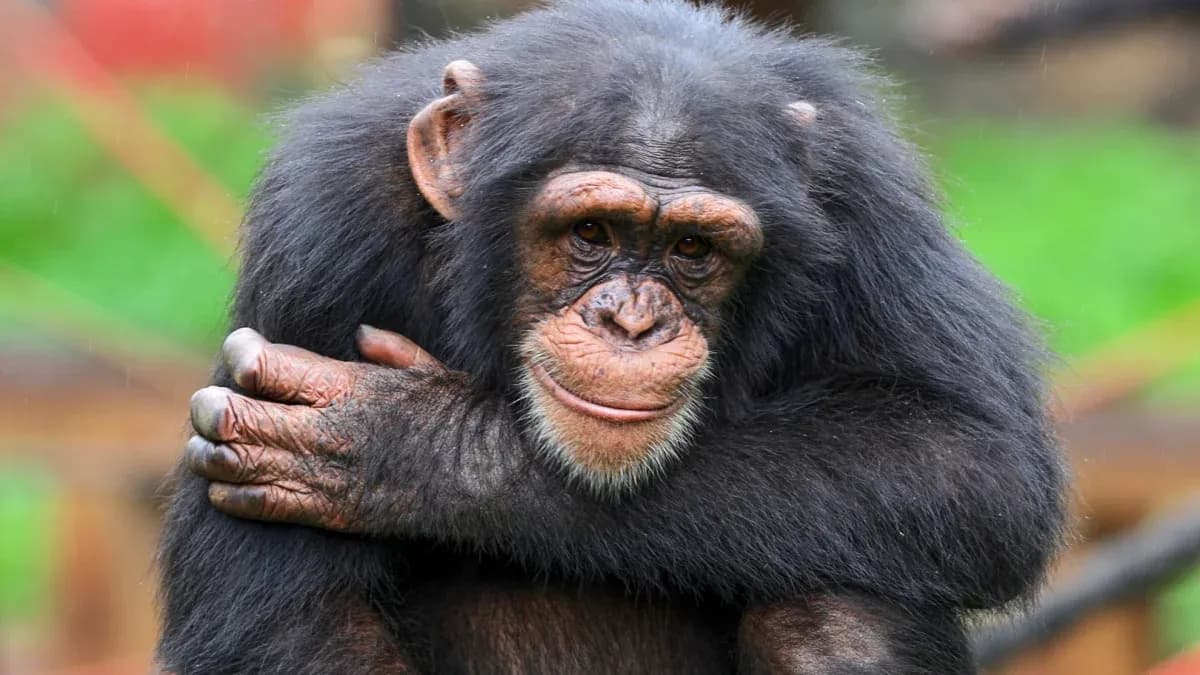
Research published in the Proceedings of the National Academy of Sciences found that chimpanzee muscle can generate roughly 1.35 times the maximum dynamic force and power of similarly sized human muscle. The same study reported that chimps carry a much higher proportion of fast-twitch muscle fibers — the explosive kind that drives sudden, violent bursts of movement.
That’s only part of the danger.
Primatologist Kimberley Hockings, who has studied chimpanzee attacks on humans, has documented how bad things can get. Research into incidents in Bossou, Guinea, between 1995 and 2009 shows that aggressive encounters between humans and chimpanzees can leave people with severe, life-altering injuries.
Hockings has warned against reducing the threat to a lazy “chimps are X times stronger than humans” soundbite. Their power is not just in raw strength. It’s in their jaws, their prominent canine teeth, their crushing grip, and an aggressive style of attack that bears no resemblance to anything seen in a sanctioned fight.
That is why the online jokes about Johnson losing fingers, ears, or far worse are laced with genuine unease. This is not a match-up. It’s a mauling waiting to happen.
No rules, no tap, no sport
An MMA fighter walks into a cage knowing the parameters: weight classes, referees, fouls, medical checks, the right to tap out. Even in the most brutal exchanges, there is an underlying framework of safety.
A chimpanzee has no concept of any of that.
It will not respect weight limits or weight cuts. It will not stop when a man taps. It will not avoid biting, gouging, or tearing because a rulebook says so. Its instinct in a perceived fight is to disable, disfigure, dominate.
The idea of people standing by with tranquillizer guns “just in case” underlines how far this strays from sport and into something else entirely. If the contingency plan for a contest is “we’ll shoot the animal if it goes too far,” the event has already crossed every conceivable line.
Beyond spectacle: ethics and legality
There is another layer to this, one that has nothing to do with arm bars or knockout power.
Deliberately provoking a captive wild animal for entertainment raises serious questions about animal welfare and legality. Any attempt to stage such a bout would face scrutiny not just from athletic commissions, but from animal-rights groups and legal authorities in whichever country tried to host it.
A chimpanzee is not a prop. It is an intelligent, social, highly stressed wild animal when placed in unnatural, threatening environments. Using it as an opponent in a human betting spectacle would invite outrage on a global scale.
The numbers being thrown around — six-figure, possibly seven-figure paydays — sound intoxicating for a young fighter chasing a break. But against a chimpanzee, the real price could be permanent and catastrophic: torn limbs, shredded faces, lost eyes, a life rewritten in a few frenzied seconds.
For now, the whole saga sits in a murky space between internet myth and grim possibility. Viral fame has already done its part. The money men, if they exist, are circling.
The real question is who steps in first: regulators, animal-welfare bodies, or an audience finally willing to say that some lines, no matter how many zeros are on the cheque, are not there to be crossed.