Kapil Pokhariya’s Journey from Backyard Brawls to Asian Games Bronze
NEW DELHI: Long before he ever laced up real gloves, Kapil Pokhariya was a menace to the pillows in his house.
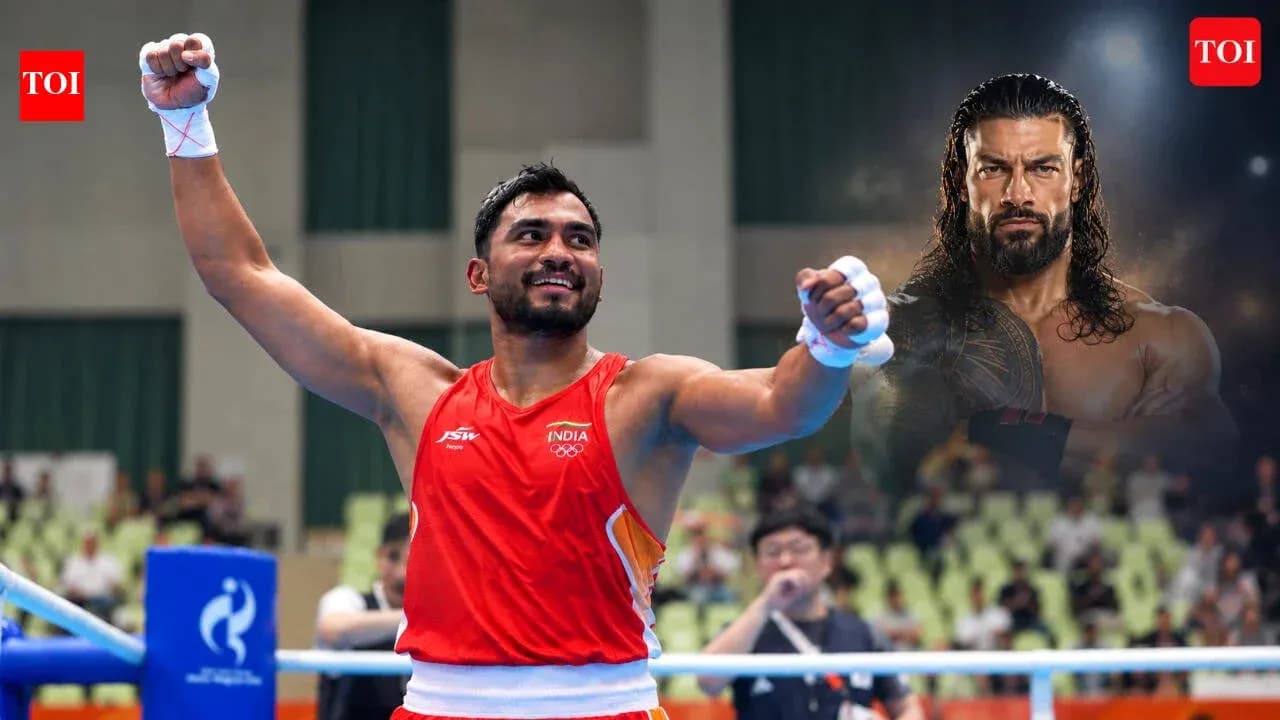
Cotton-filled mattresses became wrestling rings. Cushions were opponents. A homemade punching bag stuffed with mountain soil swung from a hook, taking the brunt of a boy’s obsession with WWE and one man in particular: Roman Reigns.
In his Chakarpur village in Khatima, Uttarakhand, everyone knew the kid who wouldn’t come out to play because WrestleMania was on. Or who skipped meals to watch Money in the Bank. Once the TV went off, the living room turned into his arena. He copied every move, every punch, every swagger.
He had no idea those make-believe fights would one day lead him to a real podium.
Today, that same boy is Havaldar Kapil Pokhariya of the Indian Army — and an Asian Games medallist. In Aichi-Nagoya, Japan, he fought his way to a bronze in the men’s 90kg boxing event at the 2026 Asian Games, the biggest moment yet in a journey that began with a grainy WWE broadcast.
“I never knew that copying Roman Reigns and practising those punches would bring me this far,” Kapil told TimesofIndia.com. He still has recordings of those old videos. He still remembers how he first learned to throw a punch: imitating a pro-wrestler on a TV screen and then trying it again and again on a sack of soil back home.
From Chakarpur to the ring
Kapil did not grow up in a boxing hotbed. Chakarpur, tucked away in Khatima, is far removed from the traditional nurseries that have produced India’s big boxing names.
His father, Narendra Singh Pokhariya, served in the Indian Army. He had a simple, clear dream for his son: study hard, wear the uniform, join as a commissioned officer, and rise higher than he did. Boxing was not part of that script.
So when Narendra saw his son flying off the bed like a WWE star and breaking things, the reaction was predictable — anger, scolding, even beatings when the damage piled up. But the boy didn’t stop. One day, he came home from school, filled a thick sack with sand and earth, and hung it up as a makeshift punching bag.
That changed everything.
“A teacher used to teach boxing at a nearby school. I saw the students punching a bag and decided to make one myself,” Kapil recalled. The father who once shouted at him now watched his son hammer that sack with a seriousness that didn’t look like a passing craze. Soon, Narendra took him to a training centre and got him admitted.
That was Kapil’s real entry into boxing.
No fancy academy. Just a small ground
There was no sprawling complex, no state-of-the-art gym waiting for him. Kapil’s first steps in the sport came on a modest training ground, sharing space with boys his age and older, all trying to learn the basics.
At the heart of that little setup was coach Pooran Bohra. He didn’t run a full-time academy. He trained a small group of boys for a few hours on selected days of the week. For many, it was a hobby. For Kapil, it quickly became something else.
“I come from a small village where boxing was never a popular sport,” Kapil said. “Pooran Bohra sir was there. He trained a small group of boys for just a few hours on selected days of the week. But I was interested in learning. I listened to him carefully and repeated everything he taught me when I returned home.”
The discipline grew. So did the ambition.
In 2015, he stepped into the ring for his first state-level competition. The scale hit him immediately. The crowd, the noise, the pressure of a real bout — it was all new. And it ended brutally fast.
He lost in the opening round.
“I was really disappointed. It was the first bout of my life, and I was seeing such a large crowd for the first time. I lost in the first round,” he said. That kind of defeat crushes some. For Kapil, it did the opposite. “That competition and the defeat taught me a lot. My interest in boxing grew even stronger after that.”
The response came at the national level. He arrived with a different mindset and left with something tangible: a gold medal. The win brought prize money, but more importantly, it opened the door that would change his life — a job with the Indian Army.
In April 2017, he joined the force and was appointed as a havaldar. The boy who learned punches from Roman Reigns now had a professional structure behind him.
The Army platform
The Army gave Kapil what small village grounds could not: regular competition, quality training, and a ladder to climb. He trained more seriously, entered Services competitions, and kept bringing back medals. Each one nudged him closer to the elite level.
His father watched the transformation with pride and a sense of fulfilment. Narendra had joined the Army as a sepoy and retired as a havaldar. His dream was for his son to go further.
“My father wanted me to study and join the Army as a commissioned officer. He joined as a sepoy and retired as a havaldar. But he wanted me to reach a higher rank if I joined the Indian Army,” Kapil said.
The first big emotional breakthrough came not in Japan, but at home — the day he won a national medal. “He was very happy. The day I won a national medal, he hugged me. That was when I realised that I had achieved something big in my life,” Kapil said.
Now, with an Asian Games bronze on his resume, the rank is catching up to the dream. Kapil will be promoted to naib subedar. The son has moved past the father’s last rank.
“Papa said, ‘Ab tu mera senior ho gaya hai’,” Kapil recalled with a smile.
‘Khatima ka Russell’
Boxing is his profession now, but like so many Indian kids, Kapil’s first love on the field was cricket. Gully cricket, inter-village tournaments, makeshift pitches — he played everywhere he could in Uttarakhand.
His frame stood out. Tall, muscular, with the kind of power that made bowlers nervous and spectators drift towards the boundary line in expectation. The sixes came often enough for him to earn a nickname that stuck: “Russell”, after West Indies powerhouse Andre Russell.
“I loved Andre Russell. I also liked Hardik Pandya,” Kapil said. “People used to call me ‘Khatima ka Russell’ because of my power. The boys wanted me in their team because I could hit big sixes.”
That raw, explosive strength now fuels his punches instead of his pull shots.
The road to LA 2028
For all the emotion of the Asian Games bronze, Kapil treats it as a checkpoint, not a destination. The medal has already reshaped his immediate future. Under the Boxing Federation of India’s selection criteria, Asian Games medallists will be the main entries in their respective weight categories for the 2027 World Boxing Championships in Astana, Kazakhstan.
The stakes there are enormous. Scheduled for April, the World Championships will be the first qualifying event in boxing for the Los Angeles 2028 Olympic Games.
Kapil knows what that means. The boy who once shadowboxed in front of a television now has a clear line drawn from his village to the Olympic rings.
“Rukna nahi hai ab, bas aage dekhna hai,” he said. There is no talk of slowing down, no temptation to bask in what he has already done. “The Olympics is the ultimate dream. I want to go there, represent my country and win a medal. That is the only thing on my mind right now. I am preparing for the World Championships in April,” he added.
From cotton mattresses in Chakarpur to the podium in Aichi-Nagoya, every step has carried him closer to that dream. The next time Kapil walks into a ring, it will not be as a boy copying Roman Reigns, or as “Khatima ka Russell”, but as a man trying to punch his way into Los Angeles — and into Indian boxing history.