Katie Taylor: A Champion's Journey in Irish Boxing
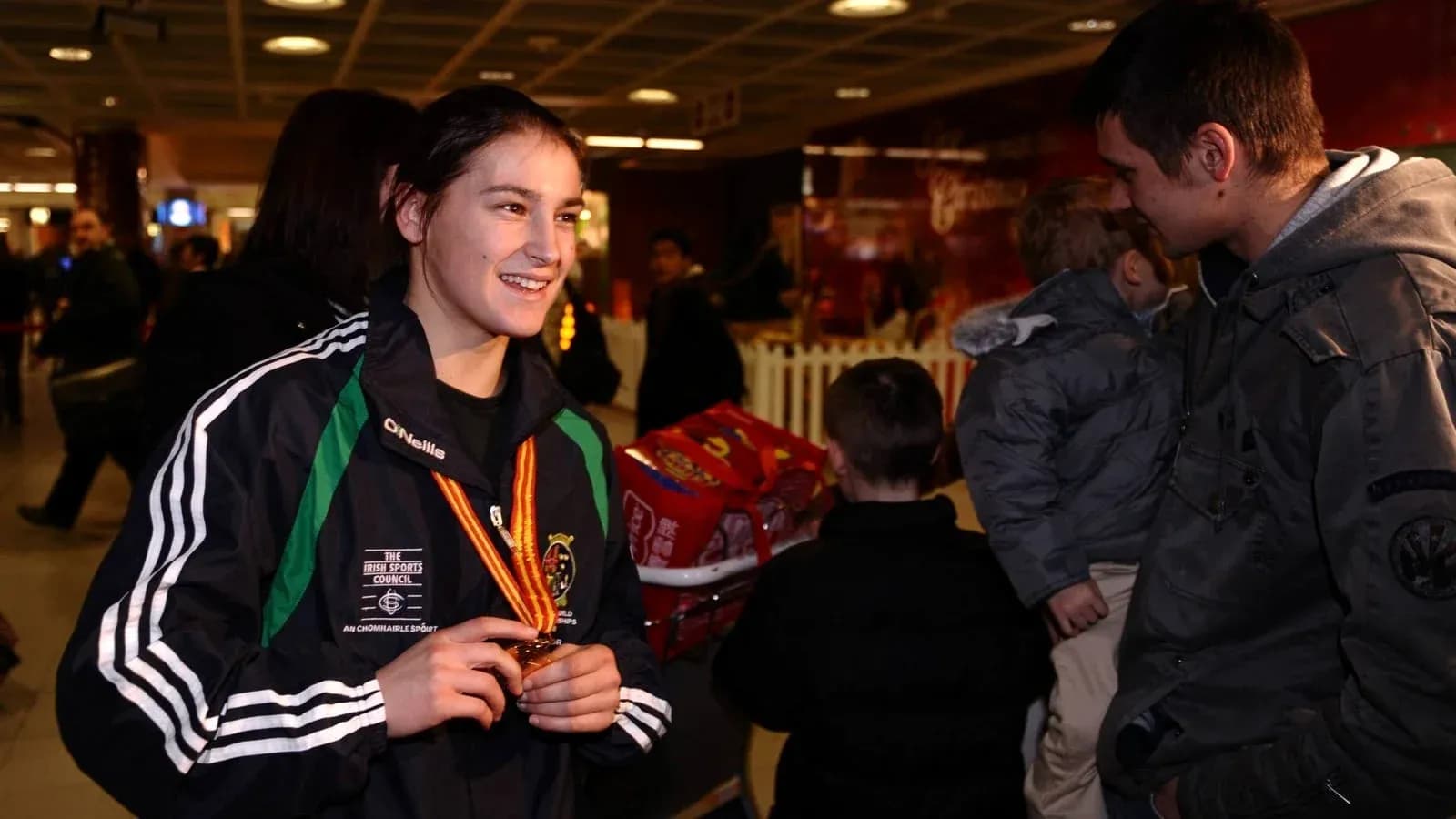
On a Dublin night that will feel more like a pilgrimage than a prizefight, Katie Taylor will walk into Croke Park to close the book on one of the most transformative careers Irish sport has ever seen. Before that final ring walk, those who shared gyms, planes and press gantries with her remember the moments when it first became clear: this was no ordinary fighter.
“She’s a girl but she is a champion”
Eric Donovan met Katie Taylor before the medals, before the sold‑out arenas, when the Irish high‑performance setup was little more than a bold idea and a handful of hopefuls.
They were teenagers then, same weight, same dreams. Same ring.
“I would have been on the Irish team from its inception in 2003,” Donovan recalls. “Katie would have been around the Irish team at that time. We were always the same weight division so around then, we would have started sparring together.”
Back then, women’s boxing was barely tolerated, never mind embraced. Donovan admits he treated her differently in those early spars. Too gently. Too carefully.
“In the early days, when I was sparring with Katie, I used to take it easy. Because she was a girl.”
His coach, the uncompromising Zaur Antia, spotted it instantly – and tore into him.
“He said, ‘Eric, that's very bad sparring. Very, very bad. Not good.’ I came back and said, ‘I'm sparring Katie Taylor. I'm sparring a girl.’ He actually got mad at me. Really, really mad. He said, ‘She's a girl but she is a champion! She wants to be Olympic champion. You have to be serious about this!’”
The message landed. Donovan was only 16 or 17, but his entire view shifted in that moment. No more half‑measures. No more pulling punches.
“I always looked at Katie differently then – she's another athlete in the gym who deserves respect and deserves to compete with us. I pushed it then. I always sparred at my absolute best with her. It was always very technical, very high-speed and intense but it never crossed the line into a malicious kind of spar.”
Those spars were not easy. Not for her, not for them.
“A lot of those spars against her male counterparts wouldn't have been, let's say, complimentary to her. She gave as good as she got but in the early days anyway, she would have been on the receiving end. Paddy Barnes would have had great, great battles with her but he was conceding a lot of weight so that kind of balanced it out.”
Taylor was one of only a handful of women operating at that level. Deirdre Gogarty had gone before, blazing a lonely trail from afar. Taylor stayed, picked up the mantle and forced Ireland to change.
“She was one of a few female boxers at the time but at that elite level, she was out on her own,” Donovan says. “Katie picked up the mantle after her and broke down barriers and it led to law changes in Ireland.”
The heartbreak came early too. Women’s boxing was shut out of Beijing 2008, even as Taylor had already become a world champion in 2005.
“I remember she was broken-hearted when women's boxing wasn't in the Beijing Olympics,” Donovan says.
Two years later, at the 2007 World Championships in Chicago, she was invited to box an exhibition on the final night. It was more than a showcase. It was a test case.
“She was told in the dressing room that she was going out to box for women's boxing to be included in the London Olympic Games. That's what the delegates told her in the dressing room before she went out to fight. That's the pressure she was under.”
Taylor walked out and delivered a masterclass. The arena knew it. So did the fighters watching.
“That night, I was in the company of a lot of top British fighters – Frankie Gavin, Billy Joe Saunders, Luke Campbell, James DeGale – and they were all saying, ‘oh my goodness, who's this?’ And I said, ‘that's my sparring partner!’”
From super‑fan to teammate
For Gráinne Walsh, Taylor was not just a peer or a name on a team sheet. She was the reason she ever laced a glove.
Walsh was a footballer first, a self‑confessed “full soccer head” whose dream was to turn professional. Boxing had no roots in her family, no tradition pulling her towards the ring. Then 2012 arrived.
“I was actually 16 when I started boxing,” she says. “I don't come from a boxing family or anything like that. There's no heritage of my dad, my uncles being into boxing. But I was always intrigued by boxing as a sport and Katie Taylor is obviously responsible for that.”
That summer, Walsh needed something to keep fit. No soccer league. No obvious plan. Then fate parked a boxing club across the road in Tullamore – and attached Katie Taylor’s name to the opening.
“There was a boxing club opening up across the road from my house. And Katie Taylor was coming to Tullamore to open this club. I figured out it was meant to be.”
Taylor arrived fresh from China, having just become world champion for the fifth time. London 2012 loomed.
“It was around May, just a couple of months before she went to London,” Walsh remembers. “After meeting her, I was glued to the Olympics. It was the first time women were allowed to compete in the Olympics. It was a monumental Games for boxing in general.”
Walsh saw more than a champion. She saw someone who had imagined a future that did not yet exist.
“I always take my hat off to Katie to be able to have seen this dream which was never actually a reality or even a possibility. She fought for it to become a possibility. It's a cliché to say but she really has paved the way for the likes of myself.”
The doors Taylor kicked open changed Walsh’s life.
“I wouldn't be in the position I'm in now if it wasn't for her opening all the doors and giving female boxing such a platform in Ireland, in particular.”
Soon, Walsh wanted to see the work behind the medals. Her club coach knew Zaur Antia, and she begged for a glimpse of the high‑performance world.
“I was asking my coach to please ask Zaur can I go and watch Katie train. I used to go to the high performance unit and just sit in the corner and watch her train.”
The girl in the corner became a national champion. Then an international.
“After a couple of years, I got called up to the Irish team – I won a couple of national titles or whatever. I started boxing in 2012. In 2016, I went to the world championships in Kazakhstan and Katie Taylor was my teammate.”
The leap from fan to colleague did nothing to dull the awe.
“That was so bizarre. I went from super-fan to... still a super-fan but she's sitting beside her on the plane and I'm trying not to stutter and go red when I'm talking to her. Because I was just in awe of her.”
Gold in London, chaos in the arena
For commentator Marty Morrissey, Taylor’s Olympic gold in London did something no All‑Ireland final, no Clare hurling epic, had ever quite managed.
“I commentated on Katie for her gold medal win on radio,” he says. “Up to Mayo winning the All-Ireland a couple of weeks ago, people might be surprised to learn that it was my No 1 experience as a commentator.”
This from a man steeped in Clare’s hurling story.
“Everyone thinks it would be the Clare hurlers [in 2013 and 2024] which would be dear to my heart. But Katie winning a gold medal in the Excel Arena in London was a different level entirely.”
The ExCeL that day felt less like a neutral venue and more like a travelling Irish cathedral. The soundtrack was unmistakable.
“It was a social occasion and a historic occasion. When the Fields of Athenry was being sung by the crowd, it echoed and reverberated around the building.”
The fight itself was tight. The result, for a few seconds, was not obvious even to the woman at the centre of it.
“I remember Katie had a moment of doubt of whether she won gold because she turned to her father Pete and her coach, Zaur Antia, and looked unsure. It was a very tough fight. They assured her that they felt that she had and then the announcement was made and she was Olympic champion.”
Around them, history twisted into something slightly surreal. British army soldiers guarded every exit. The Irish fans, delirious, turned it into a photo opportunity.
“It was amusing given our history that there were British army soldiers guarding every exit and the Irish fans were so overjoyed, they were taking pictures and selfies with the soldiers.”
Then came another strange cameo.
“One strange memory that night. Jimmy Magee, our good friend and former colleague, was beside me doing the TV commentary. And I was on the radio. And who came along to say hello to us only Kate Middleton. She was there at the boxing that night. I presume Prince William was there but he wasn't near us. We didn't meet him. But Kate was up beside us in the commentary position for some reason. I don't know why.”
RTÉ wanted Taylor on television with Bill O’Herlihy. The problem? They couldn’t get near her. She wasn’t answering her phone. Her family had other priorities.
“Her father told me they weren't doing any TV. They were doing no media. This was a night for the Taylors. It was a private moment.”
Morrissey, though, is nothing if not resourceful. A tip‑off led him towards the medical centre. A white coat offered the perfect disguise.
“I discovered from one of the backroom team that she was getting a medical done. I went down to the medical centre and saw there was a doctor's coat with a lanyard lying there. I literally put on the jacket and walked into the medical centre. A couple of the Irish boxing team saw me in there and started laughing and asked what the hell are you doing here?”
Inside, he found Katie and Pete. One more refusal from the father. One quiet intervention from the daughter.
“Pete said no again. But Katie could see what I wanted. And she said, ‘Dad, I think we should do the interview.’ So, that's how I got her on the TV that night.”
The night still had one more twist. The Taylors were told to attend the “Irish embassy” for celebrations. It was not what they expected.
“Before she appeared, Pete said they were due to go to the 'Irish embassy'. So, we organised transport and brought them to the venue as directed. Half an hour later, Pete rang me and said 'can you please send a car for us again?' He seemed a bit flabbergasted and under pressure. I said, 'OK, is everything alright?' He told me that it turned out 'The Irish Embassy' was a pub.”
The welcome was enormous. The timing, less than ideal.
“They got the biggest welcome ever in the pub but it wasn't where they wanted to be that night. And so, they were picked up again and brought back to RTÉ studios and they appeared with Bill O'Herlihy that night.”
The girl from Bray who beat up the lads
For Hugh Cahill, the legend of Katie Taylor began not on television but as a rumour travelling the short distance between Bray and Greystones.
“Katie is from Bray and I'm from Greystones. We heard about this unbelievable girl boxer called Katie Taylor,” he says. “I didn't know a huge amount about her other than she was beating up lads in sparring and more than holding her own. Which was just such a mad concept at the time.”
Cahill thought it sounded like local hype. Small‑town myth‑making.
“I thought, as is usual with these things, and particularly when it's a local story, that people were getting carried away and were overhyping her.”
Then he watched her train. Any doubts vanished.
Pete Taylor, working the door at Jim Doyle’s pub on the seafront – a sponsor of Greystones Rugby Club – was the link. Cahill knew the father before he knew the fighter.
“So, I knew him before I knew Katie and then I went to see her train.”
What he saw changed the conversation around women’s boxing in his own mind, and in the wider public’s.
“A lot of people couldn't get their heads around women's boxing at the time. And it was kind of a novelty thing until people really saw what she could do.”
By the time London 2012 rolled around, the novelty had been replaced by something else: expectation. The final against Sofya Ochigava became one of those nights that stays with a broadcaster forever.
“The 2012 Olympic final against Sofya Ochigava... alongside Bernard Dunne's world title victory in 2009, it was probably one of the most seminal sporting events that I was ever at.”
The ExCeL Arena, compact and heaving, amplified every roar.
“The Excel Arena was such a tight venue that it was like being in a nightclub. All the shouts and roars would rebound off the walls. Almost no one in there was up for Ochigava. There might have been a handful of Russians in there, her teammates and whatnot. But they were completely drowned out.”
Cahill is left with a paradox. Taylor is adored, endlessly surveyed, constantly cited as a role model – and yet, in many ways, remains unknowable.
“When I think about Katie, I still feel that not many people really know her. We know from surveys that she's hugely admired. She does a huge amount of quiet work for charity. But outside of her boxing greatness and her religious beliefs, I think much of the general public would struggle to tell you much about her.”
“She was good, she was deadly”
Long before the Olympic gold, the professional belts and the sold‑out arenas, Mick Dowling saw a young girl from Bray walk into Mount Tallant Boxing Club in Terenure. She didn’t look like a wrecking ball. She fought like one.
“Her dad Pete was a good friend of mine. He would have brought her over to my club, Mount Tallant Boxing Club, in Terenure,” Dowling says.
What struck him first wasn’t power. It was relentlessness.
“My initial memory of her was she was hugely dedicated. She threw a lot of punches, she wasn't a big hitter but she was so, so fit. She was a bob-weave-slip-slide fighter. I like that style of fighting. She was all-action.”
Behind that style stood a father who shaped every early step.
“Her dad was a huge, huge influence on her in those early days. Don't forget the contribution he made which was massive.”
Dowling’s verdict on the teenage Taylor is simple and emphatic.
“She was good, she was deadly. You could see she had a lot of promise. It's like seeing a top-class footballer. You can see the talent.”
There was toughness too. The kind you can’t coach.
“And she was able to take a punch. Many fighters don't have a good chin but Katie was able to take one. The whole trick of course is to take as little possible. Katie didn't mind taking a few shots but she would always give more than she would take.”
As a coach with the Irish team, constantly on the move, Dowling still found his eye drawn back to the same young fighter.
“I was coaching with the Irish team at the time and was travelling around the place but I could see this was a real, real up and coming young star. And she's proven that's exactly what she was.”
Now, as Croke Park prepares to host her final act, those early memories – the teenage sparring wars, the girl in the corner of the high‑performance gym, the commentator in a stolen doctor’s coat – all point to the same truth.
Katie Taylor didn’t just climb to the top of her sport. She dragged the sport with her. The question, as she steps through the ropes one last time, is who will dare to follow the path she carved.