Katie Taylor and the Evolution of Croke Park
Eddie Hearn strode to the microphone in Croke Park last June and did something he rarely does. He paused.
"It's not often I'm lost for words," he began, launching into a nine‑minute sermon about the Taylor-Pili fight and the stadium that would stage it. Then he reached for the big line.
"The last person to fight at this incredible stadium? Mohammad Ali."
It was a great soundbite. It was also wrong.
Ali did fight there, of course. But he did so in a different Ireland, in a different Croke Park, and in a different GAA. The gap between then and now tells you as much about the country as it does about the ground.
When Ali came to Croker
When Muhammad Ali met Al “Blue” Lewis at Croke Park in July 1972, Dublin treated him less like a visiting boxer and more like a visiting head of state.
He was mobbed on the steps of Leinster House. He met Taoiseach Jack Lynch in private. He sat down for a long, searching television interview with Cathal O’Shannon. Eddie Keher took him out and tried to teach him how to swing a hurl.
Ali wanted more than photo ops. He was determined to meet Bernadette Devlin, the firebrand MP from Tyrone. They had lunch on the day of the fight and talked politics, a subject on which they were perfectly aligned. This was Ali at his most engaged, most visible, most accessible.
From Eddie Hearn’s vantage point, that week in 1972 might have doubled as a warning label.
Only 18,000 people turned up on fight night. A sizeable chunk of them didn’t pay. The promotion bled money for its organiser, Michael “Butty” Sugrue, a Killorglin publican and former circus strongman once billed as “Ireland’s Strongest Man” with Duffy’s Circus.
GAA director general Seán Ó Siocháin publicly slapped Sugrue on the wrist for ticket prices he felt were too steep. Author Dave Hannigan, in his book The Big Fight: When Ali Conquered Ireland, argued that Ali’s very ubiquity in the city dulled the edge. Dubliners had seen him everywhere in the build‑up; the mystique had been spent before the first bell rang.
Rule 42 and a changing code
Ali’s night at Croke Park came long before the modern arguments about “foreign sports” and GAA grounds. The mythology around Rule 42 has grown with the years, but the text itself was narrower than the folklore.
Officially, it barred horse racing, greyhound racing and “field games other than those sanctioned by Central Council.” In practice, that meant the rival British codes. Soccer and rugby, in other words.
Yet even before the rule was loosened, Croke Park had already dabbled in outside attractions. Four American football games were staged there before the rule’s relaxation, and a couple of baseball fixtures in the late 1940s slipped into the calendar.
The real shift came at Congress in 2005. Delegates, staring at the looming redevelopment of Lansdowne Road, were appalled at the idea of Ireland home soccer games being shipped off to Anfield. A temporary lifting of Rule 42 passed, just in time to open Croker’s doors to the national teams.
Four years earlier, they had balked. In 2001, an attempt to scrap the rule missed the required two‑thirds majority by just two votes. President Seán McCague, a traditionalist, turned away all appeals for a recount. The old order held—for a while.
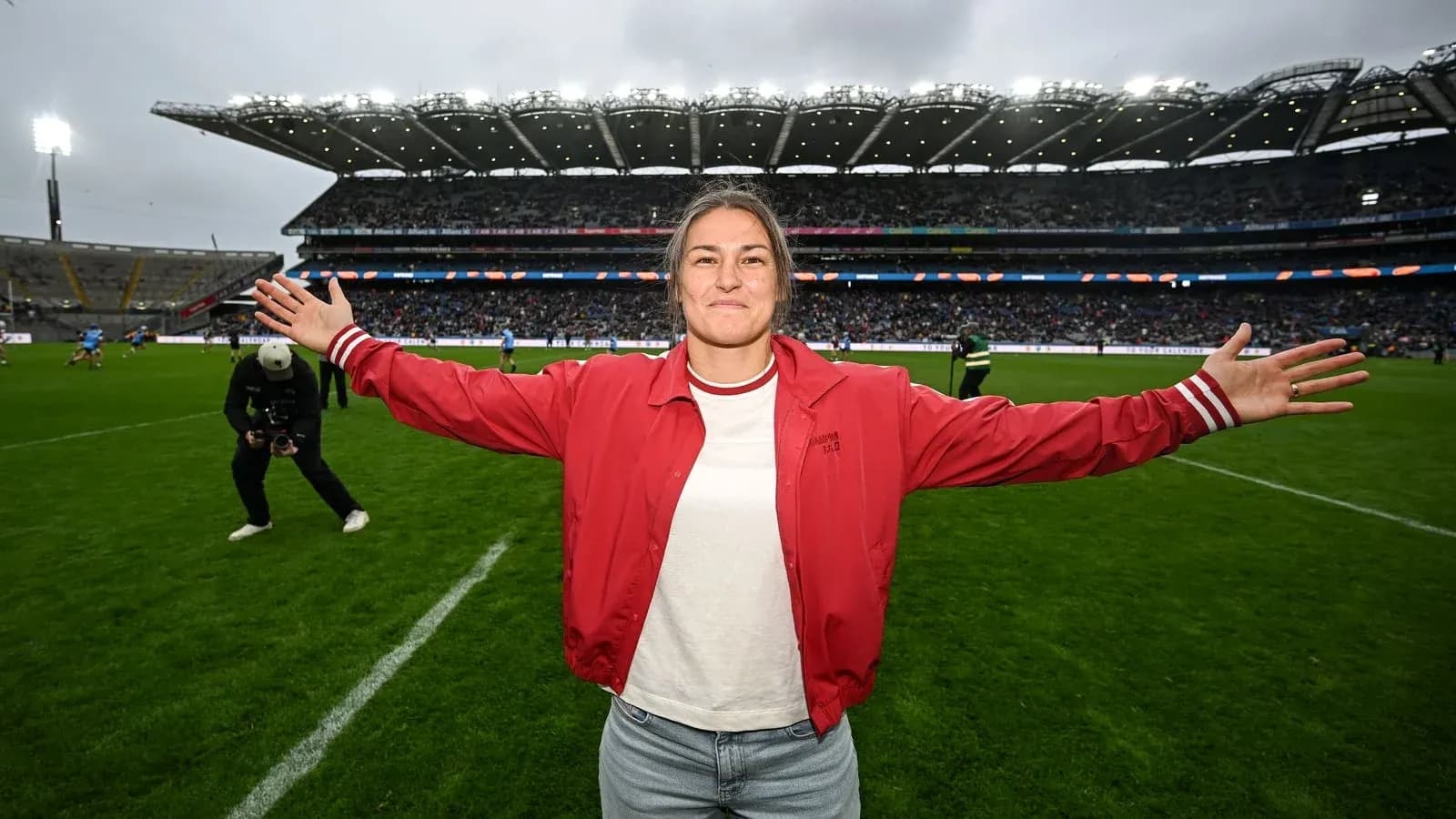
The cumulative effect is that Katie Taylor will walk into a Croke Park that Ali would barely recognise. A ground that has shifted from fortress of one code to a multi‑purpose arena, a stage for every kind of spectacle.
From stop-gap to showpiece
This summer laid bare just how far that evolution has gone.
Croke Park was first opened to soccer and rugby as a stop-gap, a necessary inconvenience to avoid the embarrassment of Ireland playing competitive home games abroad while Lansdowne Road lay in pieces.
Now? It’s a destination.
This month, the stadium hosted a pre-season friendly between Manchester United and Leeds United, a meeting that now carries the remarkable distinction of being the best attended soccer match ever played on the island of Ireland.
GAA President Jarlath Burns, whose three-year term ends early next year and has already been one of the most consequential in recent memory, turned up in his official capacity. He freely admitted he had no great feeling for either club. He has said it before and said it again: he is an Arsenal man.
Contrast that with John Downing in the late 1980s. The then GAA president told a Sunday newspaper he would not be watching Ireland play England at Euro ’88 in Stuttgart. He planned to mow the lawn instead.
Different eras. Different instincts.
By 2026, the United–Leeds fixture stirred more anger among League of Ireland ultras than among GAA loyalists, though there was still some grumbling on the latter side.
Pat Gilroy, speaking to the Irish Times, said he has taken to calling Croke Park “Ceasar’s Palace because it’s just a revenue generator. And that’s not Peter McKenna’s fault. He’s doing a great job but he’s doing it with the hand he’s dealt, which is ‘we need more money’.”
McKenna, the stadium’s commercial chief, makes no secret of his ambitions. He talks openly about bringing more Premier League pre-season games to Jones’s Road. He has even floated Croke Park as a possible Champions League final venue.
The financial logic is obvious. The GAA’s most recent annual reviews spell it out in black and white. The 2024 report showed a 19% jump in overall revenue, powered largely by a packed summer at Croke Park. Stadium income alone climbed 60% year-on-year, even though match-day attendances actually fell compared with the previous summer.
The difference? Concerts.
Croke Park staged seven of them in 2024—Bruce Springsteen, AC/DC twice, and Coldplay across four nights. In 2023, it had none, unless you count the Mary Wallopers warming up the crowd before the All-Ireland hurling final.
The split season and “Ceasar’s Palace”
Critics of the split season like to point at that concert schedule and say: there, that’s why the calendar changed. It’s easier to rail against Bruce and Coldplay than against club players who simply want to know when their championship starts.
Yet it was not the grassroots who tried to drag the All-Ireland finals back into August. It was the GAA leadership.
They put forward a compromise motion to nudge the showpiece Sundays into the later summer. By the time Congress arrived, the proposal was so clearly doomed that it was pulled before it could be voted down.
The upshot? Croke Park—Gilroy’s “Ceasar’s Palace”—remains wide open for musical superstars, Premier League heavyweights and boxing extravaganzas through August and into early September.
And that is where Katie Taylor comes in.
Katie Taylor’s line in the sand
Taylor’s long-awaited fight at Croke Park lands on one of the most evocative weekends in the GAA year.
Traditionally, the first weekend of September belonged to the All-Ireland hurling final. With a few exceptions—between 1997 and 2005, and again in 2012 and 2013, when it was pushed to the second Sunday—this was hurling’s high holy day.
From a traditionalist’s vantage point, this Saturday should have seen Galway and Limerick supporters pouring into Dublin, filling its pubs, trading stories and superstitions on the eve of a decider. It should have been the night Daithí and Jacqui sat Joe Connolly and Joe McKenna down to talk about the 1980 final, about speeches and missed chances and what it all meant.
Instead, the stage belongs to a boxer from Bray.
Whatever their reservations about the stadium’s new identity, even the most hardline GAA loyalists will struggle to begrudge Katie Taylor this moment. She is, in her own way, as emblematic of modern Ireland as any county team that has ever climbed the Hogan Stand steps.
And she was uncompromising about where this chapter had to be written. Back in June, she made it clear that the Aviva Stadium would not do. If that was the only option, she said, she would walk away.
It was Croke Park or nothing.