Katie Taylor's Historic Farewell at Croke Park
Four days out from Katie Taylor’s long goodbye at Croke Park, her camp is floating somewhere between business mode and disbelief. The fight is still to come. The occasion has already landed.
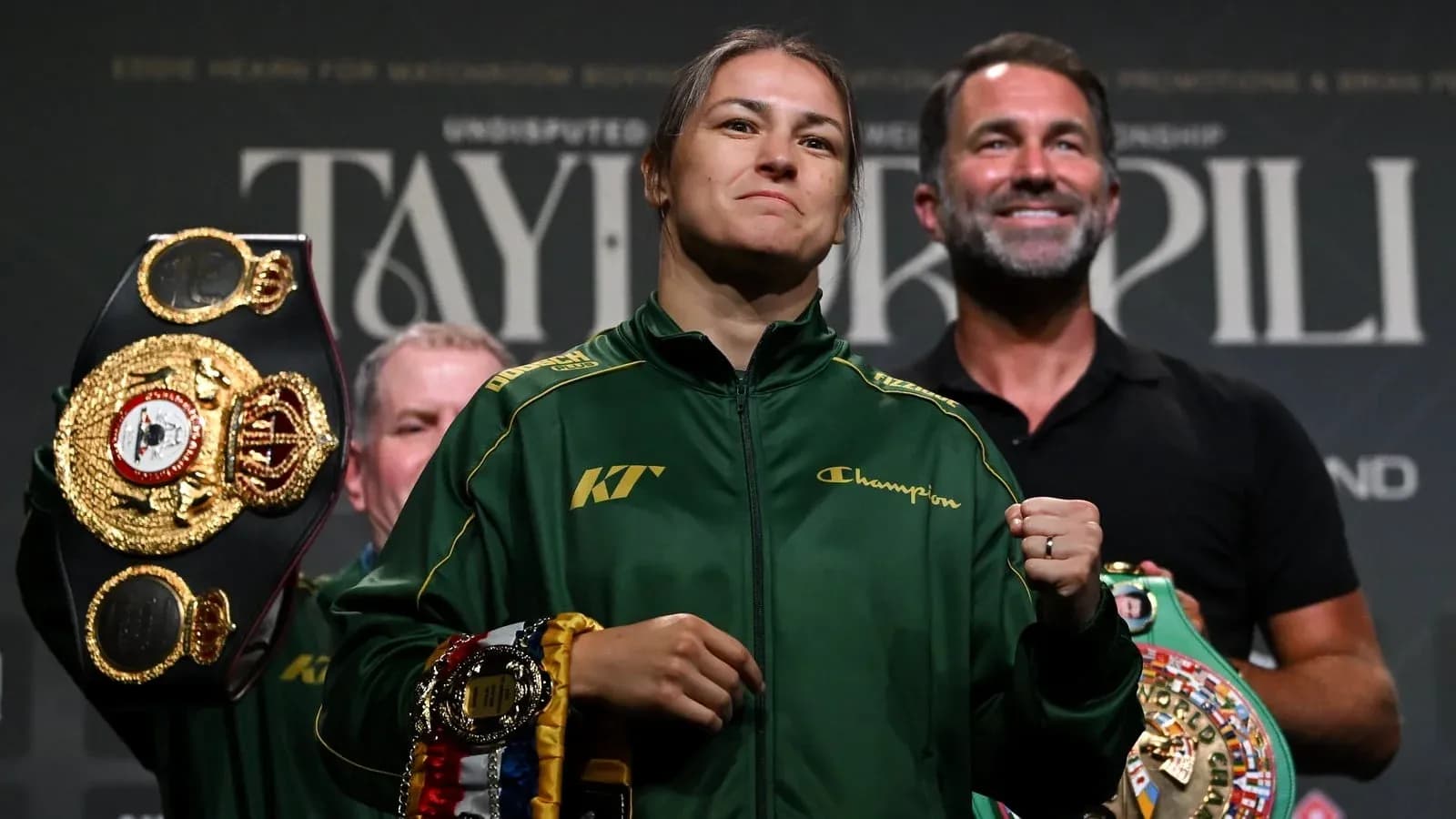
Tuesday’s press conference felt like a remix rather than a new track. Same lines, same faces, just a different backdrop. June’s launch in the Hogan Stand premium section had shifted across the city to the Helix Theatre in DCU, a short hop from lecture halls where undergraduates wandered past with headphones in, largely oblivious to the fact that Ireland’s greatest boxer was a few hundred metres away planning her final act.
Inside, the scene jarred with the campus calm. GAA regulars rubbed shoulders with Matchroom and DAZN staff, the latter instantly identifiable by sharp suits and sharper Cockney accents. Over the speakers, that familiar, tin whistle-heavy Croke Park instrumental looped relentlessly, the soundtrack of so many All-Ireland build-ups now repurposed for a different kind of headliner.
This time, there was one notable change from June: no tension about ticket sales. No nervous glances. No “how’s it going?” whispers. The numbers had crushed all doubt.
Taylor will become the first boxer to top a bill at Croke Park since Muhammad Ali in 1972.
Brian Peters, never shy about context, might argue that it’s flattering company for Ali to be keeping. Back then, only around 18,000 turned up to see Ali face Al “Blue” Lewis, and the GAA director general tore into the promoter for overpricing the tickets.
This time, Ireland answered before the question was even finished. Half of the 80,000 tickets vanished in pre-sale. The remaining 40,000 were gone within 17 minutes of going on general sale on 28 July. No spin required. Just raw demand.
Before the live-streamed top table show began, 18 journalists were squeezed into a cramped dressing room, waiting for Eddie Hearn to make his entrance. When he finally ducked in, he took one look around.
“Wow, blimey! This is small!”
The promoter who has spent years trying to drag Taylor to Croke Park wore the look of a man both vindicated and slightly annoyed with himself. The speed of the sellout, he admitted, came with a sting: why didn’t they do this sooner?
In June, Hearn had been all bonhomie with his old sparring partner in negotiations, Croke Park stadium director Peter McKenna – “Peter, me old mate, me old mucca!” – but he hasn’t forgotten the grind it took to get here. He talked again about the resistance he felt from the stadium side, the sense that the people he needed to believe in the event were the ones pouring cold water on it.
“People can sort of deflate your spirit, which is quite unusual for me,” he said. “They did deflate my spirit a bit over the years. They made me question whether we could do it or whether it would actually work.
“I’m disappointed with myself that I allowed that to happen because maybe we could have done it earlier.
“If Croker had originally gone, ‘Yes, this is going to be massive!’, we would have done it.
“But they was like, ‘Hmm... I dunno’. And it was like, well blimey, if they’re not sure, do we really want to be gambling with these costs?
“Listen, they [Croke Park] helped out as well, they were fantastic in the end.”
The story Hearn tells about this night always goes back to one moment: Katie Taylor and Brian Peters walking into his office after the bruising disappointment of the Rio Olympics, laying out a vision for a professional career that would drag women’s boxing into the mainstream.
Hearn Jr has inherited all of his father Barry’s gift for the sell. Barry Hearn, after all, was the man behind one of Ireland’s most famous boxing nights: Chris Eubank against Steve Collins in Millstreet in 1995, a fight that only happened there after Noel Smith cheerfully convinced him the venue was “just around the corner” from Cork Airport. (“IT WAS ABOU’ AN ‘OUR ‘N A ‘ALF FROM CAAAUK AIRPORT!!!”)
But when it came to Taylor, the elder Hearn didn’t see the gold at first glance.
“We decided to headline her in November [in 2016],” Eddie recalled. “I think we paid her – she’s still having a go at me about this – six grand for her debut. For a four rounder.
“Which at the time, in women’s boxing by the way, was a lot of money.
“I said to my Dad, I’m going to put Katie Taylor on last. And he’s like, ‘What? A women’s fight?’
“I was like, ‘yeah, dad, like she’s unbelievable. You’ve got to watch her.’
“He said, ‘No one’s interested in women’s boxing, son.’ It’s the same sort of thing Frank Warren would say – or anyone from that era. And he [Barry Hearn] watched her and went ‘oh my God!’”
That arc – from scepticism to sellout – hung over the entire afternoon. This wasn’t just a press conference; it was a victory lap for the business deal that made the night possible. The tone veered closer to “Art of the Deal” than “Rocky”, the fight itself sometimes drifting into the background behind the scale of the achievement.
On stage, promoter Peter Aiken tried to bat away praise for the sellout, insisting “she [Taylor] sold the tickets.” Peters, more controlled than the tearful figure from June but just as animated, went big. He crowned Taylor the greatest Irish sportsperson of all time – “No disrespect to Roy Keane, you get a good second” – and even found time to nominate Barry Keoghan for an Oscar for his turn in the promotional video. Then he told the room he’d made his own arrangements with “God almighty” to ensure “no rain after 5 o’clock.”
The challenger, Flora Pili, stepped into this swirl of nostalgia and self-congratulation like an uninvited but necessary guest. To the wider public, she might as well be listed on the undercard as “AN Other”, but she arrived at the Helix with quiet composure, dreadlocks painted in the French tricolour drawing the eye as she took her seat.
Pili has been here before, in a way. Back in April and May 2017, she boxed in a low-key international round-robin tournament at the National Stadium in Dublin, losing to Kellie Harrington and Italy’s Irma Testa. Those were amateur days, largely unnoticed. Since turning professional, she has pieced together a perfect 12-0 record and, in her last outing, picked up the IBO super lightweight title – a belt Taylor vacated in late 2025.
Several times, as the room threatened to drift fully into a celebration of brand building and legacy, Hearn and others snapped it back. This is not an exhibition, they insisted. “This is a real fight.”
Taylor herself did not sit down with the written press on the day, but when she spoke from the stage she went where she always goes: gratitude first, then the bigger picture. She thanked the Irish public again, marvelling at the idea of 80,000 people turning up for a female athlete and wondering aloud if any other country in the world would do the same.
Then the emotion caught in her throat as she rewound to the start.
“I was walking into some boxing gyms as a young girl, being sniggered at and laughed at. Who’s this girl trying to be a boxer? I had to earn people’s respect along the way.
“I’m so delighted that these young girls coming through now don’t have to go through the same struggles and adversity that I had to go through. The door is actually opened for them.
“You walk into every boxing gym now and it’s packed with female fighters. That to me is the greatest part about this legacy.”
For once, the business talk fell away. The numbers, the negotiations, the ticketing strategies – all of it shrank beside the image she painted: a kid in disguise, pretending to be a boy just to get a spar, now standing on the brink of filling Croke Park on her own name.
On Saturday night, the lights will go up, the tin whistle will fade, and it will be Taylor and Pili under the posts. The deal is done. The question now is what kind of final chapter Katie Taylor writes in the stadium that once wouldn’t open its doors – and now can’t fit everyone who wants to say goodbye.