Katie Taylor's Emotional Farewell in Croke Park
On a soft September night in Dublin, Ireland threw a retirement party and called it a fight.
No lawnmower. No carriage clock. Katie Taylor walked away from boxing with 80,000 people in Croke Park handing her something far more valuable – a roar that felt like it might never end. Natasha Jonas, once an opponent and now a voice on RTÉ, summed it up in two words that barely covered it: “it’s unreal”.
It was. Kleenex should have been on the ring apron.
Jonas, sitting alongside Bernard Dunne, wasn’t shocked by the scale of it all. She remembered chasing Olympic qualification in “the middle of nowhere in China” before London 2012, hearing a huge roar from somewhere in the distance. She went over, disbelieving, and asked a group in the stands, “youse can’t be Irish?” They were. They’d come from Beijing to follow Taylor. That’s the reach. That’s the pull. People just trail in her slipstream, wherever she goes.
Some in the stands assumed they were part of history, that this was the biggest crowd ever to watch a fight. Not quite. The internet, ever ready to puncture a good story, offered up Tony Zale v Billy Pryor in Juneau Park, Milwaukee, where 135,132 turned up in 1941. No Jumbotrons then, so 134,132 of them probably never actually saw who landed what, or even who won.
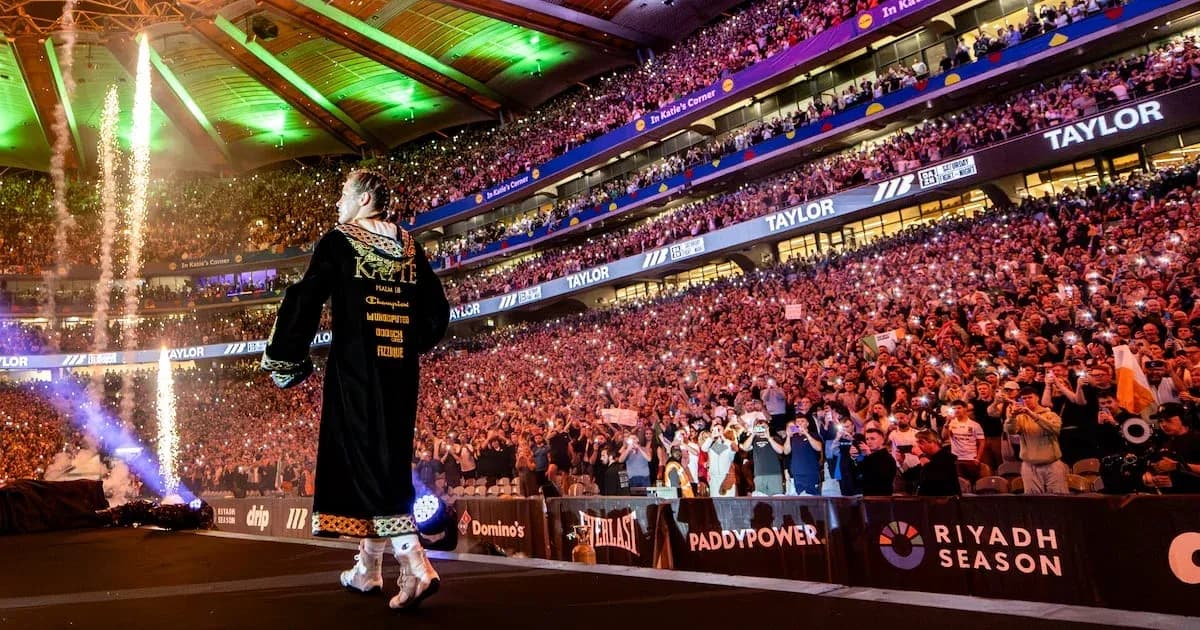
No such issue in Croke Park. The old stadium gleamed. The lighting show turned it into a cathedral, the ring a pulpit in the middle of a glowing bowl. Whoever signed off that production budget got their money’s worth and then some. The soundtrack did the rest. Grace. The Fields of Athenry. Zombie. Each one belted out with a kind of joyful sorrow only Ireland can quite manage.
Good luck to any locals trying to explain that playlist to visiting fans. A man executed after marrying his beloved. A man deported to Australia for stealing food in the Famine. The deaths of innocents in The Troubles. It’s an Irish trick: the occasion is merry, the songs are soaked in trauma. We remain, proudly, a strange bunch.
RTÉ leaned into the emotion and twisted the knife. Montage after montage. Bernard Dunne clinging to composure by his fingertips. “This is more than just a boxing match,” he told Jacqui Hurley. “It’s a celebration, a thanks for what Katie’s given us over the years.” As he spoke, My Way thundered around the stadium and any remaining dry eyes didn’t stand a chance.
Then came the phones. Eighty thousand little lights raised when three quarters of Westlife delivered You Raise Me Up. Sentimentality? Absolutely. Effective? Devastatingly so. Moments later, Marty Morrissey was dancing with Michael Flatley as Olé Olé Olé rolled around the stands. At that point, if someone had suggested a drug test, you’d have asked for the results on everyone.
Jacqui Hurley nailed it: “It’s like a rave that meets a football occasion.”
Down at ringside, Paul O’Flynn found Shane Lowry and grabbed a few words. On the big screens, tributes poured in from Bono, Ed Sheeran, Niall Horan and Rory McIlroy – all apparently unable to secure a ticket to the hottest night in town. Just before the national anthem, Barry Keoghan’s voice took over.
“All stories begin at home. The rare ones end there, too. And so, Katie returns for every fan who walked the journey beside her ... for all Ireland. When they ask you about Katie, you can begin with four simple words. Once upon a time.”
Somewhere, Kleenex shareholders smiled.
Then reality walked down the aisle in the form of Flora Pili. She emerged into the light, took one look around, and her face screamed “mon Dieu”. Many in her position might have turned and headed straight for Rosslare and the first ferry out, but she stayed. She fought. That alone took courage.
Taylor’s entrance came to the hymn All Hail King Jesus, a choice that left most of the crowd humming rather than singing. The words didn’t matter. The noise did. The ring walk ended with a firework display that made Madison Square Garden – the scene of so many of her greatest nights – feel suddenly small, like the old boxing gym in Bray by comparison. Taylor puffed out her cheeks, taking it all in, a final deep breath before the last act.
“I’m feeling pretty emotional myself here and it hasn’t even started,” admitted commentator Hugh Cahill. “Oh my gosh, this is extraordinary,” Eric Donovan added, the scale of it battering the usual punditry distance.
And then, finally, there was a fight.
Pili tried. She had to. But she rarely laid a meaningful glove on Taylor. Every time she edged forward, she met that familiar footwork, that jab, that timing. Any clean shot on Ireland’s hero would have had 80,000 people to answer to, but Taylor never really let it come to that. The judges’ unanimous decision landed like a formality, greeted not with surprise but with warmth, relief, gratitude.
The real punch came after the final bell.
Taylor spoke to the crowd, thanked them, absorbed one last surge of noise. Then she took off her gloves and walked them to the centre of the ring. She placed them down, carefully, on the canvas. They came to rest on top of the Lidl logo, a marketing moment to rival Nike’s famous Masters shot when Tiger Woods’ ball paused on the lip of the hole, swoosh perfectly framed. Somewhere in a boardroom, Lidl celebrated. Somewhere else, Aldi fumed.
And that was it. The end, marked not by a belt hoisted high, but by two gloves left behind.
“What now?” Paul O’Flynn asked her.
“I’m just going to enjoy the fruits of my labour,” Taylor replied. “I’m going to eat chocolate.”
No grand declaration. No hint of a comeback. Just chocolate. A Time Out would fit the mood. She has earned every square, every quiet evening, every ordinary moment that comes next.
Once upon a time, Katie Taylor changed everything. On this night in Croke Park, Ireland finally got the chance to say thank you.