Katie Taylor's Retirement: A New Chapter Begins
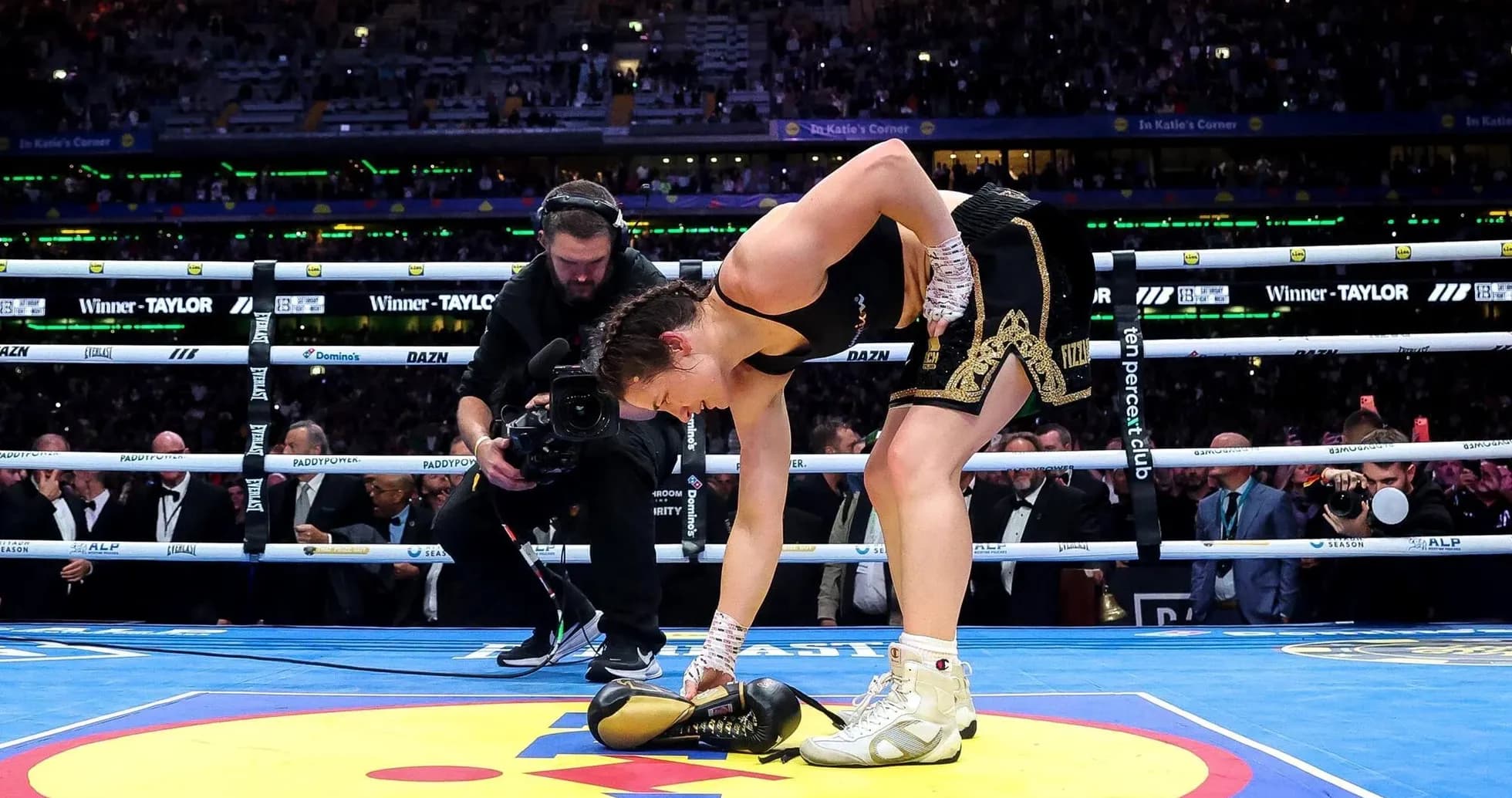
Katie Taylor stood on the canvas at Croke Park on Saturday night and looked into the kind of space no punch can touch.
Retirement. The first death, as athletes like to call it.
The numbers are grim and familiar: Premier League and NFL players filing for bankruptcy, marriages collapsing, lives unraveling once the lights go out. The stories are endless, the warnings everywhere. The American jockey Eddie Arcaro, the only rider to win the US Triple Crown twice, once summed up the brutal comedown: “When a jockey retires he becomes just another little man.”
Ray “Boom Boom” Mancini, a former WBA lightweight champion, painted the same picture in his own way. “Since I’ve retired I eat less, weigh less, train less and care less.” Both men carved out successful second lives. Both still struggled.
In its own cruel way, retirement is often the toughest opponent of them all.
A perfect farewell – and a looming question
So what does Katie Taylor do next?
Alan Minter, the undisputed middleweight king of the early 80s, used to joke that there were only two reasons boxers came back: they were broke, or they needed the money. Taylor should never be close to either.
A purse of around €3m is expected from her Croke Park farewell. She took over €7m from just the last of her three meetings with Amanda Serrano. And that’s only the headline figures. This isn’t a fighter scrambling around for one last payday.
Everything about Saturday night felt like a carefully choreographed goodbye, the kind that rarely happens in boxing. As Irish sporting exits go, it sits at the very top. Brian O’Driscoll’s long 2014 farewell, capped by a Six Nations title, suddenly looks like a distant runner-up.
Taylor walked away with a classy win over Flora Pili, the crowd pouring their affection down from the horseshoe stands and into the Dublin night. No controversy. No ugly ending. No sense that she was hanging on too long.
If her long-time manager Brian Peters gets his wish, the next time Ireland sees her will be under strip lights rather than ring lights: a parish hall in Inisbofin, then a chain of similarly unlikely venues, as she tours the country with Steve Bunce in a stage show called “Her Story”.
“It's going to be quite magical,” said the promoter.
Taylor, voluntarily criss-crossing Ireland to talk about herself? It jars with the version of her the public has known for years. She has always been the reluctant star, the fighter who ducked the spotlight even as she chased every belt. But second acts rarely follow the script.
Who would have predicted Roy Keane becoming a TV darling and advert frontman? Who saw Bill Belichick’s public persona collapsing into late-career awkwardness once he stopped winning in New England?
The next chapter rarely looks like the last.
Finding a voice
Taylor sounded different in fight week. Louder. Looser. More open than at any point in a career built on understatement. Eddie Hearn even joked about how long she spoke in the ring after outclassing Pili.
She has a voice. The world just doesn’t know yet how, or if, she intends to use it.
“I determined very, very early on in my career not to talk but to show my boxing skills and just to let my excellence do the talking and let my talent do the talking,” she said on Sunday morning.
“And I've kept to that throughout my whole career.”
Those skills don’t have to be retired with her gloves. It feels inevitable that she will stay involved in boxing in some form, but that simple statement opens dozens of doors. Coaching sits there, obvious and inviting, but it is only one path.
Her impact on Irish fighters, male and female, is already baked into the sport’s history. Dozens have said as much. They grew up watching her, chasing her, trying to live up to her. The image of her sparring with ten-year-old Clodagh Keating last week captured it perfectly: the icon in headgear, the child bouncing on her toes, the baton being passed in real time.
Asked if she might take a formal role in Irish boxing, Taylor smiled and admitted that persuading her husband to swap Connecticut for a permanent base in Ireland “might not have gone down very well”. Six children also sit at the centre of every decision she makes from here.
Boxing will remain a constant. But it will no longer be the only one.
Faith, family and a changing Ireland
Family is the obvious anchor. So is her faith, now impossible to ignore. Taylor’s walk to the ring at Croke Park was soundtracked by “All Hail King Jesus”, a public declaration of belief that she later expanded on.
She spoke of clinging to her faith and to what she believes is the word of God during the darkest spells of her career: the heartbreak of Rio 2016, the personal turmoil that followed, the quiet doubts away from the cameras.
“Look what God's done. He's done the impossible in my lifetime and he's came through time and time again. And that's what I was saying in the ring afterwards and giving him all the glory and the honour for all that I've achieved.”
Whether that faith continues to shape her public life is one of the many unknowns. Whether she even wants a public life beyond that stage production – of which she seemed only vaguely aware in the hours after her final fight – is another.
That open embrace of religion slots easily into the American sporting landscape she now calls home. In the United States, athletes praying on fields and courts barely raises an eyebrow. In Ireland, where the relationship with religion is shifting and unsettled, it lands very differently.
Yet it has never cut against her. Not once. Her popularity has proved almost immune to the usual Irish arguments over belief and institutions. The Croke Park crowd’s response said it all: faith or no faith, they were there for her.
Her place in Irish sport is unique. Her place in Irish life might be, too. She sits in a space beyond the usual categories: not just a champion, not just a trailblazer, but a kind of shared national story.
No-one has fully explained why. Not even Taylor.
“I don't know, to be quite honest,” she admitted. “I think people, the whole country, has seen me and my good times and they have also seen me during my devastations as well. I think people really resonate with your vulnerabilities as much as your successes.
“They see me cope with the heartbreak of Rio. They see me cope with the heartbreak of the shadow of loss. They see me in the, just, personal difficulties as well. So yeah, I think my story is the story of everybody in the whole country.”
Maybe that is the point. The medals, the belts, the nights in Madison Square Garden and Croke Park – they tell only part of it. The rest lies in the stumbles, the doubts, the way she kept walking back to the ring when it would have been easier to turn away.
Retirement will ask different questions. Harder ones. There will be no judges’ scorecards to offer instant verdicts, no training camp to impose structure, no title to chase.
But as the lights went out over Croke Park and the crowd drifted into the city, one thing felt certain.
Her story is not finished. Not even close.