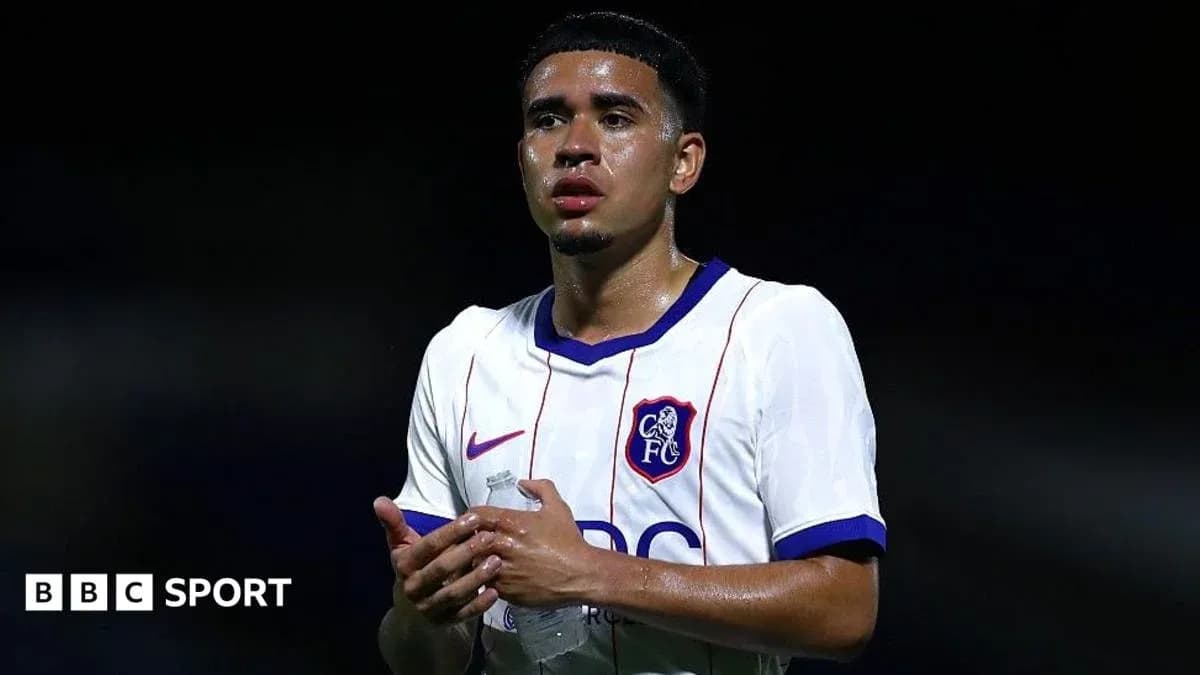
Kendry Paez: From Prodigy to Chelsea's Under-21s
Kendry Paez finally wore Chelsea blue on Saturday. Not under the Stamford Bridge lights, not to the roar of a full Shed End, but in front of a smattering of spectators at Arsenal’s training ground, as a 12th‑minute substitute for Cobham Next Gen in a 4-1 win.
Three years after Chelsea agreed a £17.27m deal for the Ecuadorian prodigy, the club’s great South American project has quietly restarted in the under-21s.
From record breaker to reality check
Paez’s story was supposed to be different.
At 15, he became the youngest debutant and goalscorer in Ecuador’s top flight with Independiente del Valle. He stepped into the Copa Libertadores before most teenagers sit their final school exams. By 16 years and 131 days, he was playing in World Cup qualifiers, the second-youngest South American to do so after Diego Maradona.
A month later he scored in a 2-1 win away to Bolivia, the youngest South American ever to find the net in a World Cup qualifier. By the time Chelsea moved for him in 2023, he already had 18 caps and two goals for Ecuador. The expectation was clear: this was the next big attacking star from the continent that gave the game Neymar, Vinícius Júnior and Lionel Messi.
Chelsea treated him like it. He trained regularly with the first team before he was even eligible to join officially after his 18th birthday. The club helped provide security for Paez, his family and the family of Moises Caicedo when violence erupted in Ecuador in early 2024. They invested money, time and protection in a teenager they believed would define their future.
The trajectory, though, has not followed the script.
Loans, lessons and a stalled rise
The first major test came in Europe. Sent to Strasbourg, part of Chelsea’s multi-club network, Paez began brightly. He won Ligue 1’s Young Player of the Month for September, a flicker of the talent that had lit up South America.
Then the glow faded.
His form dipped, his influence waned and the public tone from then-manager Liam Rosenior hardened. “We expect more, clearly,” Rosenior said. “I’m tired of using the excuse of the player's youth.” It was a sharp line, and it stuck.
One goal in 21 appearances told its own story. The loan, despite the friendly corporate ties between Strasbourg and Chelsea, ended early.
Argentina offered a fresh start. River Plate, one of the giants of the world game, took him on a two-year loan. It should have been a perfect stage: packed stands at the Monumental, ferocious derbies, a fanbase that recognises genius quickly and never forgets it.
Instead, the questions followed him across the continent.
Sources in Argentina raised concerns over his attitude. The 1-0 Superclasico defeat to Boca Juniors at the Monumental in April became a reference point – a big game in which Paez failed to impose himself. Soon after, club president Stefano Di Carlo named him among 15 players training away from the first team. Some within River felt he deserved more chances; the numbers were still stark.
- Fourteen appearances.
- One goal.
- 461 minutes.
The loan ended by mutual consent.
Off the pitch, scrutiny intensified. During an international window, Paez was filmed in a New York strip club. In Ecuador, where he had been hailed as the nation’s next great attacking talent, concern hardened into something closer to alarm.
Michel Deller, owner of Independiente del Valle, spoke publicly to Hincha Amarillo. “He's like a son to us. We care about him deeply,” he said. “He's a good kid who's had a tough time and has made decisions that have complicated his life. We are always hopeful he'll show his exceptional talent once again but right now, it's up to him to decide what to do with his life.”
It was a message wrapped in affection but laced with warning.
Alonso’s stance and a quiet restart
Then came the bluntest assessment of all, from the man now in charge at Stamford Bridge.
New Chelsea manager Xabi Alonso made it clear: Paez was “not in my plans”. On the club’s website, he appeared as an academy player. For a teenager once touted as a future first-team star, the symbolism was heavy.
Chelsea tried to find another loan, this time in English football, a chance to test him in the cut and thrust of the domestic game. Fifa regulations blocked the move. The club had already used all six of their available international loan slots. There would be no overseas detour this time.
So Paez returned to Cobham. Not as a headline act, but as another talented face in a stacked academy.
There, amid the familiar churn of youth fixtures and training sessions, came a small but significant moment. In the dying stages of Cobham Next Gen’s EFL Trophy defeat at Wycombe Wanderers, Paez delivered a reminder.
From a short corner, he whipped in an outswinging cross that Harrison Bettoni turned in during added time. Seconds later, another cross caused panic in the Wycombe box as Chelsea chased an equaliser. In front of just 778 fans, he briefly took control of the night.
For most of the evening, he had drifted on the periphery, stationed as a right-sided No 10 in a shape mirroring Alonso’s back three. He had looked a little apart from the group before kick-off, mostly keeping to himself, joining the warm-up but never quite blending in.
Then the ball came his way and instinct took over.
A career at a crossroads, not a dead end
Strip away the noise and one fact stands out: Paez is still only 19.
He has already played 70 times for Independiente del Valle and passed 100 senior appearances in total. He has 27 caps for Ecuador and a World Cup on his CV. That level of experience is rare at his age and gives him something to lean on now that the early glamour has faded.
Inside Chelsea, the concern around his path is real, but not fatalistic. Those close to him and staff at Cobham believe some of the criticism has been exaggerated. They argue he needs time – to grow as a player, to mature as a person, to live with the weight of expectation that arrived before adulthood.
Back at the training ground, they see small but important signs. He is working daily in a stable, elite environment. Family have been in the stands for his recent games, offering a layer of support that was sometimes missing during his travels. The club can monitor his habits, his fitness, his focus. They can challenge him and protect him in equal measure.
Academy games at Chelsea are rarely insignificant. Scouts from across the English Football League and beyond attend regularly. Every sharp touch, every clever cross, every quiet night is logged somewhere.
If Paez strings those flashes together, a door opens. There is hope he can earn a first loan move within England in January, or that one of the six international loan slots will free up and present another chance abroad. This time, it would come with the context of everything that has gone before.
The talent that convinced Chelsea to spend heavily on a 16-year-old has not vanished. It has flickered, been obscured by poor choices and difficult environments, but not disappeared.
Now the stage is smaller, the crowds thinner, the spotlight dimmer. For Kendry Paez, that might be exactly what he needs.