Kenny Cunningham on Ireland vs Israel: The Game Should Have Been in Dublin
Kenny Cunningham believes the Republic of Ireland should face Israel – and that the game should have been played in Dublin.
The former Ireland captain sees the upcoming Nations League fixtures not as a political statement, but as a chance for Irish supporters to show respect on a human level, even amid deep anger over the conflict in Gaza.
The game should have gone ahead in Dublin
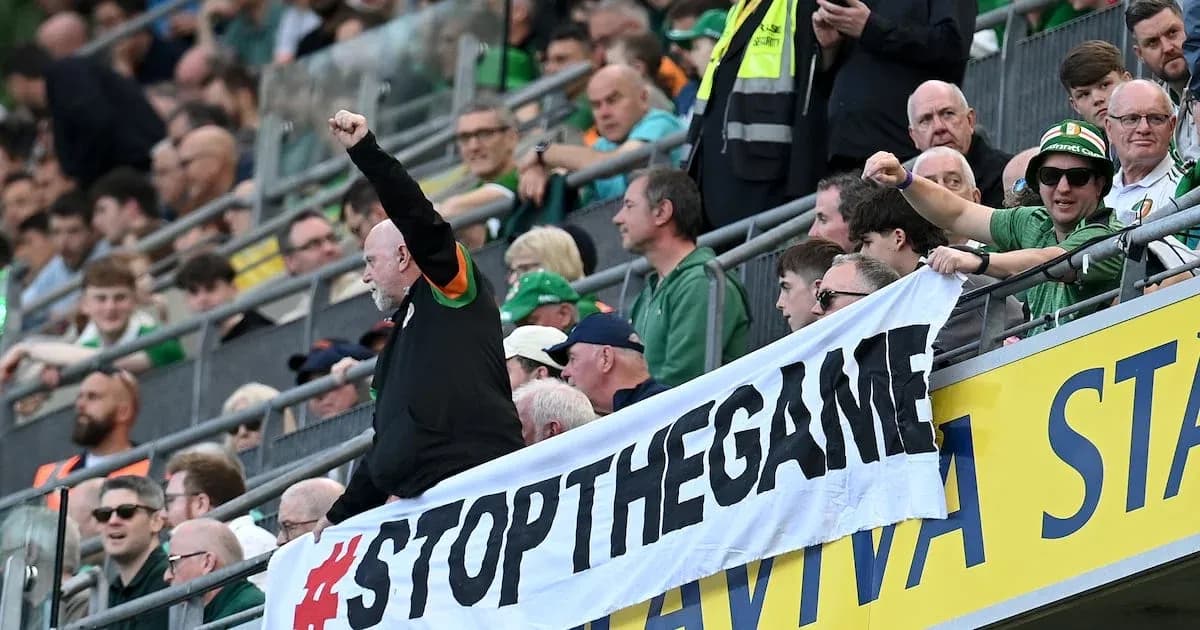
Ireland are due to play Israel at neutral venues: in Debrecen, Hungary, on September 27th and behind closed doors in Bačka Topola, Serbia, on October 4th. The latter was originally scheduled for the Aviva Stadium before the Football Association of Ireland moved it, citing “operational challenges” after tennis ball protests disrupted the friendly against Qatar in May.
Cunningham thinks that was the wrong call.
“I think the games should go ahead, and I think the home game should have gone ahead in Dublin, that’s my opinion,” he said at the launch of Premier Sports’ 2026/27 coverage.
He accepts the strength of feeling in Ireland about Israel, its policies and the Palestinian cause. He doesn’t deny the politics. He just doesn’t see cancellation as progress.
“I think there is a perception about how Irish people feel about Israel and Israeli foreign policies, and the Palestinian issue. That is pretty much out there already. We all know where people stand, so I don’t feel cancelling this game takes the argument any further.”
The FAI’s decision to move the game to Bačka Topola – a small town in northern Serbia – followed intense scrutiny after the Aviva protest. For Cunningham, that switch stripped the fixture of an opportunity.
Respect, anthem and a message from Dublin
Cunningham’s argument is not about softening criticism of Israel’s government. It is about separating people from politics for 90 minutes.
“I think it would be a good thing to see the Israeli team come on to the pitch in the Aviva. I think it would be a good thing to see the Israeli national anthem respected inside the Aviva, because that for me would send a signal, maybe from the Irish people to the Israeli people who have suffered as well in this conflict.”
He spoke of a shared sense of loss, of ordinary people caught in decisions made far above them.
“On a human level, we are actually together here. There are politicians making decisions around this, but genuinely between the Israeli people and the Irish people there is a bit of understanding there on a human level about what has been happening.
“We will respect your national anthem for those reasons. We’ll respect what you have been through on October 7th, the people you lost in harrowing circumstances, which precipitated the recent stage of the conflict.”
Israel has not hosted an international game since October 7th, 2023, when Hamas attacks killed 1,200 Israelis. Most of Israel’s subsequent fixtures have been staged in Hungary. Israel’s offensive in Gaza has since killed more than 73,000 Palestinians, according to Gaza health officials, with more than 1,300 Palestinians reported killed there since a ceasefire came into force last October.
Cunningham does not shy away from the scale or complexity of that tragedy. He just doubts that refusing to play in Dublin does anything to help.
“I think the Irish public can show respect to the Israeli people, some of whom may actually agree to a certain extent with the opinions of Irish people. Maybe some of the Israeli players are disgusted with their government and the conflict.
“It is messy, but I think the game should have gone ahead in Dublin. It’s a very complex thing. I read as much as everybody else, I read my paper and I try and educate myself as best I can. It’s not just about the last two years, it’s about the last 50 years.
“I’m not sure what the answer is to the conflict, but I don’t think us denying the Israelis a game in Dublin, or even cancelling the game, moves things any way forward in a positive way.”
Parrott, Ferguson and a shape that has to change
Once the politics fade, the football takes over. For Cunningham, the Nations League is not just about results. It is the start of the road towards Euro 2028 and a chance to fix what he sees as a tactical imbalance.
Heimir Hallgrímsson has favoured a 3-4-2-1, with a narrow front three. Cunningham doesn’t like it, and he doesn’t think it suits Ireland’s best attacking talents.
“I’m not a big fan of the narrow three up front, I think we can play with two central strikers, but then we never saw it in the summer so that was an opportunity missed.”
The names are obvious: Troy Parrott and Evan Ferguson. Two forwards viewed as the most gifted of their generation in an Ireland shirt. The question is whether they are trusted together.
“If Evan gets himself fit are we going to play him and Troy, our two best strikers of the generation, in a partnership or is one of them shifted left of a front three and how’s that going to work?”
Hallgrímsson will name his Nations League squad on September 17th, before Ireland open away to Kosovo on September 24th. His selection and his system will say plenty.
Does he bend the formation to fit Parrott and Ferguson? Or does a rigid shape leave one of Ireland’s brightest hopes stranded on the flank, and a partnership that could define a generation left unexplored?