
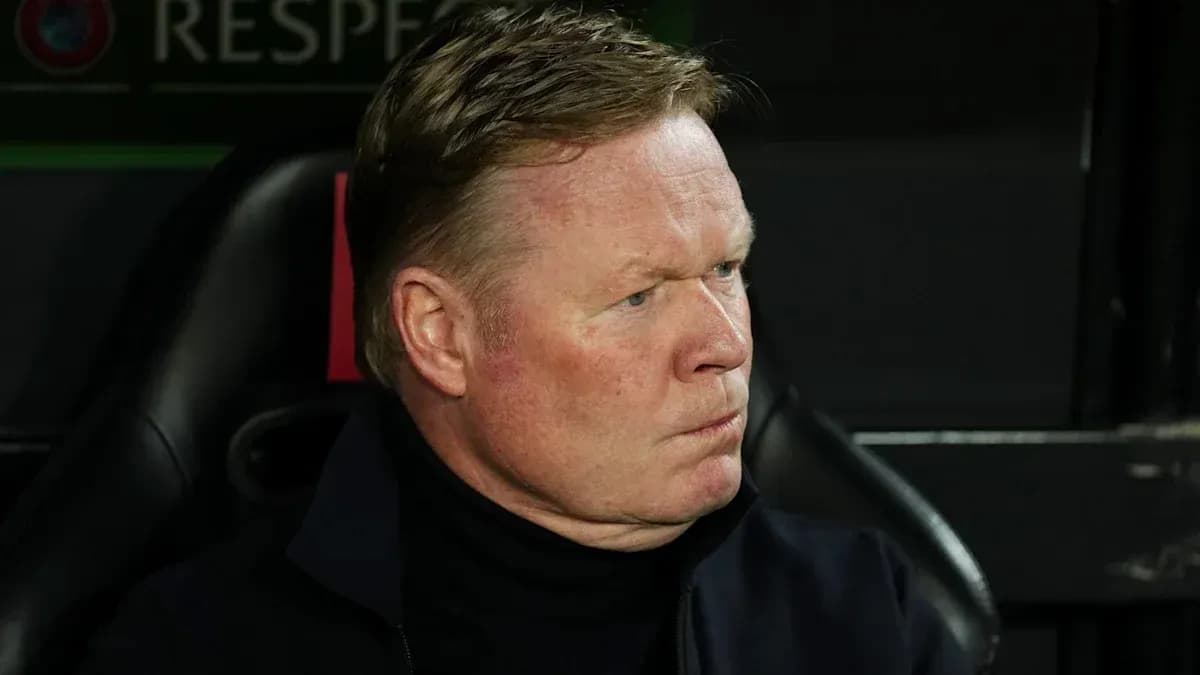
Koeman Defends Frenkie de Jong Amid Criticism
Ronald Koeman has never been one to duck a fight, especially when it involves one of his own. So when the noise around Frenkie de Jong grew louder in recent weeks, the former Barcelona and Netherlands coach stepped straight into the line of fire.
He didn’t come with excuses. He came with context.
Koeman steps in for Frenkie
De Jong has been a lightning rod at Barça this season, criticised for inconsistency, questioned for his role, even doubted as a cornerstone of the project. Koeman, who knows both the club and the player as well as anyone, pushed back.
"He's a great player," he said, making the point without dressing it up. The problem, in his eyes, is not talent. It’s timing – and the body.
Across the last two years, De Jong’s rhythm has been repeatedly broken by injuries. Koeman reminded everyone that those setbacks didn’t just hit Barcelona; they followed the midfielder onto the biggest stages, disrupting his European Championship and World Cup campaigns. You don’t just click back into top form after that kind of stop-start cycle, not in a midfield as scrutinised as Barça’s.
Koeman also underlined the reality of the current squad. Competition is brutal. "There are very good players at Barça," he noted, a simple line that explains a lot. Every off-day is amplified, every quiet performance becomes a debate.
Yet he sees no psychological crisis, no player shrinking under the spotlight.
"He knows the pressure at Barça. I don't see any problems. He's always said he wants to play for Barça, and that's what he's doing." For Koeman, that commitment still matters. In a club constantly swirling with rumours and agendas, De Jong’s insistence on staying and fighting for his place carries weight.
The right-back debate
Koeman also addressed one of the most talked-about tactical decisions of Hansi Flick’s early tenure: using De Jong at right-back against Atletico Madrid.
For many, it was a surprise. For Koeman, it was familiar.
"He can play at full-back, and also at centre-back; he did it with me. He can play in different positions," he pointed out. This wasn’t a wild experiment, but a calculated use of a versatile, press-resistant footballer in a different zone of the pitch.
Koeman has long viewed De Jong as more than a single-position midfielder. In his time on the Barça bench, he pushed the Dutchman into deeper and wider roles, trusting his reading of the game and composure under pressure. Flick has simply revisited that idea in his own way.
The message between the lines was clear: question the decision if you like, but don’t confuse tactical flexibility with a lack of faith in the player.
La Liga belief, Champions League caution
Koeman didn’t limit himself to one player. He also weighed in on the bigger picture at Barcelona under Flick – and here, his tone shifted from defensive to optimistic.
He sees a team playing at a level capable of reclaiming La Liga. The structure, the intensity, the quality across the pitch: in his view, it all points toward a genuine title challenge. Coming from a man who has lived the pressures of that dugout, that endorsement carries a certain edge of realism.
Europe, though, is another story.
"The Champions League is a different matter," he warned. Barcelona, he believes, are among the favourites, but that label comes with a caveat. The knockout rounds bring a different type of tension, a different type of opponent, and – as he put it – "tricky moments" that can flip a season in a single half of football.
It was the voice of experience. Someone who understands that being one of the favourites doesn’t guarantee anything once the draw turns brutal and the margin for error disappears.
A nod to Xavi and the Dutch link
Koeman also took a moment to look back toward the Netherlands setup, praising Xavi Hernandez in his new role as national team coach. "He's doing a great job," Koeman said, a short but pointed compliment from one former Oranje boss to the current one.
It tied the thread neatly: Barcelona, the Netherlands, and a midfielder caught between the two worlds, still under the microscope.
Koeman’s defence of De Jong wasn’t sentimental. It was grounded in years of working with him, watching him, and managing him through injury and expectation. The criticism will not disappear overnight. The debates over his best position will rage on every time Flick moves him a few metres on the chalkboard.
But as long as voices like Koeman’s are backing him, one question lingers over the noise: is Frenkie de Jong really the problem at Barcelona – or is he still part of the solution this team can’t afford to waste?





