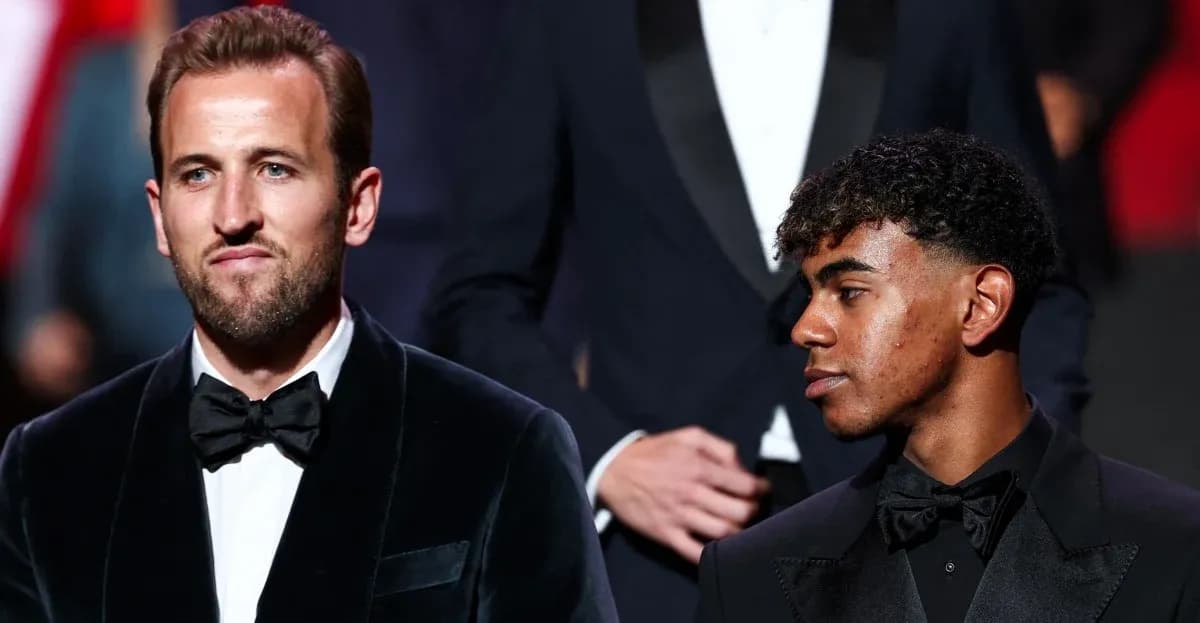
Lamine Yamal Challenges Ballon d’Or Norms Against Harry Kane
Lamine Yamal is not backing down from the Ballon d’Or debate. He’s walking straight into it.
The FC Barcelona prodigy has been talking up his own case for the game’s biggest individual prize in recent weeks, but his latest comments have taken the conversation to a sharper, more contentious place – one that brushes right up against Harry Kane’s extraordinary numbers.
Speaking to Movistar Plus Deportes, Yamal drew a hard line between goals and greatness, and in doing so, appeared to question what Kane represents in the current Ballon d’Or race.
“I think the Ballon d’Or should go to the best player in the world, period. Not to a player who’s scored 80 goals, because when you score 80 goals, you get the ‘top scorer’ award for that,” he said, in remarks captured by @iMiaSanMia. “These are very different things that people aren’t understanding.”
No names. No direct callout. But the target feels obvious. Kane, Bayern Munich’s talisman, has been racking up goals at a historic rate, putting himself firmly in the conversation for individual honours on sheer productivity alone. Yamal’s framing slices right through that narrative.
For the teenager, the Ballon d’Or should reward artistry, not arithmetic.
“The best player in the world is the one that, as a commentator, you’re watching a game and enjoying – you see him and think, ‘He’s a player who is very different from everyone else,’” he continued. “When the award goes to the best, not the one who scores the most goals or the one who has won the most titles, then it will regain its true value.”
It is a purist’s argument, dressed up as a manifesto. The kind of stance that plays well in Barcelona, where the idea of the “best player” has long been tied to vision, flair and the capacity to shape a match in ways that go beyond the scoresheet.
But the timing and tone also carry an edge. Kane’s numbers this season have been impossible to ignore. By drawing a line between “top scorer” and “best player,” Yamal is not just defining criteria; he is implicitly downgrading a rival’s claim.
Confidence? Certainly. The self-belief of a young star who already sees himself on that stage. Yet the wording nudges into a different territory, where personal advocacy begins to sound like a campaign – and where a teammate or opponent’s achievements become props in someone else’s argument.
The Ballon d’Or debate has always lived in this grey area: goals versus influence, trophies versus talent, spectacle versus efficiency. Yamal has chosen his side, loudly. Now the question is whether the voters, and the dressing rooms he shares with established stars, are ready to embrace that kind of rhetoric from a player still at the start of his story.