
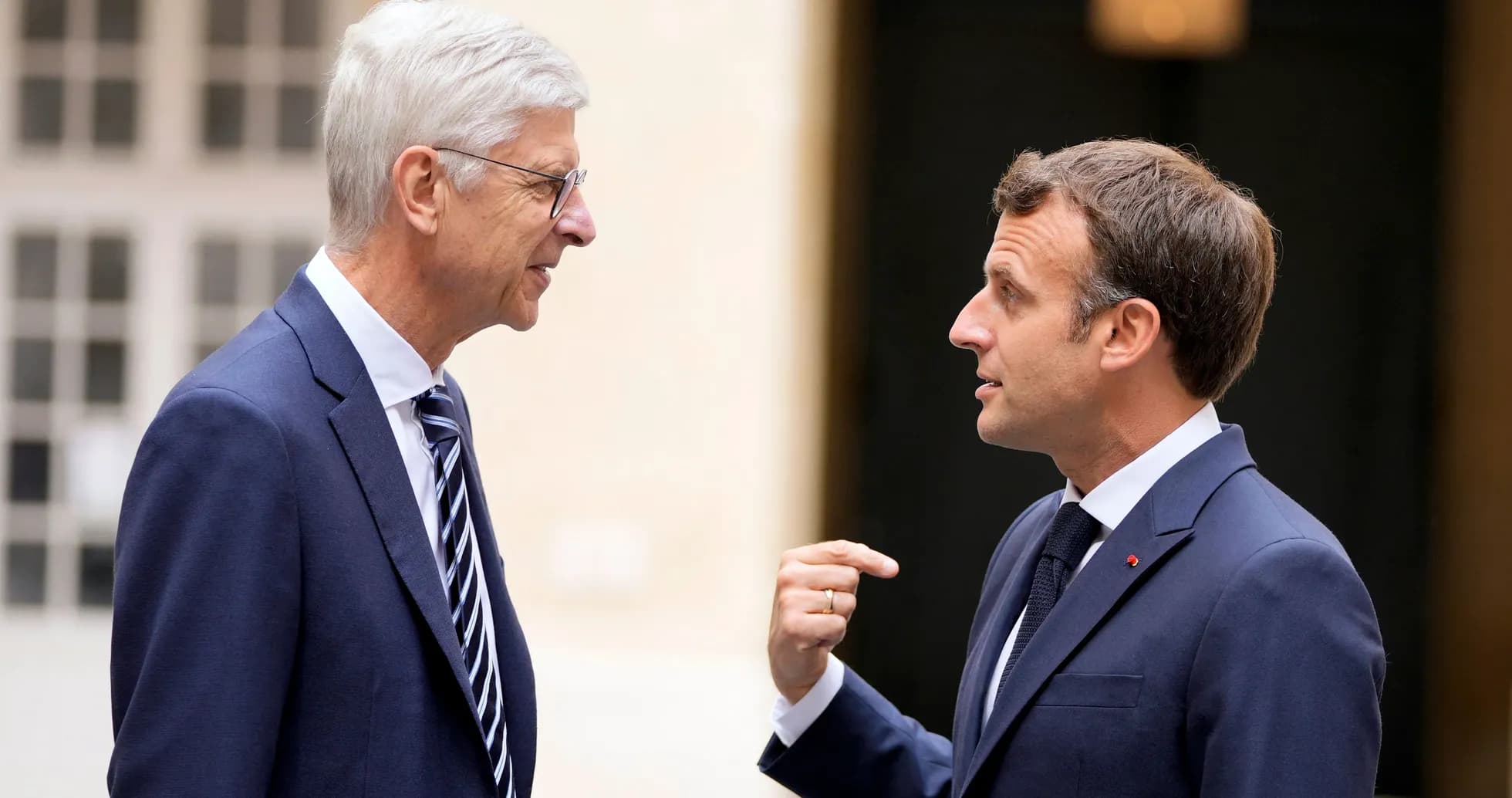
Macron Backs Wenger Against Infantino in FIFA Election
Emmanuel Macron has stepped directly into world football’s most powerful office. According to German newspaper Bild, the French president has privately pledged full backing to Arsène Wenger if the former Arsenal manager decides to challenge Gianni Infantino for the FIFA presidency in 2027.
Not just moral support. Macron is reported to have offered to rally other heads of state and government behind Wenger’s candidacy – an extraordinary move that drags the FIFA race out of the corridors of Zurich and straight into the arena of global politics.
A Deadline, A Decision, And A Professor At The Crossroads
The clock is already ticking. The deadline for submitting candidacy papers is 18 November, only days away, and all eyes are on Wenger. The expectation is that his decision will come this week.
Does “the Professor” really want this? This is not a dugout, not a dressing room, not a boardroom reshuffle. This would be the biggest challenge of his career: a direct run at the man who brought him into FIFA and the current guardian of the game’s most powerful institution.
The election itself is scheduled for March 2027. Infantino is seeking another term, as anticipated, but this time the landscape looks very different. If Wenger steps forward, he will do so armed with immense respect from across the football world and, crucially, heavyweight political cover from the Élysée Palace.
From Ally To Adversary
The irony is impossible to ignore. Infantino personally recruited Wenger to FIFA in 2019, a year after the Frenchman stepped down from Arsenal and retired from coaching. The idea then was clear: bring in one of football’s sharpest minds to shape the sport’s future.
Since then, Wenger has served as FIFA’s Chief of Global Football Development, a role that has turned him into one of the most influential figures inside the organisation. He has been at the heart of debates over calendars, competitions, and the direction of the global game.
Yet the relationship between president and adviser has cooled. In recent months, tension has slipped into public view.
Wenger openly criticised Infantino’s controversial plan last summer to bring private-sector investors into FIFA. His warning was blunt: such a move risked changing the identity of football and submitting the sport to the pure logic of money. For a man who spent decades fighting to balance finances and footballing ideals at Arsenal, that line matters.
A Reformer Who Hit A Wall
Inside FIFA, Wenger quickly became the face of sweeping reform ideas. He was one of the most prominent advocates of staging the World Cup every two years, a radical proposal that would have redrawn the international football calendar.
His blueprint went further. Wenger pushed for the European Championship to be played in odd-numbered years, interlocking major tournaments in a way that, on paper, created a more streamlined global schedule.
The backlash was ferocious. UEFA resisted. FIFPRO, the world players’ union, pushed back hard. The Association of European Leagues and Clubs lined up against it too, all pointing to an already overloaded calendar and the physical toll on players.
By 2021, the project had collapsed. The idea of a biennial World Cup was shelved, and Wenger’s grand calendar revolution was stopped in its tracks.
Still, he did not walk away from change. He played a key role in shaping the expanded Club World Cup and backed Infantino’s drive to grow the World Cup to 48 teams. Those moves underlined a simple truth: Wenger is no purist on the outside looking in. He has shown he can combine reformist zeal with political pragmatism inside FIFA’s machinery.
Contract Ticking Down, Stakes Rising
Now, the internal adviser may become the external challenger. Wenger’s contract with FIFA expires at the end of this year. Whether it will be renewed if he runs against Infantino is anyone’s guess. The uncertainty only adds more intrigue.
If he enters the race, he will not be walking into a vacuum. Infantino has spent years building a dense network of alliances across the continental confederations. From Africa to Asia to CONCACAF, the incumbent has cultivated support with development funds, expanded tournaments, and relentless travel.
Wenger would be starting from behind in that political game. His bet lies elsewhere: in his reputation for integrity, his long experience at the elite level, and the weight of French political power that Macron is apparently ready to throw behind him.
Football’s Future On The Line
This is no longer just a question of who lifts a trophy or signs the next TV deal. Between Macron’s ambition, Infantino’s calculations, and Wenger’s looming decision, world football stands on the brink of a new phase.
If Wenger runs, the 2027 FIFA presidential election will not simply decide a president. It will decide whether the sport’s next era is shaped primarily in the offices of politicians, the corridors of power in Zurich, or by a professor of football who may yet swap the touchline for the top job in the global game.





