
Manchester United's Struggles and Potential Coaching Changes
Michael Carrick is clinging to his job at Manchester United as the club heads into the international break marooned in the relegation zone and staring down the barrel of yet another reset under Ineos and Sir Jim Ratcliffe.
The mood has turned brutally quickly. The man who steadied the ship so impressively as interim last season now finds himself at the centre of United’s worst start in 40 years, his credit with supporters and players draining away with every chaotic performance.
A 4-4 draw with Aston Villa summed up the mess. United were a shambles at the back, two down and seemingly beaten, before a wild late comeback papered over the cracks. It felt less like a turning point and more like a stay of execution.
Next up? Liverpool at Anfield after the break. Then a trip to Lisbon in the Champions League. Hardly the schedule of a team looking for a quiet moment to regroup.
Carrick is far from the only problem. Lisandro Martinez pointed to deeper structural issues after the defeat to Atletico Madrid earlier this month, while Bruno Fernandes has been openly critical of the tactical approach. The captain who dragged United to the PFA Player of the Year award and the league assist record last season has not been able to rouse this side in the same way.
So the question is no longer if United will consider another change, but who they turn to if they finally pull the trigger. Who walks out at Anfield and tries to drag this team away from a relegation scrap?
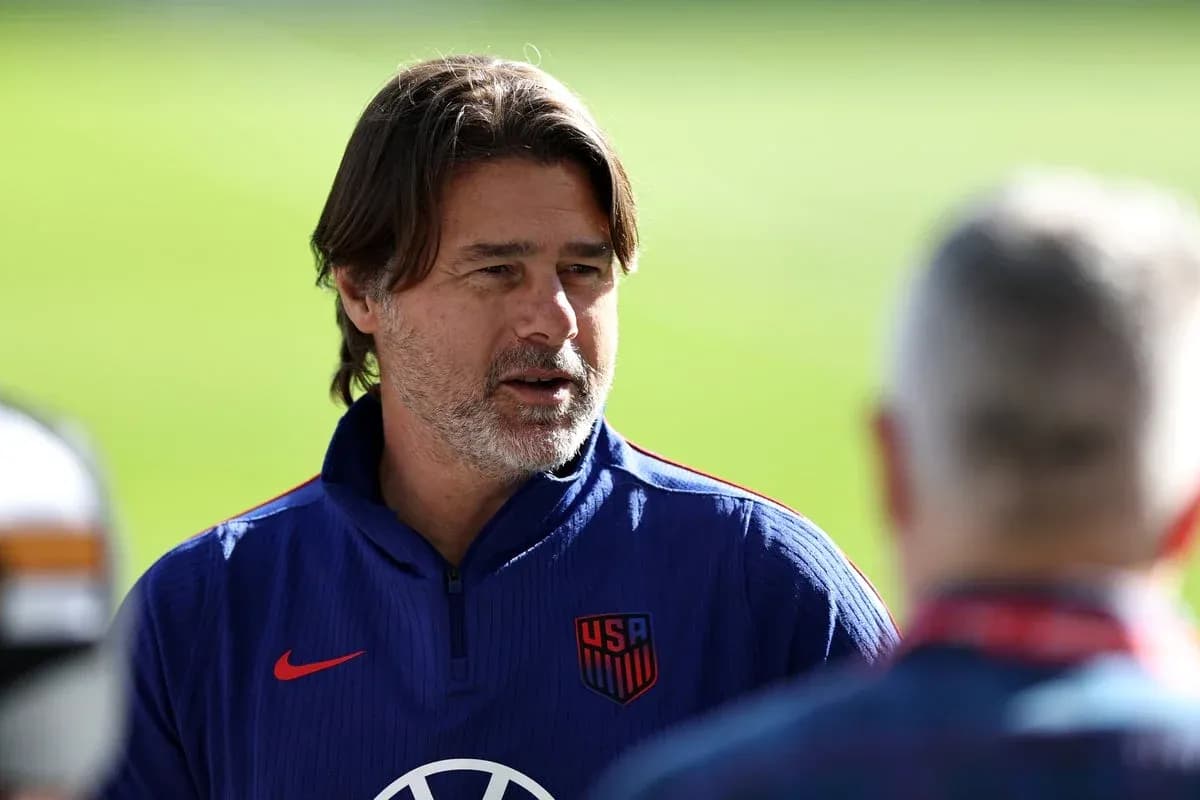
Mauricio Pochettino – the big swing
Mauricio Pochettino has emerged as the leading candidate, the bookmakers’ favourite and a name that still carries weight in boardrooms. United’s problem is that he is not free.
The Argentine is tied to the United States national team until the 2030 World Cup. Any move would demand compensation thought to be north of £7m. For a club already wrestling with financial constraints, that is a serious obstacle. For a club staring at the relegation zone, it may simply be the price of survival.
Pochettino’s aura has faded since his peak years at Tottenham, but the Chelsea spell did not end in disgrace. He left after a strong finish to the 2023/24 season and a sense that something promising had been left half-built.
His stint with the USMNT started with genuine excitement around the 2026 World Cup, only for the Folarin Balogun scandal and a heavy last-16 defeat to Belgium to sour the mood. The question now is whether he still has one more great club job in him. United, with their fractured squad and unforgiving spotlight, would be the hardest task of his career.
Eddie Howe – the Premier League builder
Eddie Howe is available. That alone makes him a serious contender.
His decision to walk away from Newcastle United in the summer shocked the league. Howe said he needed a break from management. Three months later, the chance to take over at Old Trafford would test that resolve to the limit.
His credentials are not in doubt. Howe inherited a Newcastle side in the relegation zone and drove them to their highest Premier League finish in 20 years, plus a first domestic trophy in seven decades. He twice took them into the Champions League, playing a ferocious, front-foot style that would resonate with a fanbase raised on high-tempo football.
At 48, he is still seen as one of English football’s sharpest minds. The bookmakers like him. United might, too, if they decide they want a long-term architect rather than a short-term firefighter.
Fabian Hürzeler – the bold, risky play
Brighton’s rise this season has a new face. At 33, Fabian Hürzeler has turned the Seagulls into a side capable of dismantling the league’s elite.
The 3-0 demolition of champions Arsenal was a tactical clinic. The 3-2 win at Old Trafford in the Carabao Cup, which dumped United out of the competition, felt like an audition in front of a restless home crowd.
Hürzeler is admired at Old Trafford, as reported by Miguel Delaney, but admiration alone will not be enough. Brighton will demand a hefty fee for a coach they see as central to their project. United may simply not have the money to tempt him away.
There is also the environment. At Brighton, he works inside a coherent structure where recruitment, planning and coaching are aligned. At United, he would be walking into the opposite: a club trying to rebuild its identity on the fly.
Hürzeler has already pushed back on the noise. “I’m fully focused on my job here,” he said on Friday, stressing his respect for Carrick and his belief in Brighton’s long-term “journey”. It sounded less like a come-and-get-me plea and more like a coach who knows he has time on his side.
Julian Nagelsmann – the damaged star
Julian Nagelsmann once looked destined for a job like this. Bayern Munich, RB Leipzig, the reputation as German coaching’s wunderkind – his trajectory was clear.
United tracked him when Ruben Amorim was sacked at the start of the year, earmarking him as a potential summer option after the World Cup. That plan fell apart on the pitch. Germany crashed out in the last 32 to Paraguay, a humiliation that stuck to Nagelsmann’s name.
Even so, at 39, he remains one of Europe’s most inventive coaches. The presence of Christopher Vivell, United’s director of recruitment and a former colleague from the Red Bull network, only strengthens the link.
Nagelsmann would be interested. The question is whether United, in their current crisis, can afford another grand experiment.
Unai Emery – the elite operator with a price tag
Unai Emery has quietly built something formidable at Aston Villa.
Champions League qualification, a long-awaited trophy with Europa League success, and a complete overhaul of the team’s spine over the summer have transformed Villa Park. Emery enjoys full control, a clear project and a club that is still in the early stages of its new era.
That is precisely why prising him away would be so difficult. He is under contract until 2029. Villa have no incentive to sell. United would have to pay a premium they may not be able to justify.
Emery also knows what he has. At Villa, he shapes everything. At Old Trafford, he would be one powerful voice among many, operating in a far more political environment. For a coach relishing the chance to build a second competitive side in the Premier League, walking away now would be a major step.
Antonio Conte – pure impact, pure risk
If United want shock therapy, they know where to look.
Antonio Conte’s appeal has only grown as United have drifted into a passive, predictable side. Few coaches in the game demand more from their players. Few impose intensity as quickly or as ruthlessly.
His record is undeniable: Serie A titles with Juventus, Inter Milan and Napoli, a Premier League crown with Chelsea. He took a faltering Tottenham team and dragged them back into the Champions League. Impact is his speciality.
Then comes the downside. Conte is combustible. He speaks his mind, publicly and loudly, when he feels a club is failing him. His exit from Tottenham in March 2023 followed a blistering press conference at Southampton that torched his relationship with the hierarchy.
On Friday, he moved to cool the speculation. In a statement, he called talk of “advanced negotiations” with any club “speculation” and insisted he would take time to decide his next move after a “wonderful and successful spell” at Napoli. Reports about his financial demands, desire for full control and concerns over his “strong personality”, he said, were “unfounded” because there is “no concrete basis” for such claims.
United would be playing with fire. But options of his calibre do not come around often.
Cesc Fàbregas – the rising ideologue
Cesc Fàbregas is not yet a household name in the dugout, but in coaching circles his stock is rising fast.
His Como side announced themselves to the wider continent by dismantling United in the Champions League on Wednesday night. The performance felt like a manifesto: brave on the ball, aggressive without it, and utterly unafraid of reputation.
Fàbregas, 39, appears in no rush to leave. He owns a stake in Como and is deeply invested in their first Champions League campaign. There is also the pull of his past. A future at Barcelona, or another of his former clubs, is a powerful lure. For now, patience suits him.
For United, he would be the wild card – the visionary pick for a club that has repeatedly burned itself on big-name solutions.
The old United reflex – turning to one of their own
If the board decides that another outsider is not the answer, the club has a familiar fallback: turn to the old guard.
The recent past is littered with examples. Darren Fletcher, then Under-18s manager, took charge for a draw with Burnley and an FA Cup defeat to Brighton before Carrick stepped up in January. Before that, Ruud van Nistelrooy bridged the gap between Erik ten Hag’s dismissal and Amorim’s appointment. Before him, Ole Gunnar Solskjaer rode the same wave of nostalgia and volatility that now threatens to wash Carrick away.
There is no shortage of former United players ready to walk into the dressing room and talk about the badge, the shirt, the standards. Fletcher remains an obvious candidate to steady things again, perhaps with another phone call to Sir Alex Ferguson for counsel.
The club has been here before. The names change. The cycle does not. The only real question now is whether Ineos finally break it – or reach for the same old playbook as Anfield looms and the drop zone refuses to move.





