Manchester United's Defensive Woes Continue with Draw at Everton
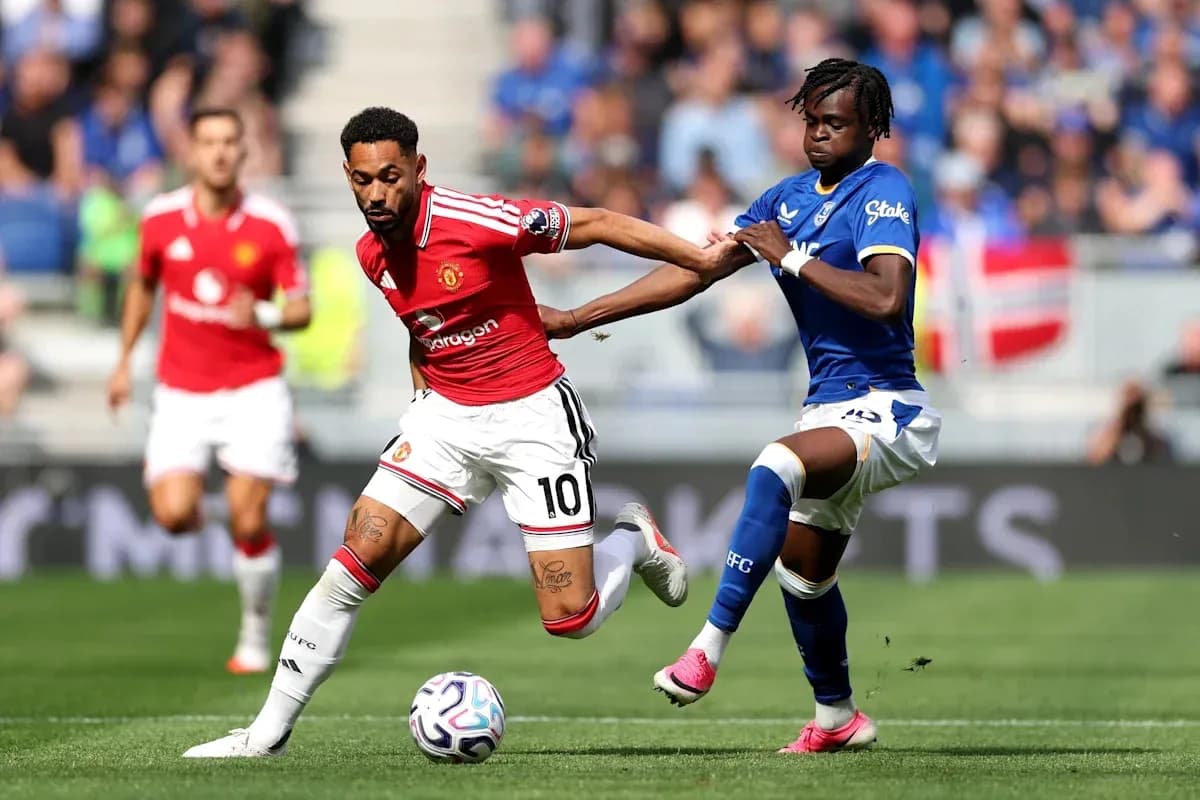
Manchester United walked out of Goodison Park with a 2-2 draw, a point that felt far closer to a warning than a platform. They led twice. They played some of their best attacking football of the young season. They still couldn’t finish the job — not in front of goal, not in game management, and certainly not at the back.
This is a team that looks like it knows how to build a performance. It just doesn’t yet know how to close one.
Everything but the Finish
United’s attacking play had shape and imagination. Three creative forwards stitched together promising moves, found pockets between the lines, and twice dragged the team in front after restarts. The structure was there. The incision was not.
In open play, United repeatedly worked their way into promising areas but lacked a true presence in and around the six-yard box. The runs into the danger zone were too often missing, the penalty area too often empty at the decisive moment. The moves were neat, the final ball less so, and the finishing touch almost entirely absent.
There are obvious solutions on paper. Benjamin Sesko’s return to fitness offers a natural focal point, the kind of striker who lives off those penalty-box runs United are crying out for. Bryan Mbeumo stepping back into a central role could also sharpen that edge. Yet there’s a void on the right as well: Amad’s absence from his usual wing duties is being felt, while Shea Lacey doesn’t quite look ready to shoulder that responsibility and Matheus Cunha at right wing doesn’t seem to be in the manager’s plans.
Despite that, United still put themselves in a position to win. They scored twice, including what looked like a late winner from Sesko, and for long stretches of the first half they controlled the tempo. But for the third straight league match, they also conceded twice. Six goals shipped to Hull City, Ipswich Town and now Everton is not a blip. It’s a pattern.
And it’s one that now defines this team more than its attacking promise.
Back Four on Shaky Ground
The numbers are damning enough, but the manner of the goals is even more troubling. Everton, a side that has laboured for attacking fluency, found a way to score two “screamers” because United invited the pressure and never convincingly shut the door.
Luke Shaw actually produced his best outing of the season so far. He overlapped Marcus Rashford with purpose, delivered several dangerous crosses — one of which Sesko buried with a towering header in the 88th minute — and made key defensive interventions. Yet even his improved display came with a costly lapse.
On Tyrique George’s 83rd-minute equaliser, Shaw drifted too far inside, leaving George the space he needed to lash a shot into the near-post top corner. Arne Lammens got a hand to it and might feel he should have done better, but the root problem lay in the defensive positioning. Shaw has been caught tucking in too narrowly multiple times already this season, and Everton punished it.
He wasn’t alone. Harry Maguire, Lisandro Martinez and Diogo Dalot all turned in subpar performances. As a unit, they allowed Everton far too many looks. Maguire was fortunate that Thierno Barry failed to keep his header down in the 42nd minute — a chance that should have been a goal. Dalot’s attempted clearance in first-half stoppage time fell straight to Jarrad Branthwaite, who fired at Lammens when a cooler head might have buried it. Later, a mis-hit Dalot cross in midfield left Shaw and Martinez scrambling to shut down Brennan Johnson, eventually deflecting his effort over the bar.
The warning signs were everywhere. United ignored them.
Holding a 1-0 lead for most of the second half, they retreated. Instead of pressing to kill the game, they sat back and allowed Everton to dominate the ball. The hosts grew into the contest, wave after wave, and United never truly wrestled control back. Had United kept the ball with more conviction, had they been braver in possession, Everton would not have had the platform to attempt — and score — the spectacular.
Once George struck, Michael Carrick turned to his bench. Noussair Mazraoui came on at left back, Leny Yoro at right. The idea was fresh legs and more security. The effect was the opposite.
In the 90th minute, Mazraoui lost George again, allowing another near-post effort that Lammens saved — only for the flag to go up for offside. The escape lasted five minutes. With the final attack of the match, Hayden Hackney glided past Yoro too easily and slipped the ball to Kiernan Dewsbury-Hall. Mazraoui’s attempted clearance fell straight to Ainsley Maitland-Niles, who unleashed a stunning, Puskas-level strike to snatch Everton a point.
Carrick’s changes didn’t work, but the bigger question lingers: would keeping Dalot and Shaw on have changed anything? On this evidence, United’s issues run deeper than individual names on the teamsheet.
Matthijs de Ligt is nearing his first appearance since November 2025 and his return will help, but one centre-back, however accomplished, cannot on his own fix a system that keeps exposing its fullbacks and leaves its back line defending in huge spaces. Young defender Ayden Heaven is another option for minutes, yet the pattern persists regardless of personnel: Manchester United cannot keep opponents out.
A Lopsided Squad and a Looming Test
Inside the performance, there were positives. The new-look midfield moved the ball with more authority, and the forward line, when it clicked, looked capable of hurting teams. United can build on that. They can also point to the fact they twice led away from home in a difficult stadium.
But the balance of this squad is off. The summer’s energy went into reshaping the midfield, and the fullback positions — the most fragile part of this side — were effectively left untouched. Shaw and Dalot remain capable players, yet both lack the recovery pace to survive when United push high and wide. Better teams will see that immediately. They will drag United’s fullbacks into races they cannot win and exploit the acres of space behind them.
Unless Carrick finds a tactical answer — a deeper line, more protection from wide midfielders, a different pressing scheme — United look destined to score enough goals to entertain and still drop points in bunches because of what happens in their own box.
The draw at Everton doesn’t just go down as two points lost. It arrives days before the club’s first Champions League match of the season, with the defence creaking and the questions growing louder.
If this is how they look against Hull, Ipswich and Everton, what happens when Europe’s elite start running at them?