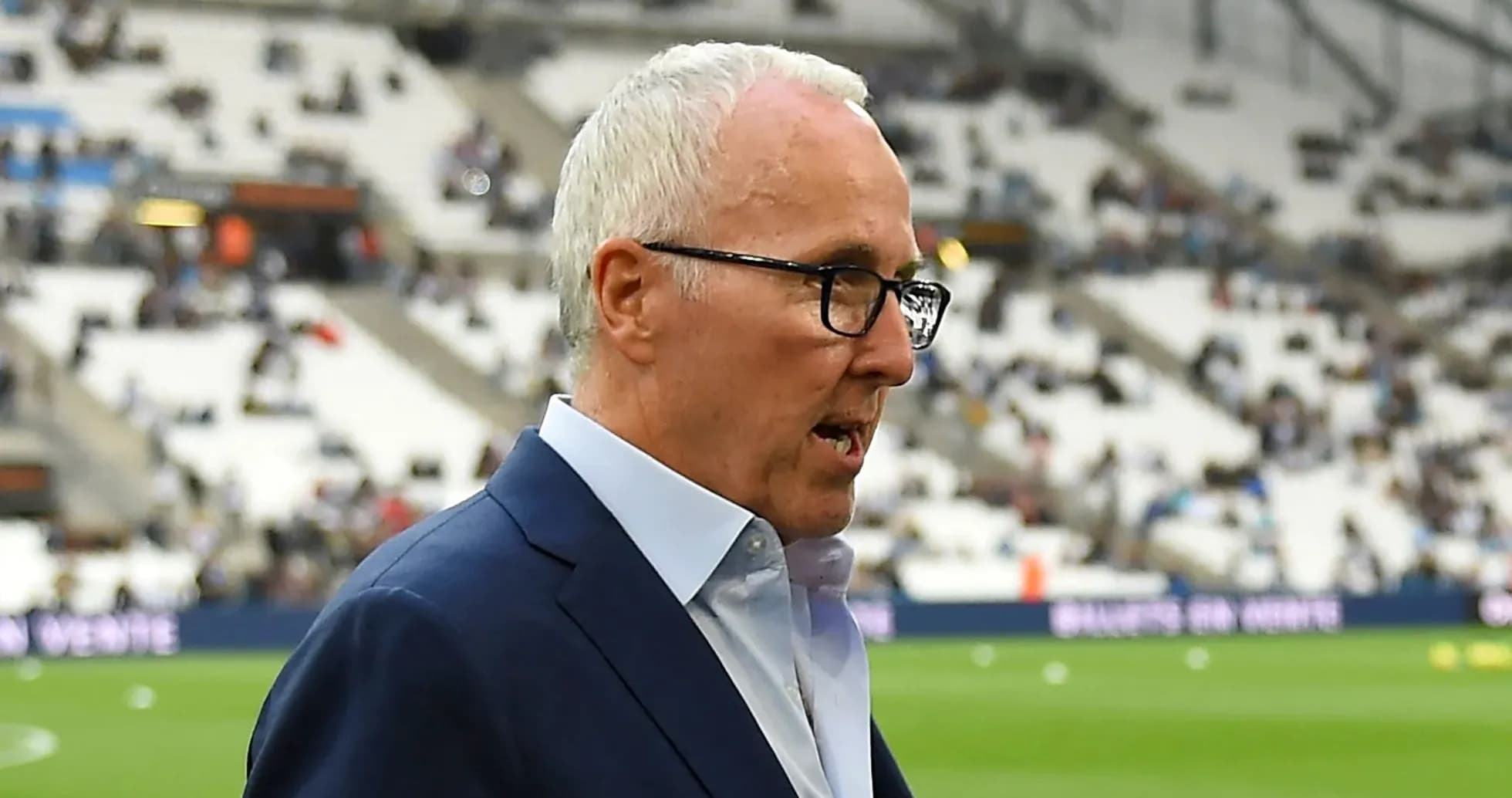
Marseille Fans Revolt Against Owner Frank McCourt
The banners went up long before the teams walked out.
In the thick Marseille dusk, with the Stade Vélodrome already simmering, angry supporters unfurled their verdict on the club’s American owner, Frank McCourt. No nuance, no patience left: this was open revolt wrapped in white and blue fabric.
“2016: Champions Project. 2026: Ligue 2 Project? McCourt Out.”
It hung there like a verdict over a club in freefall, and by the end of a bitter 2-1 defeat to Paris Saint-Germain, it felt less like provocation and more like a warning.
A Vélodrome Turns On Its Owner
McCourt arrived in 2016 talking about a “Champions Project,” pledging €200 million over four years and promising to drag Marseille back to the summit of French football and into the European elite. The words were grand, the ambition bold. The reality, eight years on, is a team staring at unwanted history and a fanbase that has simply had enough.
The hostility was not confined to a few ultras. Hostile banners appeared ahead of kick-off and again during the game, the message repeated with the relentlessness of a chant. Every miscontrol, every misplaced pass against PSG seemed to deepen the sense of betrayal.
The defeat itself cut deep. This is not just any game; this is Le Classique, the fixture that defines Marseille’s footballing identity. Losing it always hurts. Losing it while sliding into crisis is something else entirely.
Historic Club, Historic Low
The numbers are brutal. Marseille have now lost five straight matches in all competitions. For a club that once bullied French football, that sequence alone is alarming. But the damage runs deeper.
This is the first time in their history they have lost four of their opening five matches in a top-flight campaign. Not in the chaotic 1990s, not in the lean years that followed. Never. Until now.
For a fanbase raised on dominance in the late 1980s and early 1990s, and still fiercely proud of that 1993 Champions League triumph – the only one ever claimed by a French club – this slide is not just disappointing. It is an affront to what Marseille believe they are.
Paris Pull Away, Symbolically and Financially
Once, Marseille were the reference point in French football. Now, the balance of power in Le Classique has swung decisively north.
While Marseille have stumbled, PSG have grown into a superclub under Qatari ownership since 2011. Les Parisiens, now two-time defending European champions, embody the financial and sporting gulf that has opened up between the two rivals. High-profile stars, deep squads, and a conveyor belt of trophies: Paris are living the dream Marseille were sold.
Marseille, by contrast, have not won Ligue 1 since 2010. Their last piece of silverware is the now-defunct League Cup, lifted in 2012. That gap in the honours list is no longer a blip; it is an era.
Every time PSG come to town, the comparison is laid bare: one club operating at the sharp end of Europe, the other clinging to its past and its pride.
A Summer That Closed Doors
The current crisis did not start on Sunday night. It was built over a summer that stripped away both resources and hope.
Failure to qualify for the Champions League cost Marseille millions in vital revenue. That shortfall bit hard. With finances under strain, the board did not sign a single player in the recent transfer window. Not one. For a club of this size, in a league where rivals are strengthening, that is a staggering admission of weakness.
New head coach Bruno Genesio walked into this storm with a depleted squad and almost no room to manoeuvre. Tactical tweaks can only go so far when options are thin and confidence is draining away week by week.
On the pitch against PSG, that lack of depth showed. When the game demanded fresh legs and new ideas, the bench offered little. The pressure, already heavy, grew heavier.
Genesio’s Task, McCourt’s Reckoning
The defeat to PSG did more than dent Marseille’s season; it crystallised a mood. The Vélodrome, once a roaring ally, has turned its fury on the hierarchy. McCourt is now the central target.
His promises of a Champions Project ring hollow in a stadium that sees a team setting negative records and drifting away from the elite it was supposed to rejoin. The banners, the chants, the sarcasm from the stands – all of it underlines a simple reality: the supporters no longer believe.
Genesio, only just in the job, must somehow stop the slide with a squad short on quality, confidence, and reinforcements. His challenge is monumental. Every match now feels like a referendum on the owner as much as on the team.
Marseille desperately need a result, any result, to halt the spiral and ease the pressure that is crushing McCourt’s tenure. Because if the “Champions Project” has led them here, the next question at the Vélodrome is unavoidable:
What comes after the banners, if the losing does not stop?