
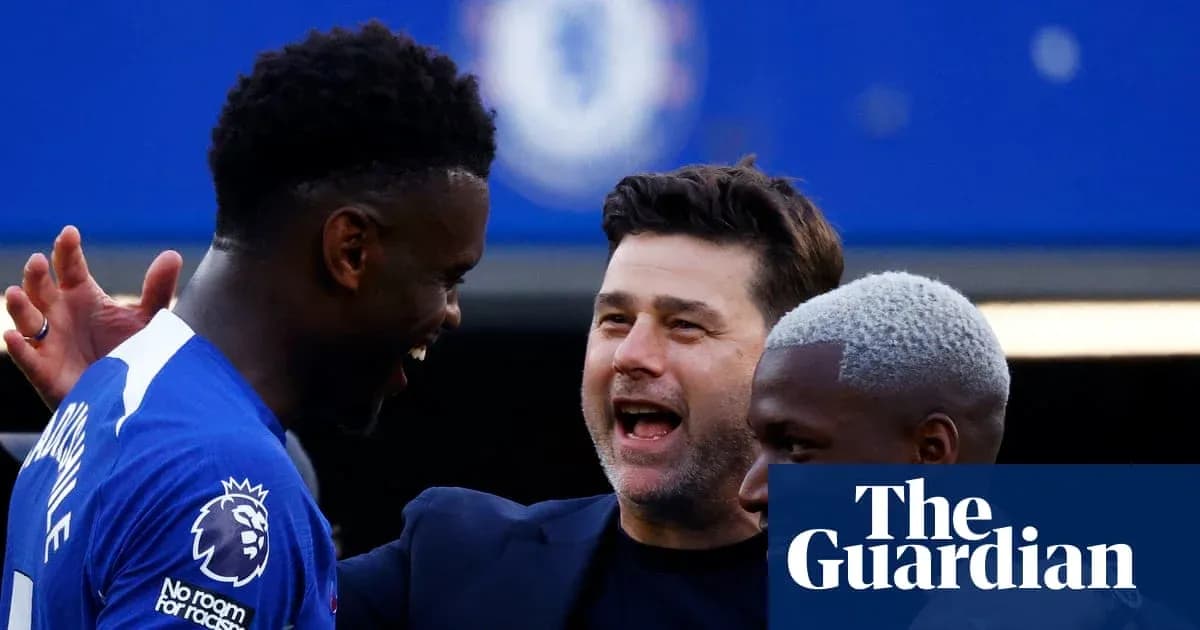
Mauricio Pochettino: Premier League Elite and Chelsea's Rebuild
Mauricio Pochettino belongs in the Premier League’s rare air. Among managers with more than 290 games, only Alex Ferguson, Arsène Wenger, José Mourinho, Jürgen Klopp and Pep Guardiola have taken more points per match. That is the company he keeps. He is, by any serious measure, an elite coach.
His rise in England was swift and emphatic. Pochettino walked into Southampton midway through their first season back in the top flight in 2012-13, a club still shaking off seven years in the lower divisions. By the end of his only full campaign, they were eighth, punching above their weight and playing with a clarity and aggression that marked him out as different.
Tottenham was where the myth hardened into reputation. Second place in 2016-17, third in the seasons either side, and a Champions League final in 2019. Spurs did not just compete; they grew under him. Players improved, the club’s expectations shifted, and his touchline presence seemed to drag standards higher. His teams ran, pressed, and believed.
Then the Premier League moved on without him. Across the last six seasons, he has only been involved in one. A trophy-laden 18 months at Paris Saint-Germain brought Ligue 1 and the Coupe de France, but those medals reveal little about his suitability for the chaos and nuance of a modern English superclub. The more relevant case study for Manchester United is far messier: Chelsea 2023-24.
Chelsea had finished 12th the year before, the first full season of the Todd Boehly/Clearlake Capital project. Almost anyone competent was likely to lift them from that low base. Pochettino did. But how much of the rise belonged to him, and how much to sheer financial weight, is where the debate starts.
Opta’s model had Chelsea pegged for sixth before a ball was kicked. They finished sixth. On that metric, Pochettino hit his mark. Yet Transfermarkt rated his squad as the third-most valuable in the league by October 2023. With that level of talent, sixth can feel less like achievement and more like obligation.
The numbers behind that squad underline the scale of the rebuild. Chelsea outspent every other club in Europe’s top five leagues in each of the three windows from summer 2022 to summer 2023. It was a rolling experiment conducted at full speed. Working for Boehly was an immersion course in volatility, a useful primer for the institutional turbulence at Manchester United, even if the Old Trafford budget will not be quite as wild.
Moulding a coherent team from that churn is a brutal assignment. Pochettino did manage to shape something that functioned more convincingly than the league table alone suggests. Chelsea produced the fifth-most expected points in 2023-24. Their 63.4 xPts trailed well behind Arsenal, Manchester City and Liverpool, but as a first-season platform it was solid, not spectacular.
The raw goals column told a more schizophrenic story. Chelsea conceded 63 league goals, their worst defensive record of the Premier League era. At the other end they scored 77, a figure they have bettered only twice in the competition’s history. They slightly outperformed expected goals both for and against, but the broad outlines of that wild season were rooted in the underlying data, not just freak finishing or bad luck.
Even that data came with caveats. Chelsea won 12 penalties in the league, the joint-second-highest total in any of the last 10 Premier League campaigns. Since Pochettino left, they have been awarded 14 penalties in 86 league matches, a far more ordinary rate. His Chelsea side also conceded five penalties and racked up the joint-most Opta-defined defensive errors leading to shots (22). The extremes cut both ways.
The performances swung just as violently as the metrics. Across three games in April 2024, Chelsea drew 2-2 with bottom club Sheffield United, shredded Everton 6-0, then were dismantled 5-0 by Arsenal. Earlier in the season they lost 4-1 at Tottenham, 4-1 at Newcastle, and somehow found a 4-4 classic against Manchester City in the middle. Over 38 games they set a Premier League record for matches in which a team scored and conceded at least twice: 12. Chaos became a weekly feature.
How do you pin a manager’s performance to that kind of maelstrom? The low point, if it was not the humiliation at Arsenal, came beneath the arch at Wembley. After losing the 2024 Carabao Cup final to Liverpool, Gary Neville branded Chelsea “billion-pound bottle jobs” on live television. Chelsea had enough chances to win that game, but nuance rarely survives the soundbite. Pochettino carried the weight of the accusation. Within three months, he was out.
While he stepped away, the Premier League kept mutating. Arne Slot arrived, won a title and departed. Guardiola’s exit stripped the league of its defining managerial presence. Tactical fashions shifted again: more man-to-man duels across the pitch, more choreographed set-piece routines deciding games that once hinged on open play. Margins tightened; structure became king.
Opta’s data suggests Pochettino’s likely new team at United will play differently to his Chelsea side. They move the ball upfield more quickly but do not press with the same intensity. That will demand a recalibration of his principles, a fresh balance between aggression and control.
There is also the question that will follow him into Carrington: can a coach whose Chelsea training methods were described by one well-placed source as “antiquated” adjust at the speed United now require? The game has accelerated. So have the demands on those who lead it.
What has not changed is Pochettino’s core body of work. His Premier League record still commands deep respect. The doubt lies not in who he has been, but in how sharply his recent experiences map onto the United job that awaits in 2026-27.





