Mauricio Pochettino's Journey with the USA National Team
Mauricio Pochettino walks into the room the way he tends to walk into football clubs – open arms, big smile, warm handshake. A few weeks out of the firing line have done nothing to dim the energy. The Sky Sports News team gets hugs and holiday stories. His summer, though, has not exactly been a break.
He has just taken the host nation to the last 16 of a World Cup on home soil. He has juggled the demands of a President who loves the camera, a FIFA storm around Folarin Balogun, and a tactical puzzle that tested every inch of his coaching brain. Somewhere in the middle of it all, he accidentally became a style icon.
And then, when the dust should have been settling and the job carousel spinning, he did something else: he committed to the USA for four more years.
‘We are much better coaches now’
Pochettino sits back and reflects on the World Cup first. For him, that is where everything starts.
"We are much better coaches now," he says, without hesitation. The tournament has hardened his conviction that detail is everything. In club football he can drill ideas day after day; with a national team, he gets fragments of time and a squad that drops in and out. Every decision is magnified. Every mistake is public.
He talks about the struggle to get messages across in short bursts, the strain of trying to make a team feel like a club when they meet only in windows. "Everything needs to be perfect," he says, and you sense he means it literally – from the training pitch layout to the timing of a substitution.
The pressure around the USA went beyond tactics. This was a World Cup on American soil, with Donald Trump hovering on the edge of every narrative. Pochettino chooses his words carefully, leaning on the support and backing the President gave the team rather than the circus that followed.
The chaos peaked around Balogun. The forward’s suspension was suspended by FIFA on the eve of the knockout tie against Belgium, a decision that triggered anger, accusations and talk of political meddling. Pochettino admits the "politics and manipulation" overshadowed the game, but insists his own role stayed simple.
"If you pay attention to the noise, you become crazy," he says. When the letter arrived the day before the match confirming Balogun could play, the choice was obvious. He picked him. End of story.
Balogun, a collapsed move and a little distance
Balogun has been back in the headlines since, this time for club reasons. His proposed move from Monaco to Everton collapsed late on Deadline Day, a deal that looked done until it suddenly wasn’t.
Pochettino has stayed away from the phone. No consoling call, no pep talk. Not yet.
He knows what a failed transfer can do to a player’s head and has decided to give him room to breathe. He would have liked to see Balogun in the Premier League, to test himself in the division Pochettino still calls home in footballing terms. For now, the striker remains at Monaco, and the national coach simply hopes he can reset and find a good place again.
The World Cup, the politics, the fashion, the Balogun saga. It was a summer that had it all.
The suit, the touchline and Wayne Rooney
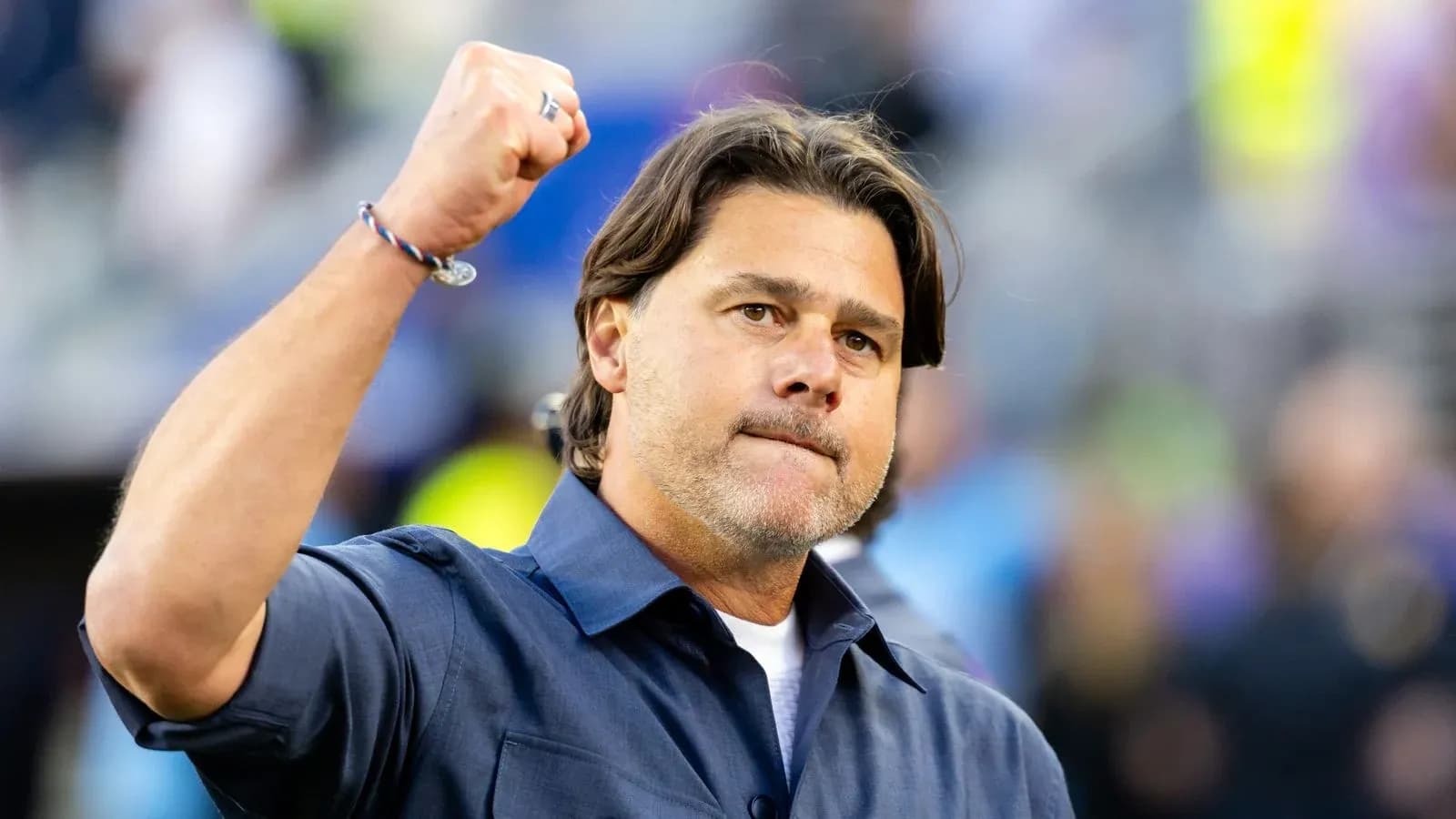
Pochettino has always cared about how he looks on the touchline, but he did not plan to set a trend. His navy ensemble during the World Cup – sharp, clean, understated – took on a life of its own.
It became a talking point, then a meme, then a must-have. Wayne Rooney even went out and bought the same outfit. Pochettino chuckles at the memory.
"I saw him. He looked good on him, like a top coach," he says, enjoying the idea of Rooney stepping into his wardrobe.
The image of Pochettino, arms folded in that navy suit, became one of the tournament’s defining visuals. But while the football world moved on, his phone did not stay quiet for long.
Four more years with the USA – but the Premier League dream lives on
Once the World Cup ended, his name slid straight back into the rumour mill. Clubs in need of a manager circled. Speculation began to build.
It didn’t last. The announcement came: Pochettino was staying with the USA, signing on until 2030.
Six years away from club football is a long stretch for a coach whose identity has been tied so tightly to the week-to-week grind of the Premier League and Champions League. Does this mean the end of his story in English football?
He shakes his head.
"I have the ambition," he says. "My dream now is to be in the USA for four years, but after that, why not? We are still young, and I think coming back is always my goal; to win the Premier League, to be in the Premier League and to build a project with the possibility of winning."
He leans on that word – winning. Not just competing, not just entertaining. Winning.
"I love the football here. I think to have the chance again is one of my wishes and I hope that happens."
Spurs, unfinished business and the call that never really came
Talk of the Premier League inevitably drags the conversation back to Tottenham. Eighteen months ago, Pochettino spoke openly about wanting to return one day, a sense of unfinished business still gnawing away after coming so close to glory in both the league and Europe.
Since then, Spurs have lurched from one direction to another. Ange Postecoglou came and went. Thomas Frank and Igor Tudor passed through as the club flirted dangerously with the drop. It has been turbulent, even by Tottenham’s own standards.
So did the call ever come? Was there a moment when Spurs asked him to come back and steady the ship?
"Always I say, one day, why not?" he replies of a return. This time, though, it never moved beyond that.
"People talk and maybe we receive some approach, but it never was close." Not this time. Not yet.
AC Milan’s name had been thrown into the mix during the World Cup as well, another heavyweight supposedly interested in his services.
"We were not open during the World Cup to talk with different clubs that were interested," he says. He confirms there were clubs who made contact – "Yes, always" – as if that is simply the reality of his standing in the game. There are always options.
Did any of them come close to turning his head?
"We never gave the opportunity to be close. We always closed the door before it got close."
The USA project came first. Everything else stayed at arm’s length.
Spurs’ spending, Chelsea’s shift and a new Premier League landscape
Pochettino still keeps a close eye on the clubs that shaped his career. Tottenham, he says with a wry smile, are never dull.
"They are investing like other clubs," he notes. After a couple of bruising seasons, Spurs have changed course and started spending heavily on players who already know the Premier League. Proven quality, big fees, fewer gambles.
For those who remember the shoestring days when Pochettino pushed Spurs to a Champions League final and a title challenge with limited backing, the contrast is stark. Asked what he might have done with £300m to spend, he feigns confusion, joking that he cannot quite comprehend that number.
Will this new approach work?
"You never know," he says. "We need time to see if that works or not.
"Like in all the games, when you make a decision like a coach that can work well or not. I think it's a different strategy and a different way to operate. I always wish the best for Tottenham because it's in my heart."
Across London, Chelsea have also taken a different route. The role he held two years ago has shifted from head coach to manager, a subtle but telling change in power and responsibility. The recruitment strategy has flipped as well, with the club now targeting Premier League-ready players rather than long-term projects under Xabi Alonso.
Pochettino avoids direct comparison, but he recognises the intent.
Buying players like this, he says, brings an expectation: you must fight for the title, you must be a genuine contender for the Premier League.
Chelsea’s defeat to Arsenal has already reminded everyone that this will not be straightforward. Pressure builds quickly at Stamford Bridge. Alonso has been handed a squad to compete now, not later.
"Of course they are disappointed after the defeat against Arsenal, but I think we need to give time to Xabi's first season after three games in the Premier League," Pochettino says. "I think we need to give time, and of course for Tottenham the same."
Time. Patience. Two commodities that modern football rarely offers, but which he keeps returning to.
Arteta, Arsenal and the bar to beat
Ask Pochettino who sets the standard in the Premier League today and his answer is instant.
"Mikel [Arteta] is the best coach in the Premier League today," he says. No caveats, no softening. Arsenal, in his eyes, are out in front.
"Knowing what he needs to do, it's going to be tough to beat them."
That is the landscape he expects to walk back into one day: Arsenal under Arteta as the benchmark, Chelsea and Tottenham throwing money and ambition at the gap, and a league that has only grown more unforgiving since he left.
For now, his world is the USA, a national team still learning how to carry the weight of expectation. His contract runs to 2030. His heart, though, has left a door open across the Atlantic.
One day, he insists, he will walk back through it – not just to return, but to finally finish the job he believes he can still do in English football: build a project that does not just dream about the Premier League title, but wins it.