
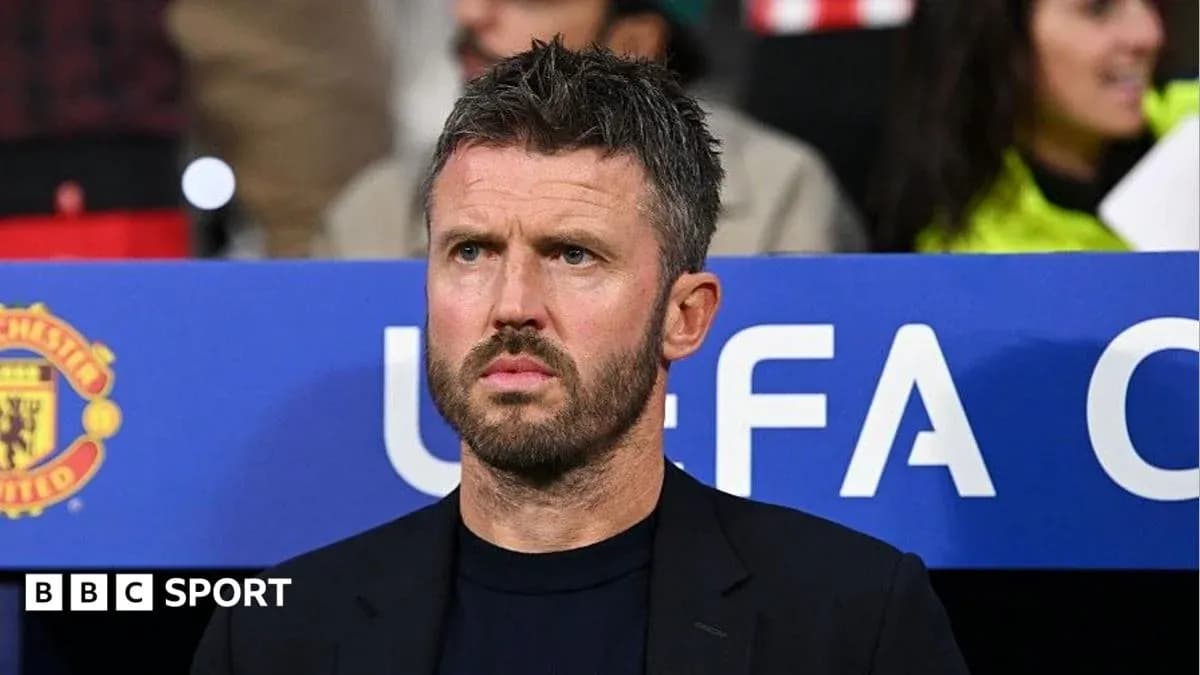
Michael Carrick Addresses Manchester United Crisis
Michael Carrick walked into the media room at Carrington knowing the questions were coming. He did not wait for them.
Before a journalist could clear a throat or flip open a notebook, the under-pressure Manchester United manager asked to speak first – and then held the floor for five minutes and 30 seconds, delivering a raw, emotional address that felt as much like a plea as a statement of intent.
This was not the usual pre-match routine. This was a man fighting for his job.
Carrick takes the microphone
Instead of settling into his chair and fielding questions about Bournemouth, form, or his future, Carrick launched straight into his own assessment of a club lurching through a crisis.
“Recently we haven't had a good time, I think that's pretty obvious,” he said, his voice carrying the weight of seven games without a win and a Champions League humiliation that has shaken the club. “Wednesday was a bad night, and it hurt me to see us play like that. It was unacceptable.”
The 4-1 defeat by Como in midweek did more than damage United’s European hopes. It exposed fractures. Lisandro Martinez publicly criticised the hierarchy. Bruno Fernandes questioned the tactics in Italy. The dressing room noise spilled into the open, and with it, the scrutiny on Carrick intensified.
So he chose to confront it head on.
“My responsibility is to get a team on the pitch that represents this football club, and the supporters, and they can be proud of in the identity we show. We have gone away from that recently. It's important we all recognise that.”
The words were carefully chosen, but the delivery was anything but cold. This was Carrick appealing to something deeper than systems or selections.
Values under the spotlight
United’s slump has stirred the old debates about what the club stands for. Carrick leaned heavily into that history.
“The foundation and values of this football club have been etched for many years. I totally understand and get every single one of them,” he said. “There's a resilience about this football club that runs very deep. I've seen it with my own eyes, I've felt it, I know some of the individuals closely who have been a big part of that history.
“Entitlement cannot be at this football club.
“It was based on being humble, having humility, and hard work. We can never lose that, and I won't let us lose that.”
It was impossible not to think of Sir Alex Ferguson. The legendary former manager occasionally used the same tactic: taking control of a press conference before a ball was kicked, setting the tone, shielding his players. Carrick, who played under Ferguson, reached for a similar playbook here, though even Ferguson rarely spoke at such length in one uninterrupted monologue.
The difference is stark. Ferguson did it from a position of absolute authority. Carrick is doing it from a position of vulnerability.
Fernandes in the firing line
The tension around the club has a focal point, and it is not just the dugout. The captaincy of Bruno Fernandes, and his own outburst after the Como defeat, have turned the spotlight on the dressing room dynamic.
So when questions finally came, they went straight to the heart of it: would Carrick consider dropping his skipper for Sunday’s Premier League game against Bournemouth at Old Trafford?
He did not flinch. He did not close the door, either.
“The most important thing for me is the team, the squad and dynamics in the squad,” he replied. “It's about the football club. I'll always do what is best for the football club.”
No public backing. No guarantee of a place. For a captain, that is a loud silence.
It leaves open the real possibility that Fernandes could be left out of the starting XI in a match that already feels like a verdict on Carrick’s tenure. Drop your captain and win, and you can claim authority. Drop your captain and fail, and the questions grow sharper.
A club on edge
Seven games without a win. A Champions League collapse. Senior players challenging decisions in public. An increasingly restless fanbase. Carrick stood in front of all of it and tried to drag the narrative back towards identity, humility and hard work.
Whether that message lands inside the dressing room will matter far more than how it sounded in the press room.
Bournemouth arrive at Old Trafford on Sunday facing a fragile giant and a manager who has drawn a line in the sand. The words have been spoken. The values have been invoked.
Now Carrick has to show, in 90 minutes, that Manchester United still recognise themselves.





