
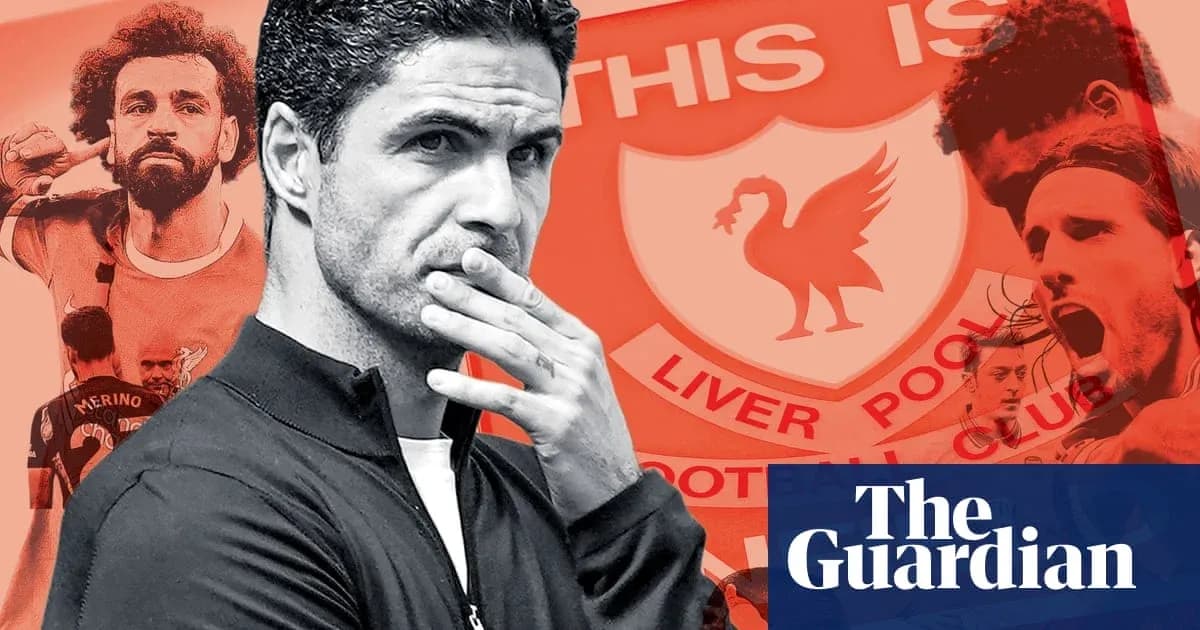
Mikel Arteta's Challenge at Anfield: A History of Frustration
Mikel Arteta has a word for what Anfield can do to a footballer: bajar.
A cyclist flying up a climb, legs humming, everything under control – and then, within a kilometre, the lights go out. “Boom.” Suddenly you’re gasping, watching the race disappear up the road. Arteta used that image in Amazon’s All or Nothing to describe the only time in his career he truly felt the game slipping away from him. It happened at Anfield.
On Sunday, he goes back again, this time with the weight of a bruised Arsenal behind him and a familiar face in the opposite dugout. Andoni Iraola, a childhood friend, stands between him and the one ground that has consistently stripped away his authority.
Anfield, the old scar
Arteta’s personal history at Liverpool is a mix of frustration, rare relief and real fear. As an Everton player, he never cracked the Merseyside derby there. Five attempts, no wins. The first taste of victory finally came in September 2012 with Arsenal, a 2-0 win that should have been cathartic. Instead, he spent the night in hospital after a collision with Jordan Henderson left him concussed and terrified. He has since called it “the biggest fear of my life”.
He went back six months later with Arsène Wenger’s side and won again, Lukas Podolski and Santi Cazorla scoring in a polished 2-0. That, remarkably, remains Arsenal’s last Premier League win at Anfield. Thirteen league visits, no victories since. It equals the club’s longest barren run away to Liverpool.
The only interruption came in the League Cup in 2020, a penalty shootout win on Arteta’s second trip there as a manager. It felt like a small psychological step. The league record says otherwise.
His attempts to change the mood have not always landed. In November 2021, he tried to harden his players to the occasion by blasting “You’ll Never Walk Alone” over the training ground speakers. Anfield’s answer was a 4-0 beating.
Last August, Dominik Szoboszlai’s late free-kick shattered a run of three draws and revived an old criticism. Arteta, accused of not releasing the handbrake, had started Mikel Merino as his No 10. Gary Neville questioned Arsenal’s mentality at “big away grounds”, pointing not only to Anfield but also to the Etihad, where they have not beaten Manchester City in the league since 2015.
Those words will have stung. They also hang over this weekend.
From Fleetwood to the fire
The timing could hardly be worse for a trip to Liverpool. Five days before the game, Arsenal were dumped out of the Carabao Cup by Fleetwood, a club 84 places below them in the pyramid, in a ground that holds fewer than 6,000.
Arteta went strong in attack. Kai Havertz and Viktor Gyökeres both started, ostensibly to ease the burden on Martin Ødegaard. Neither found rhythm. Both look short of confidence at the moment, and Fleetwood did nothing to change that impression.
The injury list tightens the screw. Bukayo Saka is out with a thigh problem. Noni Madueke’s ankle is a concern. The failed appeal over Max Dowman’s red card means the teenager now serves a three‑match ban. Options in wide and creative areas are thinning just as the season hits one of its defining away days.
All of which points towards the version of Arsenal that has carried Arteta furthest: controlled, compact, ruthless in moments rather than in waves. The romantic idea of going to Anfield and trading punches rarely ends well. Arsenal, more than most, know that.
Lessons from 1989
If Arteta needs a model, he does not have to look far into the club’s history. Thirty-seven years ago, George Graham took Arsenal to Anfield needing a 2-0 win to steal the title on the final night of the 1988-89 season. The script demanded chaos, attack, risk. Graham refused.
“I told my players to keep things tight in the first half – it was imperative we did not concede,” he said years later. The newspapers had insisted Arsenal would have to storm forward from the first whistle. Graham thought that was nonsense. An early Liverpool goal, he believed, would end everything.
He was right. Liverpool barely threatened. Arsenal stayed in the game, then seized it. Michael Thomas’s stoppage-time surge and clipped finish delivered the title and ended an 18-year wait. It became one of the most replayed moments in English football history.
That night carried a deeper emotional weight. Before kick-off, Arsenal’s players ran to all four corners of Anfield, handing flowers to Liverpool supporters as a gesture of sympathy after the Hillsborough disaster a month earlier. The idea came from Ken Friar, the club’s long-serving director, who died this month. It remains one of the most dignified acts in Arsenal’s story.
Arteta knows all of this. He understands how that team balanced steel with respect, control with courage. The parallels with Graham are not just nostalgic decoration.
Both men were 44 when they won their first league titles with Arsenal. Both were midfielders who valued structure and defensive discipline. “1-0 to the Arsenal” became the soundtrack of Graham’s later years. Under Arteta, the scoreline has returned as a calling card. Since December 2019, Arsenal have won 1-0 in the Premier League 32 times – more than any club other than Everton.
This is not a side ashamed of winning small.
Margins and set pieces
The recent 2-0 win over Everton at the Emirates carried a quiet significance. Arsenal finally scored their first set-piece goal of the season. It was routine, efficient, almost forgettable. But it hinted at a weapon that could matter on Sunday.
Liverpool have looked vulnerable from dead balls at times under Iraola as his ideas bed in. Corners and free-kicks may offer Arsenal their best route to puncturing Anfield’s noise. At the other end, the defensive buy-in Arteta has demanded becomes non-negotiable.
“Collectively, we acknowledge the importance of defending,” he said last year when comparisons with Graham surfaced again. “We know that if we excel in that part of the game, the chances and the probabilities to win more matches is going to be very, very high.”
It is not a slogan. It is a blueprint for days exactly like this.
No hiding place now
The trip back from Fleetwood, a penalty shootout defeat echoing May’s Champions League final loss to Paris Saint-Germain, will have been a long one. The Carabao Cup has stretched this squad in the last two seasons – semi-finals, then a final – and there is a cold, logical argument that an early exit might help the league campaign.
Arteta is not built to take comfort in that. For him, the Fleetwood loss will sit as the most embarrassing night of his managerial career. There is only one way he will want to answer it.
He goes to the stadium that once made him feel helpless, with a team that still has to prove it can walk into the most hostile grounds and play with authority. Graham did it in 1989 by shutting out the noise and trusting his plan.
On Sunday, we find out if Arteta can do the same – or whether Anfield drags him back into that feeling of bajar once again.





